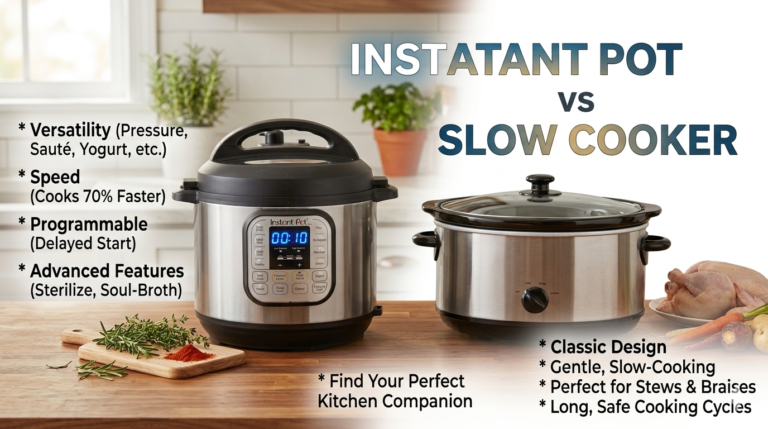
Instant Pot vs Slow Cooker: Which Should You Use — and When?
📋 What’s Covered
- Quick Answer
- How Each Appliance Works
- Speed Comparison
- Scored Category Comparison
- Food-by-Food Results
- The Instant Pot Slow Cook Mode — Honest Assessment
- When the Instant Pot Always Wins
- When the Slow Cooker Always Wins
- Converting Recipes Between Appliances
- Cost Comparison
- Food Safety & Unattended Cooking
- Who Should Buy Which
- Our Recommended Models
- Final Verdict
- FAQs
The Instant Pot has sold over 40 million units since 2010 — and a significant portion of those buyers wondered whether they’d just replaced their slow cooker. Some had. Most hadn’t. The Instant Pot and slow cooker are genuinely different appliances that excel at different tasks, and understanding the difference is the key to using both well — or choosing correctly when you can only have one.
We cooked over 60 recipes in both appliances across eight weeks, including direct side-by-side comparisons of the same recipe in both machines, before writing this guide. No brand relationships influenced these results.
Quick Answer
The honest answer for most households: if you already own a slow cooker and love it, keep it alongside an Instant Pot — they genuinely serve different purposes. If you’re choosing your first appliance and cook mostly on weeknights for 2–4 people, the Instant Pot is the more versatile purchase.
How Each Appliance Actually Works
The Instant Pot
The Instant Pot is a sealed electric pressure cooker — an airtight pot that traps steam as the contents heat, raising internal pressure to 10–12 psi above atmospheric pressure. Under this increased pressure, water boils at approximately 240°F (116°C) instead of 212°F (100°C). This elevated temperature dramatically accelerates cooking — dried beans that take 90 minutes on the stovetop cook in 25 minutes; a pot roast that takes 3–4 hours in the oven cooks in 60 minutes.
The Instant Pot also includes a slow cooker function — but as we’ll explain in detail below, this is a genuinely inferior substitute for a dedicated slow cooker rather than an equivalent replacement.
The Slow Cooker (Crock-Pot)
A slow cooker is a simple appliance: a ceramic or stoneware insert heated by a resistive element in the outer housing, with a glass lid that allows a small amount of steam to escape. It cooks food at Low (170–190°F / 77–88°C) or High (200–210°F / 93–99°C) settings over 4–10 hours. The magic of slow cooking is time — extended hours at low, stable heat break down collagen into gelatin, transform tough cuts into fork-tender meat, and develop flavour complexity that fast cooking cannot replicate.
Speed Comparison
Speed is the Instant Pot’s defining advantage. Here’s the real time comparison — Instant Pot times include pressurization and natural release; slow cooker times are active cook times.
The speed gap is enormous for most dishes — the Instant Pot is typically 5–10× faster. But faster is only better if the result is equivalent or better. As the food tests below show, faster cooking does not always produce the best result.
Scored Category Comparison
Scores based on our eight weeks of testing across both appliances for 60+ recipes.
Food-by-Food Results
We cooked every item below in both appliances and rated the result on flavour, texture, and eating quality — not speed. Speed is already accounted for in the score cards above.
Braised Meats
Soups & Stews
Beans & Legumes
Other Tasks
The Instant Pot Slow Cook Mode — Honest Assessment
This deserves its own section because it’s the most common source of disappointment for new Instant Pot owners who sell or donate their slow cookers, thinking the Instant Pot has replaced them.
The Instant Pot’s slow cook mode is inferior to a dedicated slow cooker. This is not a controversial claim — Instant Brands acknowledges it, and the cooking science explains why.
Why the Instant Pot Slow Cook Mode Falls Short
A dedicated slow cooker maintains its Low temperature at 170–190°F through a resistive element that heats the ceramic insert from below and the sides. The temperature is stable, even, and truly low.
The Instant Pot’s slow cook mode uses the same pressurised heating element designed for pressure cooking. Its “Less” setting (the lowest) produces temperatures around 190–200°F — 10–15°F hotter than a dedicated slow cooker’s Low setting. This seems like a small difference, but over 8–10 hours it compounds: the Instant Pot slow cook mode simmers rather than truly slow-cooks, producing tighter-grained braised meat, less collagen conversion, and a thinner, less developed braising liquid.
The Workaround
Instant Pot users who want to use slow-cook mode with better results should use the “Less” setting (not “Normal” or “More”), leave the lid slightly ajar (since the seal can trap too much steam at low temperatures, creating steam-cooking conditions rather than slow-roasting conditions), and reduce recipe cook times by 1–2 hours compared to a dedicated slow cooker recipe.
When the Instant Pot Always Wins
When the Slow Cooker Always Wins
Converting Recipes Between Appliances
The most common practical question: can I make my slow cooker recipe in the Instant Pot (or vice versa)? The answer is yes for most recipes, with important adjustments.
Slow Cooker Recipe → Instant Pot
Instant Pot Recipe → Slow Cooker
What Cannot Be Converted
- Rice and grains — do not convert from Instant Pot to slow cooker; slow cookers cannot cook rice properly
- Eggs — slow cookers cannot hard-boil eggs; use the Instant Pot or stovetop
- Dairy-based slow cooker recipes — do not convert to Instant Pot; cream and cheese cannot withstand pressure cooking
- Caramelised onion recipes — the slow cooker’s 10-hour caramelisation cannot be replicated under pressure
- Very short Instant Pot recipes (under 10 min pressure) — the pressurisation overhead makes these impractical to adapt
Cost Comparison
The slow cooker is the cheapest appliance in the kitchen — a capable Crock-Pot costs less than a dinner out. The Instant Pot at ~$89 costs more but replaces multiple appliances. If budget is the primary constraint, buy the slow cooker first and add the Instant Pot later when its bean-cooking, stock-making, and weeknight speed advantages become clear through slow cooker limitations.
Food Safety & Unattended Cooking
Both appliances are designed for unattended cooking, but they handle it differently.
Slow Cooker Safety
Modern slow cookers are among the safest kitchen appliances for unattended use. The heating element is embedded in the outer housing (never exposed to food), temperatures are consistently below boiling, there are no moving parts, no pressure buildup, and no steam release mechanisms that could fail. Most slow cookers include auto-keep-warm after the programmed time ends. Fire risk from a properly functioning slow cooker left on Low is extremely low — comparable to leaving a lamp on.
The main slow cooker food safety risk is temperature: slow cookers must reach a safe cooking temperature (above 140°F / 60°C) within 4 hours to prevent bacterial growth in the “danger zone.” All modern slow cookers on their Low setting reach safe temperatures within 1–2 hours. Do not cook frozen meat in a slow cooker — always start with thawed ingredients.
Instant Pot Safety
The Instant Pot has 12 built-in safety mechanisms and an excellent track record over 15+ years and tens of millions of units. The lid-lock system physically prevents opening under pressure. The pressure regulator prevents over-pressurisation. The thermal protection system prevents overheating.
The Instant Pot can be left unattended during the pressure cook cycle — it will automatically switch to Keep Warm mode when the cook time completes. The main caution: never leave an Instant Pot in Sauté mode unattended, as this operates at high heat with an open top and no automatic shutoff.
Who Should Buy Which
If you cook most evenings and need dinner in 30–90 min, the Instant Pot is transformative. Pot roast on a Tuesday.
Dried beans in 25–40 min, no soak. Lentils in 8 min. The single most compelling argument for plant-heavy kitchens.
If choosing one appliance, the Instant Pot’s versatility (7-in-1) makes it the better first purchase for most households.
Rich, gelatinous bone broth in 2 hours vs 24 hours. One of the most dramatic time savings in cooking.
Load it before you leave, come home to dinner. The slow cooker is the only appliance designed for 8-hour workday cooking.
Short ribs, oxtail, lamb shoulder — the very best result comes from 8–10 hours at true Low, not from pressure.
A capable Crock-Pot costs $30–$40. The lowest barrier to entry for home batch cooking of any appliance.
As a warm-holding vessel for parties and potlucks, the slow cooker is irreplaceable. Keeps food at serving temperature for hours.
Our Recommended Models
Meal Planning with Both Appliances
The most effective kitchen setup uses both appliances in coordination — each handling the tasks it genuinely does best. Here’s how a week of cooking might look using both intelligently.
A Practical Weekly Schedule
- Sunday evening: Slow cooker overnight — steel-cut oats on Low for 7 hours. Wake up to a week’s worth of breakfast already cooked. Transfer to containers and refrigerate.
- Monday morning: Load the slow cooker with a pork shoulder before leaving for work. 10 hours on Low. Come home to pulled pork for two weeknight dinners.
- Tuesday evening: Instant Pot — dried chickpeas from scratch in 40 minutes for a week of hummus, grain bowls, and salad protein. Also cook a batch of white rice in 12 minutes.
- Wednesday evening: Instant Pot — lentil soup in 20 minutes total. Use the sauté function to cook onions and spices in the same pot before pressure cooking.
- Friday evening: Slow cooker — short ribs loaded at 4pm, served at 8pm after a 4-hour High setting. Better texture than any weeknight Instant Pot braise.
This schedule takes approximately 15 minutes of active hands-on time across the entire week — the rest is unattended cooking. The Instant Pot handles the tasks where speed matters (beans, grains, weeknight soups); the slow cooker handles the tasks where time makes the food better (braises, overnight oats, long-cooked proteins). Neither machine is idle; neither is being forced into tasks it does poorly.
The “One Appliance” Decision Tree
If you genuinely can only buy one appliance and must choose between them, use this decision framework:
- Do you have a job that keeps you out of the house for 8+ hours? → Slow cooker. Nothing else can cook your dinner while you’re at work.
- Do you eat a lot of dried beans, lentils, or grains? → Instant Pot. The time savings on legumes alone justify the purchase.
- Do you cook mostly on weeknights in under 90 minutes? → Instant Pot. It transforms what’s achievable in a weeknight window.
- Is your budget under $40? → Slow cooker. A $35 Crock-Pot is the best value cooking appliance that exists.
- Do you primarily make long braises and stews at weekends? → Slow cooker. The result from 8–10 hours is better for these specific dishes.
Tips for Getting the Most From Each Appliance
Instant Pot Tips
Always use the sauté function first. The single biggest quality improvement for any Instant Pot recipe is browning your meat and aromatics in the pot before pressure cooking. The Maillard reaction — the browning that develops flavour on meat surfaces — cannot happen under pressure (there’s too much moisture). Sauté your onions until golden, brown your meat in batches, deglaze with a splash of wine or stock to lift the fond from the bottom (this also prevents the Burn warning), then switch to pressure cook. This adds 10 minutes but produces dramatically richer results.
The Burn warning means too little liquid or a dirty bottom. If you see the Burn notice, release pressure, add ½ cup of liquid, scrape any stuck residue from the bottom, and restart. The Instant Pot needs a minimum of 1 cup of liquid to generate sufficient steam. Thick sauces, tomato paste, and dairy can also trigger Burn warnings if touching the bottom — add these on top of the liquid rather than stirring them in before pressure cooking.
Natural release is not optional for large cuts. For whole chickens, large roasts, and any recipe over 45 minutes of cook time, natural pressure release for at least 15 minutes is essential — not a preference. The carryover cooking during natural release continues to work on the food. Quick releasing a pot roast after 60 minutes is equivalent to pulling a roast from the oven and cutting it immediately — the interior hasn’t finished cooking and the meat will be less tender than it should be.
Slow Cooker Tips
Don’t lift the lid. Every time you lift the slow cooker lid, you release 20–30 minutes of accumulated heat — effectively extending the total cook time. Slow cooker recipes are calibrated for covered cooking. Unless the recipe specifically instructs you to add ingredients at a certain point, resist the urge to check.
Less liquid than you think. Slow cooker recipes use less liquid than stovetop or oven recipes for the same dish because the sealed environment prevents evaporation. A pot roast that needs 2 cups of stock on the stovetop needs only 1 cup in a slow cooker — the meat and vegetables release their own moisture during the long cook. Recipes that call for too much liquid produce watery, thin braising sauces.
Brown the meat first for best results. A slow cooker can’t brown food — it can only steam and braise. If you want the Maillard reaction on your meat (and you do, for flavour), take the extra 10 minutes to brown it in a skillet before adding to the slow cooker. Some premium slow cookers (like the All-Clad) have stovetop-compatible inserts that allow this step in the same vessel, eliminating an extra pan.
Fill level matters. Slow cookers work best when filled between half and three-quarters full. Under half full and the temperature distribution becomes uneven. Over three-quarters full and the lid can’t trap steam effectively. For a 6-Qt slow cooker, the ideal volume of ingredients and liquid is 3–4.5 quarts.
The Deglazing Step — Non-Negotiable for Rich Results
Whether you use the Instant Pot or slow cooker, one step dramatically improves any braised meat recipe: deglazing the pan after browning. When you sear meat in a hot pan (or the Instant Pot’s sauté mode), browned proteins and sugars adhere to the bottom — this is the fond, and it contains enormous flavour. Adding a small amount of wine, beer, or stock and scraping this up with a wooden spoon before adding the remaining liquid dissolves all of that concentrated flavour into the braising liquid. Skip this step and you lose the most complex flavour contribution in the entire dish. Do it in the Instant Pot by deglazing immediately after sautéing before switching to pressure mode — this also prevents the Burn warning caused by stuck solids at the bottom.
Make-Ahead Batch Cooking — Where Both Appliances Shine Together
The highest-leverage use of either appliance is dedicated batch cooking for the week — cooking large quantities once to provide protein, grains, and sauces for multiple meals. A Sunday afternoon batch cook with both appliances running simultaneously might produce: 2 cups of dried chickpeas cooked in the Instant Pot (for hummus, grain bowls, and pasta), a large pot of beef ragù in the slow cooker (for pasta, pizza topping, and jacket potato filling), and 4 cups of white rice or farro in the Instant Pot. This investment of 2–3 hours of mostly unattended cooking produces 5–7 days of meal components and reduces weeknight cooking to simple assembly. Neither appliance alone is as powerful as both working in coordination. The combination of both appliances in active weekly rotation is the most efficient and flavour-maximising kitchen setup available for any household that cooks regularly from scratch.
Final Verdict
🫕 Instant Pot for Most Households
The Instant Pot wins for buyers who need speed, versatility, and weeknight practicality. Dried beans in 40 minutes, bone broth in 2 hours, rice in 12 minutes, and a pot roast in 75 minutes — these are not marginal improvements over the slow cooker, they are categorical advantages that change what’s possible on a weeknight. At ~$89, the Instant Pot also replaces a rice cooker, steamer, and yogurt maker, making it the most cost-efficient appliance purchase in the kitchen.
🍲 Slow Cooker for All-Day Braises and True Low-and-Slow
The slow cooker wins for buyers who cook large braises during the workday, prefer the texture of 8–10 hour collagen-rich meats, or want the simplest possible cooking experience. Nothing in cooking is more stress-free than loading a slow cooker at 8am and coming home to dinner at 6pm. The slow cooker also wins for dairy-based dishes, caramelised preparations, and desserts that need gentle, sustained heat over hours.
The honest recommendation: own both. A $35 Crock-Pot plus a $89 Instant Pot covers every slow-cooking scenario imaginable and together cost less than many single mid-range appliances. They do not compete — they complement. Use the Instant Pot for weeknights and beans; use the slow cooker for weekend braises and workday cooking. Together they represent the most versatile and practical cooking setup for the money available in any kitchen.
Frequently Asked Questions
Continue Reading
Full in-depth review of the Instant Pot Duo — every feature tested.
All Instant Pot models compared — top picks at every budget.
Which wins for each cooking task? A 25-food comparison guide.
Pair your Instant Pot with the right air fryer — tested and ranked.