Honest reviews & guides for home cooks
Air Fryer vs Oven
⚖️ VS Guide · 2026

Air Fryer vs Oven: Which Should You Use — and When?

By Digital Kitchen Guide Editors  ·  Updated March 2026  ·  16 min read
🌬️
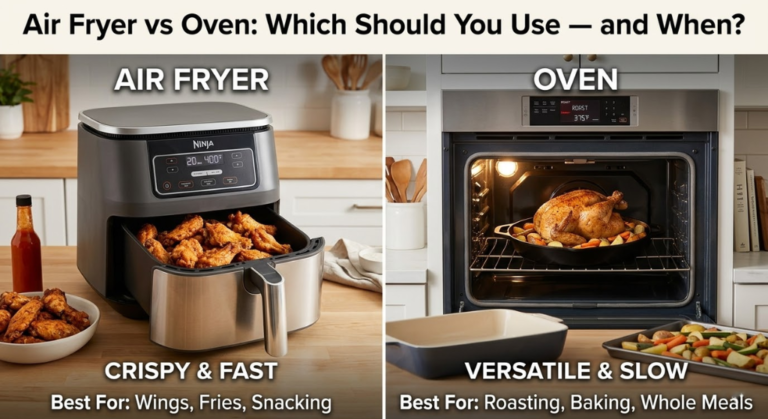
Air Fryer
Speed · Crispiness · Convenience · Small batches
VS
🔥
Oven
Capacity · Versatility · Baking · Large batches

The air fryer vs oven debate is one of the most-searched kitchen questions of the last five years — and for good reason. Air fryers have gone from novelty to countertop staple in less than a decade, and millions of households now own both. The question is no longer “should I get an air fryer?” but “which appliance should I use for this specific thing I’m cooking right now?”

This guide answers that question for 25 different cooking tasks, explains the real science behind why each appliance performs the way it does, and gives you a permanent decision framework for every future cook. We tested both appliances side-by-side for eight weeks across hundreds of cooking tasks before writing a single word.


Quick Answer — Which Should You Use?

⚡ Use the Air Fryer When: You’re cooking for 1–2 people · You want maximum crispiness · You’re short on time · You’re reheating leftovers · You want chips, wings, or any fried-style food without the oil
🔥 Use the Oven When: You’re cooking for 3+ people · You’re baking (bread, cakes, pastry) · You’re roasting a whole bird or large joint · You’re cooking a dish with liquid or sauce · You need multiple racks at once

The honest answer for most households: you need both, and they should be used for different things. This guide tells you exactly which to reach for in every situation — and at the end, tells you whether you actually need both or whether one can genuinely replace the other for your specific cooking style.


How Each Appliance Actually Works

How the Air Fryer Works

An air fryer is essentially a compact convection oven with a supercharged fan. Hot air is generated by a heating element and circulated at very high speed by a powerful fan positioned directly above the food basket. The rapid air movement achieves two things simultaneously: it transfers heat to the food surface extremely quickly, and it evaporates surface moisture almost as fast as it forms — which is why air-fried food gets so crispy.

The compact chamber size is the key advantage: because the air fryer’s interior volume is only 2–7 quarts compared to a full oven’s 4–6 cubic feet, the fan can circulate hot air around every exposed surface of the food much more efficiently. The food is essentially surrounded by rapidly moving hot air from all directions — this is fundamentally different from a regular oven, where air movement is more passive and heat distribution is less uniform.

How the Oven Works

A conventional oven heats air through elements (typically one at the bottom for baking, one at the top for broiling) and relies on natural convection — the movement of hot air rising and cool air falling — to distribute heat throughout the cavity. Most modern ovens also offer a convection setting that adds a fan, moving air more actively and improving browning.

A convection oven with the fan running is the closest thing a full oven can get to air fryer performance — but even with the fan, the large cavity means air circulation is significantly less intense than in an air fryer. The oven’s larger size is simultaneously its limitation (slower to heat, less intense air circulation) and its strength (fits large dishes, accommodates multiple racks, handles liquid-based cooking without splattering).

💡 The Technical Difference in Plain English An air fryer and a convection oven use the same principle — hot circulating air — but the air fryer’s compact size means the air moves much faster around the food surface. Think of the difference between standing in a light breeze and standing in front of a powerful fan. Same temperature air, completely different drying and crisping effect. This is why air fryers produce crispier results even at the same temperature.

Speed Comparison

Speed is the air fryer’s most significant everyday advantage. We timed both appliances from cold start to finished food for 12 common cooking tasks.

Preheat time
Air fryer: 2–3 min · Oven: 10–15 min at 400°F
Frozen chips (400g)
Air fryer: 14 min · Oven: 28 min — Air fryer 2× faster
Chicken wings (6 pieces)
Air fryer: 22 min · Oven: 40 min — Air fryer nearly 2× faster
Salmon fillet (2 pieces)
Air fryer: 10 min · Oven: 18 min — Air fryer ~2× faster
Roasted broccoli (1 head)
Air fryer: 8 min · Oven: 20 min — Air fryer 2.5× faster
Whole chicken (1.8 kg)
Air fryer: 55 min · Oven: 80 min — Air fryer ~30% faster
Baked potato (medium)
Air fryer: 38 min · Oven: 60 min — Air fryer ~35% faster
Reheating pizza (2 slices)
Air fryer: 4 min · Oven: 12 min — Air fryer 3× faster
Bacon (4 strips)
Air fryer: 8 min · Oven: 15 min — Air fryer ~2× faster
Cookies (12)
Air fryer: 8 min (4 at a time) · Oven: 12 min (12 at once) — Oven wins for batch
Roast vegetables (large tray)
Air fryer: 15 min (in batches) · Oven: 25 min (all at once) — roughly equal
Whole lasagne (9×13 inch)
Air fryer: not possible · Oven: 45 min — Oven wins

Speed summary: For anything under 2 servings, the air fryer is almost always 2× faster or more when preheat time is included. For large batches, the oven’s capacity advantage closes the gap or reverses it entirely.


Food-by-Food Results: Air Fryer vs Oven

We cooked every item below in both appliances on the same day using identical ingredients and rated the results on crispiness, texture, and flavour. Winner determined by overall result quality.

Proteins

Chicken Wings🌬️ Air Fryer Wins
Significantly crispier skin, faster cook, no flipping required mid-cook. Oven wings need the broiler at the end to match air fryer skin crispiness. Air fryer wins by a clear margin.
Chicken Thighs (bone-in, skin-on)🌬️ Air Fryer Wins
Crackling-crispy skin and juicy interior in 22 minutes. Oven produces slightly more even interior cooking for very large thighs, but skin quality in the air fryer is markedly superior.
Salmon Fillet⚖️ Tie
Both produce excellent results. Air fryer is faster (10 vs 18 min) and crisps the skin better. Oven produces slightly more even, gentler cooking through the flesh — preferred for thicker fillets.
Whole Roast Chicken (1.8 kg)🔥 Oven Wins
Air fryer fits most whole chickens and produces excellent results — crispier skin than oven — but the oven produces more even cooking throughout the breast and thigh. For 4+ servings, oven is more practical.
Beef Roast / Leg of Lamb🔥 Oven Wins
Large joints exceed air fryer basket dimensions and benefit from the oven’s low-and-slow capability. Air fryer cannot replicate a properly rested 3-hour slow roast.
Bacon🌬️ Air Fryer Wins
Crispy in 8 minutes with zero grease splatter on the stovetop. Fat drains into the tray below. Oven bacon at 15 min is good but messier and slower. Air fryer is the clear winner for bacon.
Sausages🌬️ Air Fryer Wins
Evenly browned on all sides in 12 minutes without turning. Oven sausages develop flat spots and uneven browning unless turned multiple times. Air fryer result is consistently superior.
Breaded Fish (battered or crumbed)🌬️ Air Fryer Wins
Produces the closest thing to deep-fried battered fish without oil. Oven breaded fish has softer coating that never fully crisps. Air fryer crunch is genuinely impressive.

Vegetables & Sides

Chips / French Fries (fresh or frozen)🌬️ Air Fryer Wins
This is the air fryer’s signature achievement. Crispy outside, fluffy inside, in 14 minutes from frozen with zero oil or just a light spray. Oven chips are noticeably softer and take twice as long.
Roasted Broccoli🌬️ Air Fryer Wins
Crispy, charred floret tips in 8 minutes — something the oven struggles to achieve without overcooking the stems. One of the most impressive air fryer vegetables.
Roasted Root Vegetables (large tray)⚖️ Oven Wins at Scale
Per-piece quality is marginally better in the air fryer (crispier edges) but a 6-portion roast vegetable tray requires 2–3 air fryer batches vs one oven tray. For family roast dinners, the oven wins on practicality.
Baked Potato🌬️ Air Fryer Wins
Produces a genuinely crackling crispy skin — better than oven — in 38 minutes vs 60 minutes. Rub with oil and salt, air fry at 200°C/400°F. The texture difference in the skin is remarkable.
Stuffed Vegetables (peppers, aubergine)🔥 Oven Wins
Dishes with liquid fillings or sauces that can spill into the basket are better suited to the oven’s contained baking environment. Air fryer is messier and the filling can dry out too fast.
Asparagus🌬️ Air Fryer Wins
Tender-crisp asparagus with lightly charred tips in 5–6 minutes. No preheating a full oven for a handful of spears. The air fryer is the obvious choice for quick vegetable sides.
Corn on the Cob⚖️ Tie
Air fryer produces charred, roasted corn in 12 minutes with excellent flavour. Oven broiler produces a similar result in a similar time. Both are excellent — neither is clearly superior.

Snacks & Party Food

Spring Rolls / Egg Rolls (frozen)🌬️ Air Fryer Wins
Deeply crispy wrapper in 8–10 minutes with zero oil. Oven version is noticeably softer. Air fryer spring rolls are genuinely difficult to distinguish from deep-fried versions in a blind tasting.
Mozzarella Sticks🌬️ Air Fryer Wins
Crispy exterior without the cheese exploding through (a common oven problem at high heat). Air fry from frozen at 190°C for 6–7 minutes for best results.
Pizza (full size, homemade or store-bought)🔥 Oven Wins
A 12-inch pizza simply doesn’t fit in most air fryer baskets. Personal-size pizzas (up to 8 inches) work very well in the air fryer and actually crisp the base better than a standard oven without a pizza stone.
Reheated Pizza (leftovers)🌬️ Air Fryer Wins
The air fryer is the best way to reheat pizza — crispy base restored in 4 minutes. Microwave-reheated pizza produces a soggy, chewy base. Oven-reheated pizza takes 12+ minutes to crisp. Air fryer wins decisively.

Energy & Running Costs

Energy cost is one of the most frequently cited reasons to buy an air fryer — but the reality is more nuanced than marketing suggests.

⚡ Energy Comparison — Air Fryer vs Oven

1,500W
Typical air fryer power consumption
2,400W
Typical electric oven power consumption
14 min
Air fryer time for frozen chips (400g)
35 min
Oven total time including preheat for same chips
~0.35 kWh
Air fryer energy for the chip cook above
~1.40 kWh
Oven energy for the same chip cook including preheat

For single small-batch cooking tasks, the air fryer uses approximately 75–80% less energy than a full oven. The savings come from two sources: lower wattage and significantly shorter cook times. An oven is most energy-efficient when its full cavity is in use — roasting multiple trays simultaneously. For a single serving of chips, heating a full 60-litre oven is wasteful in both time and energy.

Over a year of daily use for single-serving tasks, switching from oven to air fryer could save £50–£80 on electricity bills (at UK energy rates) or $40–$60 (at US average rates). This is meaningful but not the transformational saving some marketing suggests — it typically takes 2–3 years to recoup the air fryer’s purchase price in energy savings alone.


Capacity & Batch Size — The Oven’s Biggest Advantage

Capacity is where the oven reasserts dominance. Every air fryer on the market has a basket limitation that the oven simply doesn’t face.

🌬️
2-Qt Air Fryer
Serves 1 person. Fits 2 chicken thighs, 1 salmon fillet, or 200g of chips. Too small for anything beyond solo cooking.
🌬️
5–6 Qt Air Fryer
Serves 2–3 people. The sweet spot for couples and small families. Fits a whole chicken up to 1.8 kg and 400g of chips in one batch.
🔥
Full Oven (60L)
Serves 4–8 people. Multiple racks. Handles a 3 kg roast, two trays of vegetables, and a tray of potatoes simultaneously — impossible in any air fryer.

The capacity limitation becomes a cooking inefficiency when you’re feeding more than 3–4 people. Making air fryer chips for a family of five means running the basket 2–3 times, waiting for the first batch to stay warm while the rest cooks. For family meals, the oven’s capacity advantage is decisive and practical — not just theoretical.

⚠️ The Overcrowding Problem The biggest mistake air fryer owners make is overcrowding the basket. The air fryer’s performance depends on hot air circulating freely around every piece of food. When the basket is overcrowded, food steams rather than crisps — producing results worse than the oven. The rule: single layer only, with space between pieces. If you can’t fit everything in one layer, cook in batches or use the oven.

Baking — Who Wins?

Baking is one area where the oven wins decisively and consistently — but not for the reason most people assume.

Why the Oven Wins for Baking

The oven’s advantage in baking isn’t temperature or heat source — it’s air movement intensity. Baking relies on a gradual, even rise that is driven by the slow expansion of steam and gas (from yeast, baking powder, or beaten eggs) inside the batter. Rapid, high-velocity air circulation — exactly what the air fryer excels at — interferes with this process. The high airspeed can cause batters to set unevenly, blow the surface of soufflés flat, and create hard outer crusts on cakes before the interior has had time to cook through.

For bread specifically: yeast fermentation and oven spring (the final rise in a hot oven) require the even, radiative heat of an oven cavity. Air fryers produce excellent small quick breads (banana bread in a pan, cornbread, biscuits) but cannot replicate proper bread crust development from a full oven — particularly not the steam-injected environment that produces great artisan bread crust.

What You Can Bake in an Air Fryer

  • Cookies — works well (4 at a time), but 12 minutes in the oven beats 8 minutes × 3 batches in the air fryer for volume
  • Muffins — excellent results in silicone muffin cups; 12 minutes at 160°C
  • Banana bread — very good in a small loaf pan that fits the basket; 30–35 min at 150°C
  • Brownies — surprisingly excellent; the intense heat produces a crackling top and fudgy centre
  • Scones — good results; crispy outside, fluffy inside
  • Personal-size cakes — works for small tins (up to 6-inch round); larger cakes cook unevenly

What Should Stay in the Oven

  • Full-size layer cakes (8–9 inch rounds)
  • Cheesecakes and egg-based custard tarts (need gentle, even heat)
  • Soufflés (airflow deflates them)
  • Yeasted breads (proper crust development requires steam)
  • Meringues (low-temp long cook impossible in most air fryers)
  • Pies and pastries larger than 8 inches

Reheating — Air Fryer Wins Almost Every Time

Reheating is where the air fryer demonstrates one of its clearest, most consistently useful advantages over every other reheating method including the oven, the microwave, and the stovetop.

Food to Reheat
Best Method & Why
Pizza
Air fryer (4 min) — restores crispy base. Microwave makes it soggy. Oven works but takes 12 min.
Fried chicken
Air fryer (6–8 min) — re-crisps the coating fully. No other method achieves this.
Chips / fries
Air fryer (4–5 min) — the only method that makes day-old chips crispy again.
Spring rolls
Air fryer (5 min) — wrapper re-crisps. Microwave makes them rubbery.
Steak / roast meat
Air fryer (3–4 min at 160°C) — warms without overcooking. Better than oven for small pieces.
Soup / stew / pasta with sauce
Microwave or stovetop — air fryer cannot reheat liquids or sauced dishes.
Casserole / lasagne
Oven (covered with foil, 160°C, 20 min) — too large for air fryer, needs gentle moisture-retaining heat.
Croissant / pastry
Air fryer (3 min at 160°C) — restores flaky layers. Far better than microwave.

When the Air Fryer Always Wins

These are the cooking scenarios where the air fryer is so clearly superior that it should be the automatic choice regardless of what else is happening in your kitchen.

🍟
Chips & Fries
The air fryer’s defining achievement. Crispy, fast, minimal oil. Oven chips never match the result.
🍗
Wings & Skin-On Chicken
Crispier skin than any oven method in less time. The air fryer is the definitive wing machine.
🥦
Quick Veg Sides
Broccoli, asparagus, green beans — crispy-charred in 5–8 minutes. No reason to heat a full oven.
🥚
Reheating Crispy Food
Pizza, fried chicken, chips, pastries — the only appliance that restores crunch on leftovers.
🥓
Bacon
Crispy, mess-free, 8 minutes. Zero grease splatter. The best way to cook bacon that exists.
🧆
Frozen Party Food
Spring rolls, mozzarella sticks, nuggets, samosas — air fryer beats oven on crispiness every time.
🥔
Baked Potato
Crackling crispy skin, fluffy interior, 38 minutes. The best baked potato method outside a commercial oven.
🐟
Breaded/Battered Fish
The closest to deep-fried texture without oil. The oven version never gets the coating properly crisp.

When the Oven Always Wins

🍰
Baking (Cakes, Bread)
Yeasted bread, large cakes, soufflés, meringues — the oven’s even heat is irreplaceable for proper baking.
🥩
Large Roasts
Whole legs of lamb, large joints, turkeys — the oven handles size and benefits from longer low-heat cooking.
🍕
Full-Size Pizza
A 12-inch pizza won’t fit in most air fryers. Any pizza for 3+ people goes in the oven.
🫕
Casseroles & Braises
Dishes with liquid, braising, or covered low-and-slow cooking need an oven-safe vessel. Air fryers can’t handle this.
🥘
Lasagne & Gratin
Large baked pasta dishes and layered gratins don’t fit air fryer baskets and need even, moderate heat to cook through.
🧁
Full Batch Baking
24 cookies, 12 muffins, a whole tray of scones — oven bakes the full batch at once vs 3–4 air fryer batches.

Converting Oven Recipes to Air Fryer

Most oven recipes can be adapted to the air fryer with two simple adjustments. Understanding why these adjustments work helps you apply them to any recipe confidently.

The Two Universal Rules

Rule 1: Reduce Temperature by 25°F / 15°C If your oven recipe says 400°F (200°C), set the air fryer to 375°F (190°C). The air fryer’s intense air circulation transfers heat more aggressively than an oven, so the effective cooking temperature is higher for the same dial setting.
Rule 2: Reduce Cook Time by 20–25% If your oven recipe says 30 minutes, start checking at 22–24 minutes in the air fryer. The combination of faster heat transfer and more efficient air circulation means food cooks faster — significantly faster for thin or small pieces.

Additional Tips for Specific Categories

  • Meats: Always use a meat thermometer. Air fryers can crisp the outside quickly while the interior is still underdone — appearance is a less reliable guide than in an oven. Chicken breast should reach 165°F (74°C), pork 145°F (63°C), beef to your preferred doneness.
  • Baked goods: Reduce temperature by 25°F AND reduce time by 20%. Check earlier than you think necessary — the top surface of cakes and muffins can brown quickly in an air fryer.
  • Frozen foods: Follow the package instructions for a convection oven if available, not a standard oven. If only standard oven instructions are given, apply the same two rules above.
  • Liquid-containing dishes: Do not adapt. Dishes with sauces, marinades, or liquid fillings that can drip into the basket heating element belong in the oven.
  • Covered dishes: Cover with foil if the air fryer recipe requires the food to steam or retain moisture — but reduce time further, as the foil slows crisping.

Do You Need Both?

This is the question that actually matters. Here’s our honest answer for different household types.

👤
Solo Cooks / Couples

Buy the air fryer first — it handles 90% of your daily cooking better and faster. Add the oven when you want to bake or cook for guests.

🧊
Frozen Food Lovers

The air fryer transforms frozen food quality. If you regularly cook frozen chips, nuggets, or party food, the air fryer will get daily use.

👨‍👩‍👧‍👦
Families of 4+

The oven is non-negotiable for feeding a family. Add the air fryer for weeknight shortcuts and reheating — they serve different functions.

🥧
Regular Bakers

The oven is your primary appliance. An air fryer is a useful supplement for savoury weeknight cooking, but baking stays in the oven.

Speed-First Cooks

If your priority is fast weeknight dinners for 1–3 people, the air fryer handles 80% of your cooking faster and better than the oven.

🍖
Sunday Roast Cooks

The oven is irreplaceable for a proper roast with multiple dishes cooking simultaneously. The air fryer can supplement with chips and veg sides.

The honest verdict on needing both: For most households that cook regularly, both appliances earn their place. The air fryer handles weeknight solo/couple cooking, reheating, and crispy food tasks. The oven handles batch cooking, baking, large roasts, and anything with liquid. They genuinely don’t overlap much once you understand each one’s strengths — using the right tool for each task produces noticeably better results than forcing one appliance to do everything.


Air Fryer Oil Guide — How Much, What Type, and When to Skip It

One of the most misunderstood aspects of air frying is oil usage. Marketing often implies “no oil needed” — but the reality is more nuanced, and understanding when and how to use oil transforms your results.

When You Need Oil (and When You Don’t)

You do NOT need oil for: foods with high natural fat content that will render during cooking. Chicken wings, sausages, bacon, and skin-on chicken thighs all release their own fat as they cook, which self-bastes and crisps the food without any added oil. Adding oil to these foods wastes it and can cause excessive smoking if dripping fat ignites on the heating element.

You DO need a light coat of oil for: lean proteins (chicken breast, fish fillets, pork loin), fresh vegetables, homemade chips, and any food coated in breadcrumbs or flour. Without oil, these foods dehydrate quickly and develop a tough, papery surface rather than a properly crisped crust. A light spray or brush is sufficient — you’re coating the surface, not soaking the food.

How Much Oil to Use

The optimal amount is 1–2 teaspoons of oil for most air fryer basket loads — far less than oven roasting typically uses. The best application method is a pressurised oil mister or a food-safe spray bottle rather than pouring directly from the bottle, which makes it easy to over-apply. Aerosol cooking sprays work but should be used sparingly — the propellants in some aerosol sprays can damage non-stick basket coatings over time. A dedicated refillable oil mister (~$12) is the better long-term investment.

Best Oils for Air Frying

  • Avocado oil — the best all-purpose air fryer oil. Smoke point of 520°F/271°C means it never burns even at the highest air fryer temperatures. Neutral flavour. Slightly expensive but a small amount goes a long way.
  • Light olive oil (not extra virgin) — smoke point of ~465°F/240°C. Works for most air fryer temperatures. Extra virgin olive oil has a lower smoke point (~375°F) and can smoke at high air fryer temperatures.
  • Coconut oil — works well for foods where a slight coconut flavour is welcome; smoke point of ~450°F/232°C. Solidifies at room temperature — melt before use in a mister.
  • Vegetable / sunflower oil — the budget option with a high smoke point (~450°F). Neutral flavour. Fine for everyday air frying.
  • Avoid: Butter and extra virgin olive oil at high temperatures — they smoke and can leave a coating on the basket that’s difficult to clean.

Air Fryer Mistakes That Ruin Results — And How to Fix Them

After eight weeks of daily testing comparing air fryer and oven results, these are the mistakes we consistently saw produce disappointing outcomes — and the fixes that immediately improve results.

Mistake 1: Not Shaking or Flipping Mid-Cook

Even though air fryers circulate hot air around food, the pieces sitting at the bottom of the basket make more direct contact with the hot basket surface than those on top. For chips, cubed vegetables, and smaller pieces, shaking the basket halfway through cooking ensures every surface gets direct heat exposure. For larger pieces like chicken thighs or salmon fillets, flip once at the midpoint. This single habit produces dramatically more even browning — a clearly visible improvement.

Mistake 2: Cooking Wet, Un-Dried Protein

Moisture on the surface of chicken, fish, or pork forms steam when it hits the hot air, which actively works against the crisping process. Before seasoning any protein, pat it completely dry with paper towel — including inside the cavity of a whole chicken. This takes 30 seconds and produces noticeably crispier skin and more evenly browned surfaces. Dry protein = crispy result. Wet protein = steamed surface that never properly browns.

Mistake 3: Under-Seasoning

The air fryer’s intense heat evaporates surface moisture very quickly — which also carries away surface seasoning. Air-fried food requires 20–30% more seasoning than equivalent oven-cooked food to achieve the same flavour intensity. Season generously before cooking and taste immediately after — if it tastes under-seasoned, it probably is. This is particularly noticeable with salt on chips and chicken.

Mistake 4: Ignoring the Drip Tray

The drip tray below the basket collects fat and food debris with every cook. If it’s not emptied and cleaned regularly, this accumulated debris begins to smoke at high temperatures — filling your kitchen with acrid smoke and affecting the flavour of everything subsequently cooked. Empty and rinse the drip tray after every use. This takes 60 seconds and is the single most important maintenance habit for an air fryer.

Mistake 5: Using Cooking Spray on the Basket

Aerosol cooking sprays (PAM, etc.) contain propellants and additives that can break down the non-stick coating of air fryer baskets over time, causing it to flake and peel. Use a refillable oil mister with pure oil instead. If you must use an aerosol spray, apply it to the food rather than the basket — this significantly reduces coating contact.

Mistake 6: Opening the Drawer Too Often

Every time you open the air fryer drawer, heat escapes and the cook cycle is interrupted. The air fryer needs to reheat from a lower temperature, extending the total cook time. Check food once at the midpoint for shaking or flipping, then leave the drawer closed until the timer ends. Trust the process — frequent checking disrupts the cooking environment and produces less consistent results.


The Air Fryer Cooking Cheat Sheet

A quick reference for the most common air fryer cooking tasks — times and temperatures verified in our testing on a 5.8 Qt basket air fryer at sea level. Add 1–2 minutes if your model runs cool or at altitude.

Frozen chips (400g)
400°F / 200°C · 14 min · Shake at 7 min
Chicken wings (6 pieces)
400°F / 200°C · 22 min · Flip at 11 min
Chicken thighs, bone-in
375°F / 190°C · 22–25 min · Flip at 12 min
Chicken breast (1 inch thick)
375°F / 190°C · 18–20 min · Flip at 10 min
Salmon fillet (1 inch thick)
400°F / 200°C · 10–12 min · No flip needed
Sausages (4 links)
375°F / 190°C · 12–14 min · Turn at 7 min
Bacon (4 strips)
375°F / 190°C · 8–10 min · No flip needed
Baked potato (medium)
400°F / 200°C · 38–40 min · Pierce before cooking
Broccoli florets
400°F / 200°C · 8 min · Shake at 4 min
Asparagus
400°F / 200°C · 6 min · No shake needed
Frozen spring rolls
375°F / 190°C · 9 min · Flip at 5 min
Reheating pizza (2 slices)
350°F / 175°C · 4 min · No preheat needed
Reheating fried chicken
375°F / 190°C · 7 min · No flip needed
Muffins (silicone cups)
325°F / 165°C · 12–14 min · No shake needed
✅ Universal Air Fryer Rule Always preheat 2–3 minutes. Always pat proteins dry before cooking. Always use a single layer with space between pieces. Season 20–30% more generously than you would for the oven. These four habits produce consistently excellent results from any air fryer model at any price point. The air fryer rewards technique more than the oven does — master these basics and the machine will consistently outperform what you’d expect from a $100–$200 countertop appliance.

Our Recommended Models

If you’re buying a new air fryer or oven, here are our tested picks from each category.

🌬️
Ninja DZ401 Foodi 10 Qt Dual Zone Air Fryer
~$180
Our top-rated air fryer — dual baskets let you cook two different foods simultaneously at different temperatures. 10-quart total capacity handles family-size portions. Match Cook, Sync Cook, and Smart Finish functions. Read our full Ninja Air Fryer Review for complete details.
Check Price on Amazon →
🌬️
Cosori Pro Gen 2 5.8 Qt Air Fryer
~$100
The best mid-range air fryer for 1–3 people. Square basket fits more food than round competitors. 12 preset programmes, app connectivity for recipe access, and dishwasher-safe basket. Great value for the price.
Check Price on Amazon →
🔥
Breville Smart Oven Air Fryer Pro
~$400
The best toaster oven/air fryer hybrid on the market — 13 cooking functions including Air Fry, Roast, Bake, Broil, and Proof. Large enough for a 13-inch pizza or a 9×13-inch casserole. For small households wanting one counter appliance that does both jobs excellently. Read our Best Toaster Oven guide for all options.
Check Price on Amazon →

Frequently Asked Questions

Is an air fryer healthier than an oven?
For most foods, the health difference between an air fryer and an oven is minimal. Both produce results with significantly less fat than deep frying. The air fryer’s main health-adjacent advantage is that it produces crispy results without the oil you’d typically add for oven roasting — if you consciously add less oil when using an air fryer (which most people do), your overall fat intake from those foods is slightly lower. The calorie difference per serving is typically 20–40 calories less per serving when oil is reduced or eliminated.
Can an air fryer replace an oven completely?
For single people or couples who don’t bake, yes — an air fryer handles the vast majority of daily cooking tasks faster and often better than a full oven. The genuine limitations are: capacity (can’t cook for 4+ people in one batch), baking (large cakes, bread, pastries belong in the oven), and dishes with liquid (braises, casseroles, sauced dishes). If none of those apply to your cooking style, an air fryer combined with a microwave covers most home cooking needs.
What temperature should I use when converting oven recipes to air fryer?
Reduce the oven temperature by 25°F (15°C). If the oven recipe says 400°F/200°C, set the air fryer to 375°F/190°C. Also reduce the cook time by 20–25% and check earlier than expected — particularly for baked goods, which can brown quickly on the surface. Always use a meat thermometer for proteins rather than relying on colour or time alone.
Why is my air fryer food not crispy?
Almost always one of three causes: (1) overcrowding the basket — food must be in a single layer with space between pieces; (2) food is too wet — pat proteins dry with paper towel before cooking and don’t over-marinate; (3) temperature too low — most foods need 375–400°F/190–200°C to crisp properly. Ensure the air fryer has fully preheated (2–3 minutes) before adding food. A light spray of oil on the food surface also dramatically improves crispiness on lean proteins and vegetables.
Do I need to preheat an air fryer?
Yes — 2–3 minutes at cooking temperature. Many air fryers have a preheat function built in. Preheating ensures the basket is hot when food is added, which immediately begins crisping the surface rather than slowly warming. Skipping preheat produces softer, less evenly cooked results — particularly noticeable with chips and chicken skin. The 2–3 minute preheat is still dramatically faster than a full oven’s 10–15 minute preheat.
Which is better for cooking steak — air fryer or oven?
Neither is the best method for steak — a cast-iron skillet produces the best sear and crust. That said, the air fryer is better than the oven for steak, particularly for a reverse-sear approach: cook the steak in the air fryer at 250°F/120°C until 10°F below your target internal temperature (about 15–20 minutes for medium-rare on a 1-inch steak), then sear in a screaming-hot cast-iron pan for 1–2 minutes per side. This produces a more evenly cooked steak with a better crust than oven-only methods.
Is the air fryer worth it if I already have a convection oven?
Probably yes, but the gap is smaller. A convection oven with a fan running produces results closer to an air fryer than a standard oven, but the air fryer’s compact size still means more intense air circulation and faster cooking — typically 30–40% faster for the same food vs a convection oven. The more useful question is whether the speed and convenience of a countertop appliance (no preheating a full oven for a handful of chips) justifies the counter space. For most households, it does.
How do I clean an air fryer?
After every use: remove the basket and drip tray, discard used oil, and wash both with warm soapy water or place in the dishwasher if stated dishwasher-safe. The basket’s non-stick coating is preserved by hand washing with a soft cloth rather than a rough scouring pad. For stubborn residue, soak in hot soapy water for 10 minutes before washing. The interior of the air fryer unit (not the basket) should be wiped down with a damp cloth when cool — never submerge the main unit. Clean the heating element monthly by turning the unit upside down and wiping the element with a damp cloth.

Continue Reading

🏆
Best Air Fryer for Family 2026

Top-rated air fryers tested — best picks at every price point.

Ninja Air Fryer Review

Our #1 rated air fryer reviewed in full detail — the Ninja DZ401.

🔥
Best Toaster Oven 2026

The best countertop ovens including air fryer combo models.

🫕
Best Instant Pot 2026

Add a pressure cooker to your kitchen arsenal — the ultimate buying guide.

Digital Kitchen Guide is reader-supported. When you buy through links on this site, we may earn an affiliate commission at no extra cost to you. All products are independently selected and tested. As an Amazon Associate we earn from qualifying purchases.

Leave a Comment

Your email address will not be published. Required fields are marked *

Scroll to Top