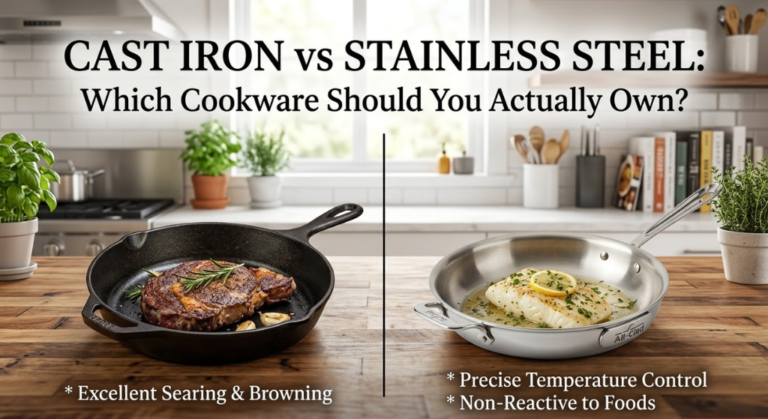
Cast Iron vs Stainless Steel: Which Cookware Should You Actually Own?
📋 What’s Covered
- Quick Answer
- How Each Material Works
- Scored Category Comparison
- Task-by-Task Results
- Searing — The Critical Test
- Heat Distribution Deep Dive
- Cast Iron Seasoning Guide
- The Fond — Why Stainless Wins for Sauces
- Acidic Foods — Important Differences
- Care & Maintenance
- Weight & Everyday Usability
- Who Should Own Which
- Our Recommended Pieces
- Final Verdict
- FAQs
Cast iron and stainless steel are the two materials that professional cooks swear by — and they each earn that loyalty for completely different reasons. Cast iron holds heat like a thermal battery and builds a natural non-stick surface over time. Stainless steel heats and cools quickly, develops a built-up fond for pan sauces, and goes in the dishwasher without a second thought. Choosing between them is not about which is better — it’s about which is better for what you cook most often.
We cooked over 150 recipes across both materials over twelve weeks — from seared steaks and pan sauces to cornbread and braised chicken — before writing this comparison.
Quick Answer
The honest recommendation for most serious home cooks: own both. A 10-inch cast iron skillet and a 3-quart stainless steel saucier together cost less than one high-end non-stick pan and handle a wider range of cooking tasks more effectively than either alone.
How Each Material Works
Cast Iron — The Thermal Battery
Cast iron is a dense, porous iron alloy with very low thermal conductivity — it heats slowly but, once hot, holds that heat with extraordinary stability. When you preheat a cast iron skillet for 5 minutes over medium heat and then add a cold steak, the pan’s thermal mass is large enough to absorb the cold from the steak without a significant temperature drop. This is why cast iron produces a better sear than almost any other material — the surface temperature stays consistent throughout the contact, producing an even, deep Maillard crust.
Cast iron’s low thermal conductivity also means it has hot spots — the area directly above the burner heats faster than the pan edges. This is the opposite of what most people assume about a “heavy” pan. Preheating is essential (5–8 minutes minimum over medium heat) to allow the heat to distribute before cooking begins.
Over time and repeated use, cooking oils polymerise into the porous surface of the iron, building a natural non-stick layer called seasoning. A well-seasoned cast iron skillet produces fried eggs that slide freely — without any cooking spray or added fat beyond a small amount of butter.
Stainless Steel — Precision and Reactivity
Stainless steel is a chromium-iron alloy that heats quickly and — critically — responds to temperature changes quickly. Turn down the heat and the pan cools rapidly; turn it up and the pan responds within seconds. This thermal reactivity is the opposite of cast iron’s thermal inertia, and it’s exactly what you need when cooking delicate fish, egg-based sauces, or anything that requires precise temperature control.
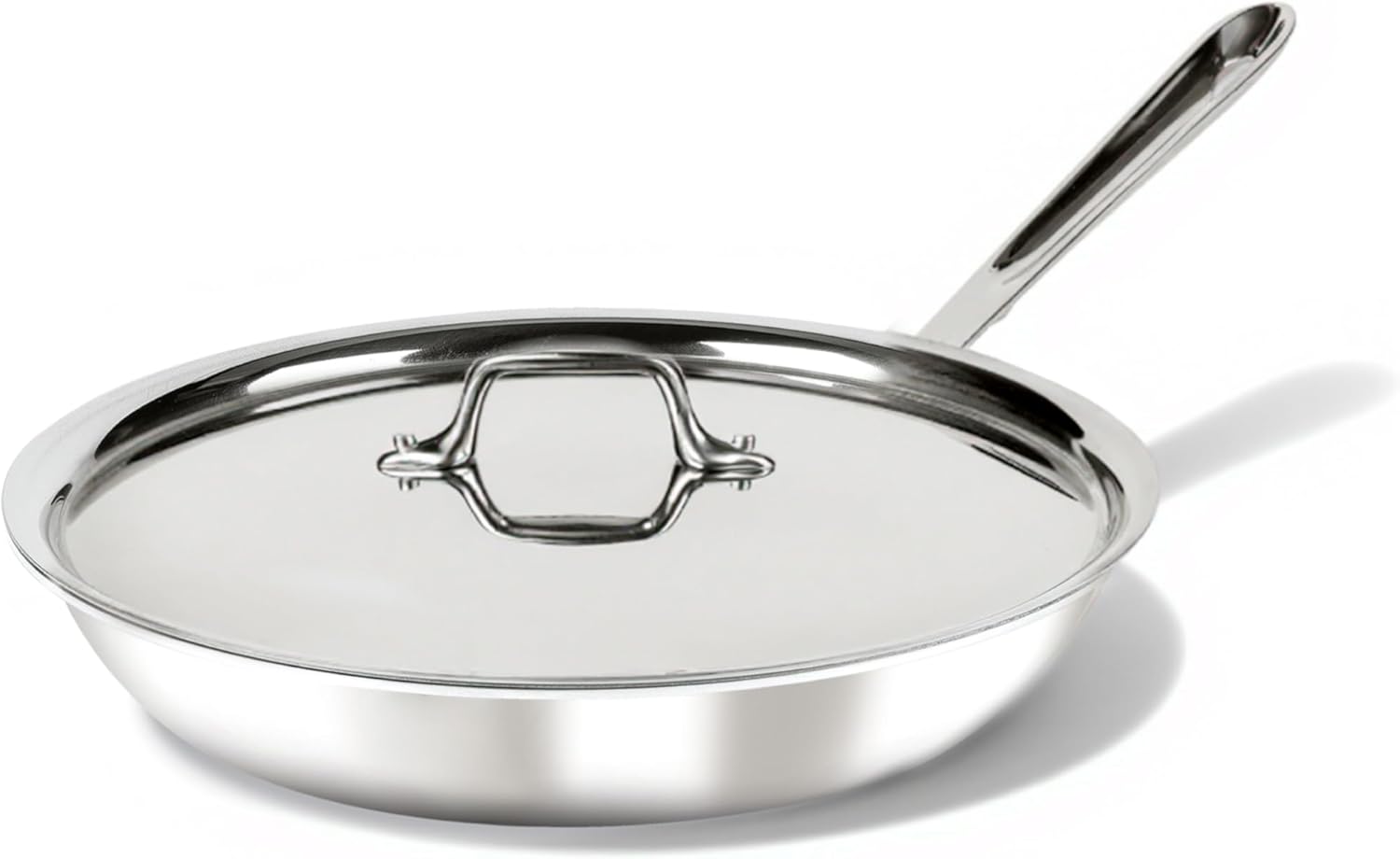
Quality stainless steel cookware is always multi-ply — a sandwich of stainless steel bonded to an aluminium or copper core. Pure stainless steel has poor thermal conductivity; the multi-ply construction adds the conductivity of aluminium or copper while maintaining stainless steel’s durability, non-reactivity, and dishwasher compatibility. All-Clad’s tri-ply (steel-aluminium-steel) and five-ply constructions are the industry benchmark.
Stainless steel’s light-coloured interior surface makes it easy to monitor the colour development of fond — the brown-black deposits left by caramelised proteins and sugars after searing. This fond is the foundation of all French-style pan sauces, and the stainless pan’s visible surface is why professional kitchens use stainless almost exclusively for sauce work.
Scored Category Comparison
Task-by-Task Results
Proteins
Vegetables & Eggs
Braising & Sauces
Searing — The Critical Test
Searing is the task that most clearly separates these materials, and cast iron’s advantage here deserves a detailed explanation.
Why Cast Iron Sears Better
When a cold steak contacts a hot pan, the temperature at the contact surface drops. In a stainless pan with lower thermal mass, this temperature drop is significant enough to slow Maillard reaction for the first 30–60 seconds — producing a less uniform crust. In cast iron with its much higher thermal mass (a 10-inch Lodge skillet weighs approximately 5 lbs vs a 10-inch All-Clad stainless pan at approximately 2.4 lbs), the stored heat is sufficient to compensate for the cold protein’s effect on the surface temperature.
We measured surface temperature during searing using an infrared thermometer. After adding a 200g cold steak to a preheated pan:
- Cast iron: surface temperature dropped from 450°F to 412°F within 5 seconds, then recovered to 435°F within 30 seconds
- Stainless tri-ply: surface temperature dropped from 450°F to 368°F within 5 seconds, then recovered to 420°F within 30 seconds
The stainless pan dropped 82°F on contact vs cast iron’s 38°F drop — more than double. At lower temperatures, the Maillard reaction slows significantly, producing a paler, less flavourful crust. This is the physics behind cast iron’s searing reputation, and it is measurable and real.
Heat Distribution Deep Dive
Cast iron’s reputation for “even heat distribution” is one of the most misunderstood claims in cookware marketing. Cast iron does NOT distribute heat evenly — it distributes heat poorly compared to multi-ply stainless steel.
We tested both pans using a thermal imaging camera. After 5 minutes of preheating over a gas burner set to medium:
- Cast iron skillet: centre (above burner) at 480°F; pan edge at 310°F — a 170°F differential
- All-Clad tri-ply stainless: centre at 420°F; pan edge at 390°F — a 30°F differential
The stainless tri-ply distributes heat 5–6× more evenly across the pan surface. Cast iron has massive hot spots directly above the burner. So why does cast iron produce better sears? Because heat retention matters more than heat distribution for searing. Once cast iron reaches temperature, it holds it. Stainless distributes better but loses heat faster.
The practical implication: when cooking in cast iron, move food around the pan during cooking to compensate for the hot spot in the centre. Or use cast iron in the oven — oven heat is radiant and even from all directions, which eliminates the hot spot problem entirely and is why cast iron Dutch ovens and skillets work brilliantly for braising.
Cast Iron Seasoning Guide
Seasoning is the most misunderstood aspect of cast iron ownership. New owners often give up on cast iron because of sticking — almost always caused by insufficient seasoning or incorrect seasoning technique.
What Seasoning Actually Is
Seasoning is a layer of polymerised oil baked into the porous surface of the iron. When oil is heated above its smoke point in thin layers, it undergoes polymerisation — the oil molecules cross-link into a hard, plastic-like film. Multiple layers of this film build up over time to create a smooth, naturally non-stick surface. A factory-seasoned Lodge skillet has 2–3 layers of seasoning. A skillet used weekly for five years may have 20–30 layers — and will perform noticeably better than a new pan.
How to Season a New or Stripped Cast Iron Pan
- Wash with soap and hot water to remove factory coating (this is the only time you soap a cast iron pan)
- Dry completely on the stovetop over low heat for 3–5 minutes until no moisture remains
- Apply a very thin coat of flaxseed oil, Crisco, or Crisbee all over the pan — inside, outside, and handle. Use a paper towel and buff off almost all the oil; the pan should look almost dry. Too much oil = sticky, gummy seasoning.
- Place upside-down in an oven at 450–500°F for 1 hour
- Let cool in the oven, then repeat the oiling and baking process 3–4 more times
Maintaining Seasoning Through Cooking
The best seasoning maintenance is regular high-heat cooking with fat — bacon, sautéed vegetables in olive oil, pan-fried chicken. Each cook adds a micro-layer of polymerised fat. After cooking: rinse with hot water (no soap), scrub with a chainmail scrubber or stiff brush if needed, dry completely on the stovetop, and apply a very thin coat of oil while the pan is still warm. This takes 3 minutes and keeps the seasoning building with every use.
The Fond — Why Stainless Wins for Sauces
The fond is the single most important reason professional kitchens use stainless steel. Understanding what it is and why it requires stainless transforms your sauce-making.
What Fond Is and Why It Matters
When you sear protein in a pan, a layer of caramelised proteins, sugars, and Maillard compounds adheres to the pan surface. This is fond (from the French fond de casserole — “bottom of the pan”). It is concentrated, complex flavour — more intensely flavoured per gram than the meat itself. When you deglaze the pan with wine, stock, or water and scrape up the fond, those compounds dissolve into the liquid and become the flavour base of your sauce.
Why Stainless is Better for Fond
Two reasons: visibility and adhesion. Stainless steel’s light-coloured interior surface lets you see the fond developing — you can judge whether it’s a light golden (good for a delicate sauce) or deep mahogany (good for a rich braise sauce) and deglaze at exactly the right moment. Cast iron’s dark surface makes this judgement nearly impossible.
Stainless steel also produces more complete fond adhesion than seasoned cast iron. The seasoning in a cast iron pan acts as a partial barrier — some fond sticks, some doesn’t, producing an inconsistent sauce base. In stainless steel, the fond adheres reliably across the entire pan surface and releases completely on deglazing.
Acidic Foods — The Material That Matters
This is a practical consideration that genuinely affects what you can cook in each material.
Enamelled cast iron (Le Creuset, Staub) eliminates this limitation — the enamel coating is non-reactive and fully safe for all acidic foods. If you want cast iron versatility without acid restrictions, enamelled cast iron is the solution — at a significant price premium over bare cast iron.
Care & Maintenance
Cast Iron — The Real Story on Care
Cast iron has a reputation for being high-maintenance that is significantly overstated. The care requirements are simple once understood:
- Cleaning: Rinse with hot water while warm, scrub with a stiff brush or chainmail scrubber for stuck food, dry immediately on the stovetop over low heat, apply a thin coat of oil. Time: 3–4 minutes.
- No dishwasher: The high-heat detergent cycle strips seasoning and causes rust. Cast iron is hand-wash only — non-negotiable.
- Soap: Occasional mild soap is fine. The old rule of “never use soap” was based on older lye soaps that stripped iron. Modern dish soap in small amounts does not damage seasoning. Avoid heavy soap sessions; use sparingly if at all.
- Rust: If rust develops (from drying incompletely), scrub off with steel wool, re-season as described above. Rust does not ruin a cast iron pan — it is fully recoverable.
Stainless Steel — Genuinely Low Maintenance
Stainless steel is the most maintenance-free cookware material available:
- Dishwasher safe: Most quality stainless pans are dishwasher safe. Check the manufacturer’s recommendation for handles — riveted stainless handles are always fine; some wooden or silicone handles are not.
- Stuck food: Fill with water and bring to a simmer — stuck food releases easily after 2–3 minutes. Bar Keepers Friend powder restores a stainless pan to near-new shine after any discolouration.
- Rainbow discolouration: Normal and harmless. Caused by minerals in water or overheating. Remove with Bar Keepers Friend or white vinegar.
- No seasoning required: Stainless has no coating to maintain. The same pan bought today performs identically in 20 years.
Weight & Everyday Usability
Cast iron’s weight is the most frequent practical complaint. A 10-inch Lodge skillet weighs approximately 5 lbs (2.3 kg); a 10-inch All-Clad stainless skillet weighs approximately 2.4 lbs (1.1 kg). A 5-quart cast iron Dutch oven weighs 12+ lbs. This weight difference is relevant to three groups of users:
- Users with wrist injuries, arthritis, or limited hand strength — cast iron’s weight can make daily use impractical. Stainless is the more accessible material.
- Users who frequently pour from the pan (tilting to drain, pouring sauce into a serving vessel) — heavier cast iron is more difficult and creates pour-control issues.
- Glass or ceramic cooktops — cast iron should be placed rather than slid on glass cooktops, and very heavy cast iron Dutch ovens risk cracking glass surfaces if dropped. Stainless is safer on glass cooktops for everyday handling.
Who Should Own Which
The definitive searing tool. No pan produces a better crust on a steak at any price point.
Dutch oven bread (no-knead style) requires a heavy, lidded vessel that creates steam. Cast iron Dutch ovens are the standard tool for home artisan bread.
Cast iron is the only cookware material that works reliably over open flame, campfire coals, and outdoor grills. Indestructible in these conditions.
A cast iron skillet bought today will still work in 100 years. Virtually indestructible with basic care.
For pan sauces, reductions, and any dish that benefits from visible fond development and clean deglazing.
Long-simmered tomato sauces, wine braises, citrus-based dishes — fully non-reactive, no restrictions.
Dishwasher safe, no seasoning, no rust risk, no special care. The most hassle-free cookware material.
Fast temperature response for scallops, fish fillets, and egg-based sauces that need precise, controllable heat.
Our Recommended Pieces



Enamelled Cast Iron — The Best of Both Worlds
Enamelled cast iron (Le Creuset, Staub, Lodge Enamelled) deserves its own section because it changes the acid-restriction equation entirely. The enamel coating on the cooking surface is chemically inert — it doesn’t react with acids, doesn’t require seasoning, and is dishwasher safe. You get cast iron’s thermal mass and heat retention without the maintenance requirements or acid restrictions of bare cast iron.
Enamelled Cast Iron vs Bare Cast Iron
The trade-off: enamelled cast iron costs significantly more than bare cast iron. A Lodge bare 10-inch skillet costs a fraction of a Le Creuset equivalent. For buyers who primarily want a Dutch oven for braising and bread baking — and regularly cook acidic braises with wine and tomatoes — the enamelled option is worth considering. For buyers who primarily sear proteins and bake in the skillet, bare cast iron is the better value.
The Leidenfrost Effect — Why Your Stainless Pan Sticks
The single most important technique for stainless steel is the water-drop preheating test, and understanding the physics behind it eliminates sticking permanently.
When a metal pan is at the right temperature, a drop of water placed on the surface forms a sphere and skitters across the pan rather than immediately evaporating. This is the Leidenfrost effect — at the exact temperature where stainless steel’s pores are closed by thermal expansion, the water drop sits on a thin layer of steam rather than directly contacting the metal. This same surface closure is what prevents protein from adhering to the pan.
To use this in practice: heat your dry stainless pan over medium heat for 2–3 minutes. Flick a few drops of water into the pan. If they sizzle and evaporate immediately, the pan is too cool — wait another minute. If they form round beads that skitter freely, the pan is at the correct temperature. Add oil, let the oil shimmer, then add your protein. The protein will not stick. This technique works 100% of the time on properly preheated stainless steel and is the reason professional cooks can use stainless for eggs without difficulty.
The Essential Cookware Set — What to Actually Buy
Rather than a full cookware set in a single material, the most practical kitchen setup combines the strengths of both. Here is what we recommend for different household sizes and cooking styles.
What You Don’t Need to Buy
The cookware industry sells matched sets of 10–14 pieces that include several sizes you will never use. Avoid buying a full set in either material. The pieces that actually get used in most kitchens are: one 10-inch skillet (cast iron or stainless), one 3–4 quart saucepan or saucier (stainless), and one 5–7 quart Dutch oven (cast iron or stainless). Everything else — 8-inch skillets, 1.5-quart saucepans, matching sauté pans — spends most of its life in a cabinet. Buy individual pieces that match your actual cooking habits rather than a comprehensive set that fills a drawer you never open.
A Note on Non-Stick
This guide focuses on cast iron and stainless steel because they are the two permanent, non-coating-based materials — pans that perform better over time rather than worse. Non-stick pans have their place (eggs and very delicate fish primarily) but their Teflon or ceramic coating degrades with use and requires replacement every 2–5 years. A Lodge cast iron or All-Clad stainless pan bought today will still perform identically — or better — in 20 years. Non-stick pans are consumables; cast iron and stainless steel are investments.
Cooking Fats — What to Use in Each Material
The choice of cooking fat matters differently for each material. For cast iron: use fats with moderate-to-high smoke points — clarified butter (ghee), avocado oil, or vegetable oil — for high-heat searing. For lower-temperature cast iron cooking, whole butter works beautifully. Avoid spray cooking oil (like PAM) in cast iron — the propellants and additives build up a sticky residue on seasoning that is difficult to remove. For stainless steel: any fat works because there is no seasoning to maintain or degrade. Use whole butter at medium-low heat for eggs and delicate proteins; use neutral high-smoke-point oils for searing. The Maillard reaction produces the same quality result regardless of which fat you choose at the same temperature, so use whichever fat complements the flavour of the dish.
Deglazing — The Technique That Justifies Owning Stainless
Deglazing is the technique of adding liquid to a hot pan after searing to dissolve the fond into a sauce base. The process: after removing your protein, pour off excess fat from the pan, increase heat to medium-high, and add cold liquid (wine, stock, water) to the hot pan. The liquid immediately boils and the temperature differential causes the fond to release from the surface. Scrape with a wooden spoon or silicone spatula, incorporating all the brown bits into the liquid. Reduce by half over 2–3 minutes, add butter or cream to enrich, season, and pour over the rested protein. This process, which takes 4 minutes and uses only what was already in the pan, produces a restaurant-quality sauce at zero additional ingredient cost. It is the defining technique of French-inspired home cooking — and it requires stainless steel to do correctly.
The “Seasoned is Non-Stick” Reality Check
Cast iron advocates sometimes overclaim that a well-seasoned skillet is as non-stick as Teflon. This is not accurate. A well-seasoned cast iron pan is significantly less sticky than an unseasoned one, and over many years of use approaches a genuinely non-stick result for most foods. But it is not the frictionless surface of a brand-new non-stick pan. The appropriate expectation: a well-seasoned cast iron skillet handles fried eggs, sautéed fish, and pancakes without sticking when used with a small amount of butter or oil. Finely minced herbs, raw cheese, and sticky glazes will still stick to cast iron regardless of seasoning level. Understanding this prevents the frustration that causes many new cast iron owners to give up prematurely on what is otherwise an exceptional pan. The same expectation-setting applies to stainless steel: new stainless pan owners often experience sticking in the first few cooks before mastering the Leidenfrost preheating technique. Both materials reward learning their specific requirements — and both perform extraordinarily well once those requirements are understood and applied consistently. Cast iron rewards patience and repetition; stainless rewards technique and precision. Both paths lead to excellent cooking results, and the home cook who masters both materials has access to a broader range of professional cooking techniques than any single-material kitchen can provide. Every technique described in this guide — the Leidenfrost preheating test, the fond deglaze, cast iron seasoning, searing physics — takes one afternoon to learn and produces a lifetime of better cooking. Investing that time pays dividends every single time you cook. The combination of a Lodge cast iron skillet and an All-Clad stainless pan is, without exaggeration, the most capable and long-lasting two-pan kitchen setup available at any price.
Final Verdict
🍳 Cast Iron for Searing, Baking & Lifetime Value
No cookware produces a better crust on a steak, crispier skin on chicken, or more perfectly crusted cornbread than cast iron. It is essentially indestructible, improves with use, and costs less than a restaurant dinner. A 10-inch Lodge skillet is one of the highest-value purchases in all of kitchen equipment. If you own only one pan, make it a 10-inch cast iron skillet.
🥘 Stainless Steel for Sauces, Versatility & Ease
Stainless steel’s visible fond, precise temperature control, full acid compatibility, and dishwasher safety make it the professional chef’s everyday workhorse. A good tri-ply stainless skillet is better than cast iron for pan sauces, delicate proteins, and acidic preparations — and significantly easier to live with on a daily basis. The All-Clad D3 is the benchmark that everything else is measured against.
The best-equipped kitchen owns both: a Lodge cast iron skillet for searing and oven work; an All-Clad stainless skillet for sauces and delicate proteins. Together they cost less than a single high-end non-stick pan and handle every cooking task more effectively than either material alone.
Frequently Asked Questions
Continue Reading
The only three knives every home cook needs — and what to avoid.
The best food processor for home cooks — reviewed in full detail.
Complete your kitchen — the top air fryers of 2026 tested and ranked.
The best pressure cooker ever made — reviewed in full detail.


