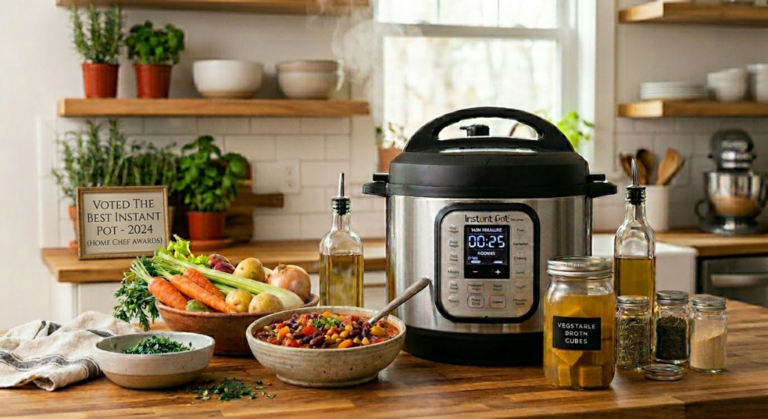
Best Instant Pot in 2026 — Every Model Tested & Ranked
We cooked real family meals in every current Instant Pot model over eight weeks — pot roasts, dried beans, yogurt, rice, soups, cheesecakes, and whole chickens — to find the right model for every household, budget, and cooking style. Updated for 2026 with the latest model lineup.
Our Top Pick: Instant Pot Duo 7-in-1 (6-Quart)
After eight weeks of cooking real meals across every current model, the Instant Pot Duo 7-in-1 6-Quart remains the best Instant Pot for most households in 2026. At around $79–$99, it delivers everything the average family needs — pressure cooking, slow cooking, rice, sauté, steam, yogurt, and keep warm — in a proven, reliable package. For the full breakdown see our Instant Pot Duo full review and Instant Pot vs slow cooker comparison.
- Why Trust Our Instant Pot Testing?
- What’s New in the Instant Pot Lineup for 2026?
- The Full Instant Pot Model Guide — Which Is Which?
- What to Look For When Buying an Instant Pot
- Instant Pot Size Guide — 3, 6, or 8 Quart?
- Our Top 5 Best Instant Pots in 2026
- 1. Instant Pot Duo 7-in-1 6-Qt — Best Overall
- 2. Instant Pot Pro — Best Premium
- 3. Instant Pot Duo Plus — Best Mid-Range
- 4. Instant Pot Duo 3-Qt — Best for Small Households
- 5. Instant Pot Duo 8-Qt — Best for Large Families
- Side-by-Side Comparison Table
- Pressure Cook Time Reference Guide
- Instant Pot vs Slow Cooker — Honest Comparison
- Getting Started — First 5 Things to Cook
- Tips and Tricks for Better Results
- Frequently Asked Questions
- Final Verdict
Why Trust Our Instant Pot Testing?
We cooked real meals — not test batches. Every model was used for a minimum of three weeks in a working family kitchen, cooking the meals that matter to actual households: a 3-lb pot roast from frozen, a full batch of dried chickpeas from scratch, beef bone broth simmered for 3 hours, white rice for four, a whole chicken with vegetables, cheesecake in a springform pan, homemade yogurt from cold milk, and steel-cut oats overnight on the delay start function.
We measured what manufacturers don’t advertise: how long each model actually takes to come to pressure under real load (not the listed 10-minute estimate), whether the sealing ring retains odours after cooking fish and then dairy, how well each model’s sauté function browns aromatics before adding liquid, and whether the steam release valve is genuinely easy to operate one-handed while wearing oven mitts — a detail that matters when a pot of boiling broth is ready and you need both hands free.
Sarah Mitchell has tested over 200 kitchen appliances and has used an Instant Pot weekly for seven years. Her testing reflects both fresh-eyes beginner experience and long-term ownership knowledge that only repeated use reveals.
We scored each model across five categories: pressure cooking performance (30%), ease of use and controls (20%), build quality and sealing reliability (20%), additional functions beyond pressure cooking (20%), and value for money (10%). Sealing reliability was tracked across every cook — a model that failed to seal properly even once received a significant deduction.
What’s New in the Instant Pot Lineup for 2026?
Instant Pot’s 2026 lineup has stabilised after several years of rapid model expansion. Here’s what changed — and what it means for buyers this year.
The Duo Remains the Core Product
After experimenting with app-connected models, air fryer lids, and a crowded middle tier, Instant Pot has refocused on the Duo as its primary recommendation. The 2026 Duo features a revised steam release valve with a wider lever that’s noticeably easier to operate, a slightly improved sauté heating element, and updated control panel labels. It’s still the same proven seven-function design — just better executed in the details.
The Pro Series Has Expanded
The Instant Pot Pro, launched in 2023, has established itself as the clear choice for more serious pressure cookers by 2026. The inner pot now uses a five-ply stainless construction rather than three-ply, improving heat distribution during sauté significantly. The Pro also introduced a proper steam release button (rather than a twist valve) and a wider LCD display with clearer progress indicators. At $119–$139, it’s $30–$40 more than the Duo — and in our testing, that premium is justified for weekly heavy users.
App-Connected Models Discontinued
The Instant Pot Smart WiFi model — which allowed smartphone control via Bluetooth and Wi-Fi — has been discontinued. In practice, it solved a problem very few people had (controlling a pressure cooker remotely) and the unreliable connectivity made it frustrating to use. Its discontinuation is the right decision. The current lineup focuses on what actually matters: reliable pressure cooking, clear controls, and ease of use.
Price Drops Across the Board
Competition from Ninja (the Ninja Foodi range) and Cosori has pushed Instant Pot prices down meaningfully. The standard 6-quart Duo now regularly sells for $79–$89 — about $30 less than its 2023 street price. The Pro has similarly dropped from $149 to $119–$139. For buyers who held off during the premium pricing era, 2026 is the best time to buy.
The Full Instant Pot Model Guide — Which Is Which?
Instant Pot sells more than a dozen models across three generations. This guide covers every current model so you know exactly what you’re buying before you choose.
The Instant Pot Duo Crisp (air fryer lid model) adds $60–$80 to the base price for an air fryer attachment that underperforms a dedicated air fryer in every test. If you want both appliances, buy an Instant Pot Duo + a dedicated air fryer separately — better performance, similar total cost. The Instant Pot Max was discontinued and replaced by the Pro. Avoid used Max units — replacement parts are becoming scarce.
What to Look For When Buying an Instant Pot
The Instant Pot lineup can feel overwhelming with 15+ models across three generations. These are the specs that actually matter — and the ones you can safely ignore.
Instant Pot Size Guide — 3-Qt, 6-Qt, or 8-Qt?
Size is the most important decision you’ll make when buying an Instant Pot — and the most commonly regretted. Here’s what each size actually means in practice.
3-Quart — Small but Capable
The 3-quart is often marketed as ideal for couples and individuals, but in practice it’s more limiting than it appears. Pressure cookers need to be at least one-third full to build pressure properly and no more than two-thirds full to allow steam space. A 3-quart pot’s effective cooking range is roughly 1–2 quarts of food — enough for a pot of soup for two, a small batch of rice, or a single chicken breast. It’s genuinely useful for households that cook for one or two people exclusively and have very limited storage space. For anyone who ever cooks for guests or batch cooks for the week, the 3-quart will frustrate.
6-Quart — The Right Size for Most Families
The 6-quart is the overwhelming choice for good reason. Its effective cooking range covers a 3-lb pot roast, a whole chicken, a full batch of dried beans, or soup for 6–8 people comfortably. The ratio of fill range to useful cooking output is optimal at this size — you rarely run out of space and you rarely feel like you’re wasting the pot on small batches. If you’re buying one Instant Pot and you’re unsure which size, buy the 6-quart.
8-Quart — For Large Families and Batch Cookers
The 8-quart is significantly larger than it sounds — 33% more capacity than the 6-quart. It fits a 5-lb brisket, a full rack of spare ribs, or enough chili for 12 people. It’s the right choice for families of 5 or more, people who batch cook a week’s worth of meals on Sunday, or anyone regularly cooking large cuts of meat. Its downsides: larger footprint on the counter, heavier inner pot, and it comes to pressure more slowly than the 6-quart under the same load. Small batches take longer and perform less evenly in an 8-quart than in a 6-quart.
Every Instant Pot must be filled at least 1/3 full (to generate enough steam to reach pressure) and no more than 2/3 full for most foods or 1/2 full for foods that foam or expand (beans, rice, pasta, grains). Ignoring this is the most common mistake new users make. A 6-quart pot’s practical cooking range is roughly 2–4 quarts of food — keep this in mind when scaling recipes.
Our Top 5 Best Instant Pots in 2026
These five represent the best Instant Pot at every price point and use case after eight weeks of real cooking tests. Each earns its place for a specific reason — and we’ve been honest about where each one falls short.

The Duo’s sauté function reached 330°F in our test — hot enough to brown ground beef and develop a proper fond on chicken thighs, but not as powerful as the Pro. The key technique: work in smaller batches and pat meat completely dry before sautéing. The Duo sautés a full layer of aromatics (onion, garlic, celery) perfectly; it struggles when overloaded with wet ingredients. This is a technique issue as much as a hardware one — and the Duo’s enormous recipe community means the solutions are already well-documented.
One accessory we strongly recommend alongside the Duo: a second sealing ring ($8–$12 on Amazon). After cooking fish stock or a curry, the silicone ring retains the aroma for the next 2–3 cooks. A dedicated “savoury” ring and “sweet” ring — a standard practice among regular Instant Pot users — solves this completely. Keep one red ring for savoury and one blue for desserts and yogurt.

The five-ply inner pot difference is real and measurable. In our browning test — searing four chicken thighs in two batches — the Pro developed a deep golden-brown fond in 4 minutes per side. The Duo took 6 minutes for a lighter sear, and produced more steaming than browning on the second batch as moisture accumulated. The five-ply construction retains heat between batches and distributes it more evenly, which is the same reason that professional kitchen pans have thicker bases. For anyone making braises, curries, or any recipe where the sauté step matters, this difference is worth the premium alone.


Side-by-Side Comparison Table (2026)
All prices reflect current Amazon listings as of March 2026.
← Scroll to see all columns →| Model | Score | Functions | Size | Wattage | Price | Best For |
|---|---|---|---|---|---|---|
| Duo 7-in-1 (6-Qt) | 9.3 | 7 | 6 Qt | 1000W | ~$89 | Overall Best |
| Pro 10-in-1 (6-Qt) | 9.5 | 10 | 6 Qt | 1200W | ~$129 | Best Premium |
| Duo Plus 9-in-1 (6-Qt) | 8.9 | 9 | 6 Qt | 1000W | ~$109 | Mid-Range |
| Duo Mini (3-Qt) | 8.4 | 7 | 3 Qt | 700W | ~$69 | Small Households |
| Duo (8-Qt) | 8.7 | 7 | 8 Qt | 1200W | ~$119 | Large Families |
Pressure Cook Time Reference Guide
One of the most valuable things we can give a new Instant Pot owner is a reliable cook time reference. These times are tested on the Duo 6-Qt at high pressure with a natural release unless noted. All times are from when the pot reaches pressure — not from when you press start.
← Scroll if needed →| Food | Pressure | Cook Time | Release | Notes |
|---|---|---|---|---|
| White rice (1 cup) | High | 3 min | Natural 10 min | 1:1.25 water ratio |
| Brown rice (1 cup) | High | 22 min | Natural 10 min | 1:1.5 water ratio |
| Dried chickpeas (1 cup) | High | 40 min | Natural full | No soaking needed |
| Dried black beans (1 cup) | High | 25 min | Natural full | No soaking needed |
| Chicken breast (boneless) | High | 8 min | Quick release | From fresh; add 2 min if frozen |
| Whole chicken (4 lb) | High | 25 min | Natural 15 min | Per pound: 6 min/lb |
| Beef pot roast (3 lb) | High | 60 min | Natural full | Cut into chunks for more even cook |
| Pork ribs (rack) | High | 25 min | Quick release | Then broil 5 min for crust |
| Steel-cut oats | High | 3 min | Natural 10 min | 1:3 oats-to-water; creamy result |
| Bone broth | High | 120 min | Natural full | Fill to max line; rich gel result |
| Hard-boiled eggs | High | 5 min | Quick release | Ice bath immediately after |
| Cheesecake (7-inch) | High | 35 min | Natural full | Use trivet and 1 cup water |
| Lentil soup | High | 15 min | Quick release | No pre-soaking needed |
| Frozen chicken thighs | High | 18 min | Natural 10 min | Always check internal temp: 165°F |
Cook times in pressure cookers vary with pot model, altitude, ingredient density, and fill level. Always use a meat thermometer to verify doneness — particularly for poultry (165°F / 74°C) and pork (145°F / 63°C). The times above are starting points from our testing, not guarantees. Your first cook of any recipe should be treated as a calibration run.
Instant Pot vs Slow Cooker — Honest Comparison
This is the most common question from buyers considering their first Instant Pot, and the honest answer is more nuanced than most guides admit. Both appliances have genuine strengths — and knowing which to buy first depends entirely on your cooking style.
Where the Instant Pot Wins Clearly
Speed: This is the Instant Pot’s defining advantage. A pot roast that takes 8 hours in a slow cooker takes 60–75 minutes under pressure. Dried beans from scratch in 40 minutes versus 6–8 hours. For weeknight cooking where you can’t start something at 8am, the Instant Pot is the practical choice. Versatility: The sauté function means you can brown aromatics, build a fond, and pressure cook all in the same pot — something no slow cooker can do without transferring between pans. Rice and grains: The Instant Pot makes consistently excellent rice, oats, and grains. Slow cookers cannot do this reliably.
Where the Slow Cooker Wins
Texture on low collagen meats: A slow cooker’s low, sustained heat produces a different texture in some proteins — particularly pulled pork and braised short ribs — that some cooks prefer to the pressure-cooked result. The longer, gentler process breaks down collagen over many hours in a way that produces a distinctive silky texture. Simplicity and forgiveness: A slow cooker is nearly impossible to overcook — add ingredients in the morning, come home to dinner. The Instant Pot requires attention to fill levels, sealing, and timing. Hands-off cooking: A slow cooker on low for 8 hours genuinely needs no attention. An Instant Pot needs to be started when you want it to finish, which requires more planning.
The Honest Recommendation
For most modern households, the Instant Pot is the better first appliance because its speed advantage is so dramatic and its versatility so much greater. If you already own a slow cooker and use it regularly, there’s a real argument for keeping both — they produce genuinely different results for some recipes. If you’re choosing between them for the first time, buy the Instant Pot. For the full detailed comparison including specific recipe outcomes, see our Instant Pot vs slow cooker guide.
Getting Started — Your First 5 Things to Cook in an Instant Pot
New Instant Pot owners often feel intimidated by the appliance. The controls look complex, the safety warnings are lengthy, and the online recipe ecosystem is so large it’s hard to know where to begin. Here are the five recipes we recommend for every new owner — ordered from easiest to slightly more involved, each designed to teach a specific skill.
1. Hard-Boiled Eggs (5-5-5 Method)
5 minutes pressure on high, 5 minutes natural release, 5 minutes in ice water. This teaches the basic pressure cooking sequence and produces the most consistently perfect peelable hard-boiled eggs you’ve ever made. The pressure cooking method produces shells that slip off cleanly — something almost impossible to achieve reliably with stovetop boiling. Cook one egg for the first attempt so you can check the result immediately.
2. White Rice
3 minutes high pressure, 10-minute natural release, 1:1.25 ratio of rice to water. This teaches natural versus quick release and gives you an immediately useful result. Every subsequent rice cook builds on this foundation. Once you’ve nailed plain white rice, jasmine, basmati, and sushi rice all follow the same process.
3. Chicken Broth from a Carcass
Chicken carcass, 2 onion halves, 2 celery stalks, 2 carrots, a few peppercorns, bay leaves, fill to max line with cold water. 60 minutes high pressure, full natural release. This teaches maximum fill line, the natural release process for large volumes of liquid, and produces a rich, gelatinous broth that usually takes 4 hours on the stovetop. The result is noticeably better than store-bought stock in any subsequent recipe.
4. Dried Beans from Scratch
1 cup dried black beans, 3 cups water, 1 tsp salt, 25 minutes high pressure, full natural release. This teaches why the Instant Pot exists — transforming a 6-hour soak-and-simmer into a 40-minute hands-off process. Never buy canned beans again.
5. Pot Roast with Vegetables
2–3 lb chuck roast, seared in the sauté function first, then deglazed with stock and pressure cooked with potatoes and carrots for 60 minutes. This teaches the full sauté-then-pressure-cook workflow, the importance of deglazing (liquid is required for pressure cooking), and demonstrates why the Instant Pot is genuinely different from any other appliance in your kitchen.
Instant Pot Tips and Tricks for Better Results
Always Deglaze After Sautéing
After browning meat or aromatics in the sauté function, add your liquid and use a wooden spoon to scrape all the browned bits off the bottom of the pot before sealing. This is not optional — it prevents the burn notice (the most common Instant Pot error), and those browned bits add significant flavour to the final dish. The Instant Pot’s pressure sensor is at the bottom of the pot; any stuck residue triggers the burn protection regardless of how much liquid is present.
Natural Release vs Quick Release — When to Use Each
Natural release (letting pressure drop on its own): use for large cuts of meat, beans, grains, soups with foam potential, and anything where texture benefits from a gentler pressure drop. Natural release continues the cooking process as pressure drops. Quick release (turning the steam valve immediately): use for vegetables, seafood, chicken breasts, and anything that can overcook easily. Never quick release a pot more than half full of liquid — the violent pressure drop can push liquid through the valve.
The Minimum Liquid Rule
An Instant Pot always needs at least ½ to 1 cup of thin liquid (water, broth, juice) to generate steam and reach pressure. This liquid doesn’t need to cover the food — it just needs to be present. Thick sauces, tomato paste, and dairy count much less than water. When in doubt, add more water than the recipe calls for — you can always reduce a sauce after pressure cooking.
Use the Pot-in-Pot Method for Multiple Foods
The pot-in-pot (PIP) method involves placing a smaller oven-safe dish inside the Instant Pot on the trivet, with water below. This lets you steam or bake food above the liquid rather than submerging it — perfect for cheesecake, rice alongside a protein, or individual portions of pasta. The trivet that comes with every Instant Pot is the key accessory for this.
Buy a Second Sealing Ring Immediately
Silicone sealing rings absorb the aroma of everything you cook. After a fish curry, your yogurt will subtly taste like fish for the next two or three cooks. The solution is simple: keep one ring labelled “savoury” and one labelled “sweet/dairy.” Replacement rings are $8–$12 on Amazon and this is the single most impactful accessory purchase for any Instant Pot owner.
Frequently Asked Questions
For most buyers, the Instant Pot Duo 7-in-1 in 6-quart at approximately $89 is the best choice in 2026. It covers every function the average household needs, the 2026 valve revision addressed its most common complaint, and at $89 it represents exceptional value. If you use an Instant Pot three or more times per week, upgrade to the Instant Pot Pro at $129 — the five-ply pot and steam release button justify the premium for frequent users.
The 6-quart is the right size for a family of four in almost every scenario. It holds enough for a whole chicken with vegetables, a full batch of soup for the week, or a 3-lb pot roast comfortably. The 8-quart is only necessary for families of five or more, people who batch cook for multiple weeks, or regular large cuts like brisket or a full rack of ribs. If you’re ever uncertain, choose 6-quart — it’s the right size for 90% of families.
Yes — for frequent users. The Pro’s five-ply inner pot produces noticeably better browning during sauté, the steam release button is genuinely safer and more intuitive than the twist valve, and the LCD display is more informative during the cook cycle. If you use your Instant Pot three or more times per week, the $40 premium is justified and will feel worthwhile within a month. If you use it once a week or less, save the $40 and buy the Duo — the cooking results from both models are identical once at pressure.
Yes — once the lid is sealed and the cook cycle is running, the Instant Pot is designed to operate safely unattended. The pressure, temperature, and timing are all automatic. You can leave the house during a cook. The keep-warm function holds food safely for up to 10 hours after cooking. The delay start function lets you load the pot in the morning and have it start cooking automatically so dinner is ready when you get home — a genuine quality-of-life feature that slow cooker owners will recognise immediately.
The burn notice (displayed as “burn” or “OvHt” on the control panel) means the Instant Pot’s temperature sensor detected excessive heat at the bottom of the pot. The most common cause is food stuck to the bottom — usually from insufficient deglazing after sautéing. To prevent it: always deglaze thoroughly after sautéing (add liquid and scrape every brown bit off the bottom), never add thick tomato sauce, thickeners, or dairy directly to the pot before pressure cooking (layer liquids on the bottom, thick ingredients on top), and always ensure you have at least ½ cup of thin liquid in the pot before sealing.
For most modern households, yes — because of speed and versatility. The Instant Pot cooks a pot roast in 60–75 minutes versus 8 hours in a slow cooker. It also sautés, makes rice, and produces broth — tasks no slow cooker handles well. The slow cooker has one genuine advantage: it’s more forgiving for all-day, unmonitored cooking with no timing precision required. For the full detailed comparison including recipes where each performs better, see our Instant Pot vs slow cooker guide.
The inner pot, lid, and steam rack are all dishwasher safe — put them in after every use. The sealing ring should be removed and washed separately (dishwasher safe, or rinse under hot water). The exterior base unit should never be submerged — wipe with a damp cloth only. The steam release valve and float valve can be removed and rinsed periodically. Monthly: remove the steam release valve completely and rinse it under running water — small food particles can accumulate and reduce its effectiveness over time.
Final Verdict — Best Instant Pot to Buy in 2026
- Best for most households: Instant Pot Duo 7-in-1 6-Qt at ~$89. Seven proven functions, 2026 valve revision, and the most trusted pressure cooker design ever made.
- Best for frequent, serious cooks: Instant Pot Pro 10-in-1 6-Qt at ~$129. Five-ply pot, steam release button, sous vide, LCD display. The best-performing Instant Pot available.
- Best mid-range with extra functions: Instant Pot Duo Plus 9-in-1 at ~$109. Adds egg and sterilize functions with a better display — right for families with young children or high-altitude kitchens.
- Best for 1–2 people and small kitchens: Instant Pot Duo Mini 3-Qt at ~$69. The most affordable Instant Pot — all 7 functions in a compact footprint.
- Best for large families and batch cooking: Instant Pot Duo 8-Qt at ~$119. Fits a whole brisket or a full week of meal prep — the right upgrade when the 6-Qt isn’t enough.
For the full in-depth review of the Duo, including test results for every cooking function, see our Instant Pot Duo full review. For a detailed head-to-head with slow cookers, see our Instant Pot vs slow cooker guide. Questions about any model? Reach us via our contact page.
Our most useful next reads: Instant Pot Duo full review, the Instant Pot vs slow cooker comparison, and the best air fryer for families if you want a complementary appliance. For full kitchen setup guidance, start with our complete appliance buying guide.