🌬️ Complete Guide · 2026
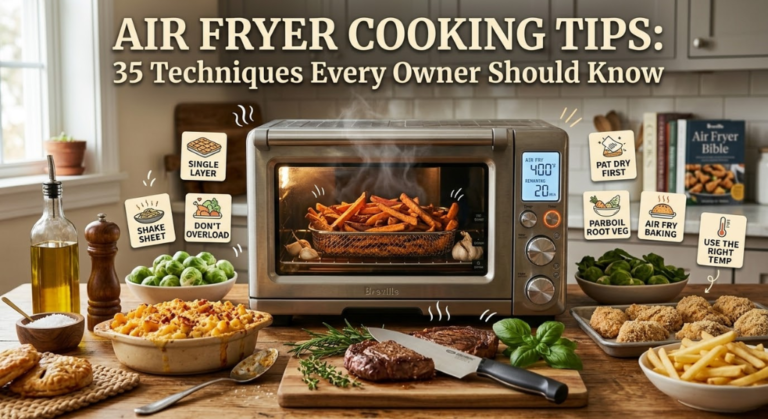
Air Fryer Cooking Tips: 35 Techniques Every Owner Should Know
By Digital Kitchen Guide Editors · Updated March 2026 · 18 min read
Most air fryer owners use 30% of what their machine can do — cooking chips and frozen nuggets while missing the techniques that turn an air fryer from a convenient gadget into the most-used appliance in the kitchen. This guide covers every technique, tip, and troubleshooting solution we’ve developed across eight weeks of daily air fryer testing and hundreds of cooked meals.
Whether you bought your air fryer last week or have owned one for years and gotten stuck in a routine, these 35 tips will change how you cook with it.
The 5 Fundamental Rules
Before any specific tips, these five rules govern everything. Break any of them and results suffer regardless of what else you do correctly.
1
Always preheat — every single time
2–3 minutes at cooking temperature before adding food. A cold basket means food steams rather than crisps during the first 2–3 minutes of cooking. Preheating is not optional — it’s what makes the air fryer different from a slow oven. Set the air fryer to your target temperature, press start, wait until it reaches temperature, then add food. Total time added: 2–3 minutes. Crispiness improvement: dramatic.
2
Single layer only — no exceptions
The air fryer works by circulating hot air around all exposed food surfaces simultaneously. Stacking food blocks airflow between pieces, turning an air fryer cook into an oven steam. One layer, with visible gaps between pieces. If your ingredient volume exceeds one layer, cook in batches or use the oven. This is the most important rule and the most commonly broken one.
3
Pat proteins dry before cooking
Surface moisture creates steam that actively fights crisping. Before adding any protein — chicken, fish, pork, tofu — pat completely dry with paper towel. This takes 20 seconds and produces a noticeable difference in browning and crust development. The drier the surface, the faster and more aggressively the Maillard reaction begins on contact with hot air.
4
Season 20–30% more generously than for the oven
The air fryer’s high-speed air circulation evaporates surface moisture — and surface seasoning along with it. Salt, spice rubs, and coatings applied at oven quantities will taste under-seasoned after air frying. Add 20–30% more seasoning than you’d normally use for an oven recipe. Taste immediately after cooking and adjust on the next batch.
5
Shake small items or flip large items at the midpoint
Hot air circulates primarily from above in most air fryers. The bottom surfaces of food receive less direct airflow than the top. Shaking chips, cubed vegetables, and small pieces halfway through ensures all surfaces receive equal exposure. For larger pieces — chicken thighs, salmon fillets, pork chops — flip once at the midpoint. This single habit produces more even browning and eliminates the pale-bottom problem.
Preheating — Everything You Need to Know
How Long to Preheat
The standard preheat time for most air fryers is 2–3 minutes. Larger-capacity machines (10 Qt dual-zone models) may need 3–4 minutes. Smaller compact models (2–3 Qt) are ready in 1.5–2 minutes. Many air fryers now have a dedicated preheat button that handles this automatically — use it if your machine has it. If not, simply set temperature, start the machine, and wait 2–3 minutes before adding food.
Do You Always Need to Preheat?
For most cooking tasks: yes. Exceptions are genuinely rare:
- Thick, room-temperature proteins (chicken breasts, thick chops) that need a gentle initial cooking phase may occasionally benefit from starting in a cold basket
- Very thin items that cook in under 5 minutes anyway (asparagus, thin fish fillets) where the preheat and cooking time are roughly equivalent
- Items you want to gently warm rather than crisp — leftover rice, bread, etc.
For everything else — chips, wings, vegetables, frozen food, anything you want crispy — preheat without exception.
Preheat With Accessories Inside
If you’re using a rack, skewer holder, or baking pan insert, place it inside the basket during preheating. A cold accessory inserted after preheating drops the basket temperature and extends cooking time unnecessarily.
Oil Guide — How Much, What Type, and When to Skip It
When You Need Oil
Lean proteins
Chicken breast, fish fillets, pork tenderloin, tofu — always use a light coat of oil. Without it, these dry out and develop a tough, papery surface rather than a browned crust.
Fresh vegetables
All vegetables need a light coat to develop proper caramelisation and prevent drying. 1–2 teaspoons for a full basket load.
Breadcrumbed / battered food
A light spray over the coating dramatically improves browning and crunch — the coating browns in the oil’s heat rather than just drying out.
Homemade chips
A thin coat on raw potato ensures even browning without burning. 1–1.5 teaspoons per 400g of potato is sufficient.
When You Don’t Need Oil
Fatty proteins
Chicken wings, skin-on thighs, sausages, bacon — all render their own fat during cooking. Adding oil creates excess smoke and greasy results.
Frozen breaded foods
Frozen nuggets, fish fingers, spring rolls — already contain fat in the coating. No additional oil needed.
High-fat cheeses
Halloumi, mozzarella sticks — the cheese’s natural fat content is sufficient.
Best Oils for Air Frying
🥑
Avocado Oil
Best all-purpose choice. Smoke point 520°F — never burns at any air fryer temperature. Neutral flavour.
🌻
Sunflower / Vegetable
High smoke point (~450°F), budget-friendly, neutral flavour. The practical everyday choice.
🫒
Light Olive Oil
Good to 465°F. Use light, not extra-virgin — EVOO smokes at ~375°F, adding burnt flavour at air fryer temperatures.
🥥
Coconut Oil
Good to 450°F. Adds subtle flavour. Solidifies at room temperature — melt before use in a mister.
❌
Avoid: Spray Cans (on basket)
Aerosol sprays contain propellants that degrade non-stick coating over time. Apply spray to food, not the basket.
❌
Avoid: Extra Virgin Olive Oil
Smoke point ~375°F — too low for most air fryer temperatures. Produces bitter, burnt notes.
✅ The Oil Mister — Buy One
A refillable pressurised oil mister filled with avocado oil is the single most useful air fryer accessory available. It applies an even, microscopically thin coat of oil to food — far thinner and more even than pouring from a bottle. Over hundreds of uses, it also saves money vs spray cans and avoids the coating-damaging propellants.
The Overcrowding Problem — Solved
Overcrowding is the #1 cause of disappointing air fryer results — and it’s also the most misunderstood. Here’s exactly what happens and how to work around it.
What Happens When You Overcrowd
When pieces of food touch each other in the basket, two things happen: (1) the surfaces touching other food are insulated from hot air — they steam against each other instead of crisping; (2) the excess moisture from all that food has nowhere to go, creating a humid cooking environment that further inhibits the Maillard reaction. The result is soft, pale, steamed food — exactly the opposite of what an air fryer is supposed to produce.
The Batch Strategy
The solution to overcrowding is batch cooking — and with the right approach it doesn’t significantly slow down your meal preparation:
- Cook the longest-cooking item first, then keep it in a warm oven (200°F) while cooking the second batch
- For chips specifically: cook in two batches, then combine both batches in the basket for a final 2-minute blast at maximum heat to re-crisp everything simultaneously
- For proteins: cook in single-layer batches; they stay hot longer than vegetables and can rest on a wire rack while the second batch catches up
- Dual-zone air fryers (Ninja DZ401) eliminate the batch problem for two different foods — use both baskets simultaneously with Smart Finish
Tips for Proteins
6
Rest chicken at room temperature for 20–30 minutes before cooking
Cold chicken straight from the fridge creates a large temperature differential between surface and interior. The surface browns before the interior reaches safe temperature, which means either underdone inside or overdone outside. Resting at room temperature for 20–30 minutes before air frying produces more even cooking throughout and better surface browning.
7
Always use a meat thermometer for poultry
Air fryers can brown the outside of chicken quickly while leaving the interior underdone — the browned exterior is not a reliable guide to internal doneness in the way that oven-cooked chicken often is. Use an instant-read thermometer: chicken breast to 165°F (74°C), chicken thighs to 170–175°F (77–79°C). Thighs at higher temperature produce more tender, less rubbery texture than pulling at the minimum safe temperature.
8
Brine chicken breasts for 30 minutes before air frying
Chicken breast is the hardest protein to keep juicy in an air fryer — the lean meat dries quickly under high heat. A simple 30-minute brine (1 tablespoon salt per 1 cup of cold water, submerge the breasts) seasons the interior and helps the meat retain moisture during cooking. The difference in juiciness between brined and unbrined chicken breast from the same air fryer is immediately noticeable.
9
Score chicken skin before cooking for maximum crispness
Scoring — making shallow cuts through the skin before cooking — allows subcutaneous fat to render more completely, producing dramatically crispier skin. Use a sharp knife to make shallow cuts (not into the meat) every inch across the skin of thighs and drumsticks before seasoning. This technique produces chicken skin that crackles like a proper roast bird.
10
For steak: reverse sear first, air fryer last
The best steak method with an air fryer uses it for the final sear rather than the entire cook. Air fry the steak at 225°F (105°C) until 10–15°F below your target internal temperature (about 20–25 minutes for 1-inch thick medium-rare). Then finish in a screaming-hot cast-iron pan for 60–90 seconds per side. This produces edge-to-edge even cooking with a perfect crust that cooking at high air fryer heat alone cannot match.
11
Let fish reach room temperature before air frying
Cold fish from the refrigerator cooks unevenly — the outside overcooks before the interior warms. Remove fillets from the fridge 15 minutes before cooking. For skin-on fish, press the skin flat against the basket with a spatula for the first minute of cooking to ensure full skin contact and prevent curling, which leads to uneven cooking.
12
Marinated proteins need a quick pat before the basket
Wet marinades on protein create surface steam during the first minutes of cooking, delaying browning. After marinating, shake off or blot excess marinade before placing in the preheated basket. A thin remaining coat of marinade is fine and will caramelise; a thick wet coating steams. This applies to teriyaki-glazed chicken, yogurt-marinated kebabs, and anything with a liquid marinade.
Tips for Vegetables
13
Cut vegetables uniformly for even cooking
Uneven pieces produce uneven cooking — smaller pieces burn while larger pieces are still raw. Cut all pieces to the same size before seasoning. For a mixed vegetable roast, cut denser vegetables (carrots, sweet potato) smaller than softer ones (courgette, pepper) to compensate for their longer cooking time.
14
Dry vegetables thoroughly — moisture is the enemy of crispiness
Vegetables like mushrooms, courgette, and fresh herbs contain enormous amounts of water. If cooked wet, they steam rather than roast. After washing, dry thoroughly with a clean towel or salad spinner. This applies particularly to broccoli — wet broccoli becomes limp and soggy in the air fryer; dry broccoli develops those coveted charred, crispy tips.
15
Season vegetables after oiling, not before
Toss vegetables in oil first to ensure every surface is coated, then add salt and spices. If you add salt directly to dry vegetables before oiling, the salt draws moisture out immediately — exactly the surface moisture you want to eliminate. Oil-then-season produces drier, more evenly coated vegetables that crisp better in the basket.
16
For the crispiest broccoli: high heat, small florets
Cut broccoli into small, uniform florets — no larger than a golf ball. Toss with oil and salt. Air fry at 400°F (200°C) for 8 minutes, shaking at 4 minutes. The tips become deeply charred and crunchy while the stems remain tender. This is the technique that converts broccoli-resistant household members. Finish with a squeeze of lemon immediately before serving.
17
Mushrooms need more oil than you think
Mushrooms absorb oil like a sponge and need more than most vegetables. Use 1.5–2 teaspoons of oil per 200g of mushrooms. Under-oiled mushrooms shrivel rather than brown. Toss well to ensure even coating. Air fry at 380°F (190°C) for 10–12 minutes, shaking halfway. The result — deep mahogany, umami-concentrated mushrooms — is one of the air fryer’s best vegetable achievements.
18
Asparagus is the fastest air fryer vegetable — watch it closely
Asparagus at 400°F for 5–6 minutes produces perfect tender-crisp spears with lightly charred tips. At 8 minutes, it’s overcooked. At 10 minutes, it’s ruined. Thin spears at 4 minutes; thick spears at 6–7 minutes maximum. Check at 4 minutes — asparagus forgives no inattention in the air fryer.
Tips for Frozen Foods
19
Use convection oven instructions, not standard oven instructions
Most frozen food packaging gives instructions for a standard oven and sometimes a convection oven. Use the convection oven temperature and time as your starting point for the air fryer — then subtract 5 minutes and check early. Air fryers are more efficient than even a convection oven and typically cook frozen foods 20–25% faster than convection oven instructions indicate.
20
Do not thaw before air frying — cook from frozen
Most frozen foods are specifically engineered to go straight from frozen to the cooking environment. Thawing first produces soft, wet surfaces that steam rather than crisp. Add 2–3 minutes to the cooking time to compensate for the cold start. Frozen chips, spring rolls, nuggets, and fish fillets all produce better results cooked directly from frozen than from thawed.
21
Spray frozen breaded items for extra crunch
Apply a light mist of oil to the top surface of frozen breaded foods before air frying. The additional oil accelerates browning and produces crispier results than cooking dry. This is particularly effective for frozen breaded fish fillets, mozzarella sticks, and spring rolls — the difference between a light oil spray and none is visually and texturally obvious after cooking.
22
Break apart frozen items before cooking, not during
Frozen chips, nuggets, or other items often stick together in the bag. Break them apart before placing in the basket — trying to shake them apart mid-cook disturbs the cooking environment and drops the basket temperature. Place frozen items in a bowl at room temperature for 2–3 minutes to slightly soften the surfaces before transferring to the preheated basket in a single layer.
Reheating Tips — The Air Fryer’s Secret Superpower
23
Reheat pizza at 350°F for 4 minutes — never microwave pizza again
The air fryer restores pizza to a state indistinguishable from fresh delivery — crispy base, melted (not rubbery) cheese, hot toppings. Place slices directly on the basket floor. 350°F for 4 minutes. No oil needed. If slices are very thick or loaded with toppings, 5 minutes. The microwave produces a soggy, chewy result from the same slice; the air fryer restores it completely.
24
Reheat fried chicken and crispy food at 375°F for 6–8 minutes
No other appliance can re-crisp the coating on fried chicken. The air fryer is unique in this capability. 375°F for 6–8 minutes (no preheat needed for reheating — the gradual warmup actually helps). The coating comes back to a close approximation of freshly fried. Works equally well for fish and chips, spring rolls, and breaded anything.
25
Reheat chips at 400°F for 4–5 minutes — they taste freshly cooked
Day-old chips can be restored to crispy in 4–5 minutes at 400°F. No oil needed. Shake halfway. The result is not identical to fresh — the interior starch has already gelatinised — but the exterior crunch is fully restored and the result is dramatically better than microwave-reheated chips, which are simply impossible to salvage.
26
Reheat croissants and pastry at 300°F for 3 minutes
The air fryer restores the flaky, laminated layers of croissants to a state genuinely close to fresh bakery. The low temperature (300°F) warms through without burning the delicate pastry. If slightly stale, lightly mist with water before placing in the basket — the steam created as the water evaporates in the hot air helps restore softness to the interior layers. Day-old croissants reheated this way are indistinguishable from that morning’s in most tasting tests.
Baking in the Air Fryer
27
Use silicone muffin cups for individual bakes — no parchment needed
Silicone muffin cups fit most air fryer baskets 4–6 at a time and allow muffins, egg bites, brownie cups, and individual cakes to be made without paper liners or additional cleanup. They’re reusable, dishwasher-safe, and the silicone doesn’t interfere with air circulation the way solid baking pans can. For muffins: fill ¾ full, 160°C (325°F) for 12–14 minutes.
28
Reduce temperature by 25°F and time by 20% for any oven baking recipe
The air fryer’s intense circulation means baking happens faster and at effectively higher temperature than the same dial setting on an oven. For any baking recipe converted from oven: reduce temperature by 25°F (15°C) and start checking 20% earlier than the oven time specifies. A muffin recipe that calls for 350°F for 20 minutes in the oven translates to 325°F for 14–16 minutes in the air fryer.
29
Cover baked goods with foil if browning too fast
Cakes and muffins can develop dark tops in the air fryer before the interior is cooked through — the concentrated heat from above browns the surface faster than in an oven. If you notice the top browning faster than the recipe expects, loosely tent with a small piece of aluminium foil for the remaining cook time. The foil blocks direct heat while allowing the interior to finish cooking by convection.
30
Brownies in the air fryer produce a crackling top and fudgy centre
The air fryer is surprisingly excellent for brownies — the intense top heat creates the shiny, crackling sugar crust that brownie lovers prize, while the shorter overall cook time (compared to an oven) preserves the fudgy interior. Use a small square silicone pan or a parchment-lined ramekin. 160°C (325°F) for 18–20 minutes. Check with a toothpick — should come out with moist crumbs, not completely clean (that indicates over-baking).
Temperature & Time Cheat Sheet
Tested times are from a preheated 5.8 Qt basket air fryer at sea level. Add 1–2 minutes for larger machines, subtract 1 minute for compact 2–3 Qt models. All times assume a single layer with appropriate gaps.
Chicken wings (6 pcs)
400°F / 200°C
22 min
Flip at 11 min
Chicken thighs, bone-in
375°F / 190°C
22–25 min
Flip at 12 min. To 175°F
Chicken breast (1-inch)
375°F / 190°C
18–20 min
Flip at 10 min. To 165°F
Salmon fillet (1-inch)
400°F / 200°C
10–12 min
No flip needed
Sausages (4 links)
375°F / 190°C
12–14 min
Turn at 7 min
Bacon (4 strips)
375°F / 190°C
8–10 min
No flip needed
Pork chops (1-inch)
380°F / 195°C
12–14 min
Flip at 7 min. To 145°F
Shrimp (large)
400°F / 200°C
6–8 min
Shake at 4 min
Broccoli florets
400°F / 200°C
8 min
Shake at 4 min
Asparagus
400°F / 200°C
5–6 min
No flip; check at 4
Courgette / Zucchini
390°F / 198°C
10 min
Flip at 5 min
Mushrooms (sliced)
380°F / 195°C
10–12 min
Shake at 5 min
Baked potato (medium)
400°F / 200°C
38–40 min
Pierce before cooking
Corn on the cob
390°F / 198°C
12–14 min
Turn halfway
Brussels sprouts (halved)
380°F / 195°C
12–15 min
Shake at 7 min
Sweet potato cubes
400°F / 200°C
15–18 min
Shake at 8 min
Frozen chips (400g)
400°F / 200°C
14–16 min
Shake at 8 min
Fresh-cut chips
400°F / 200°C
20–25 min
Soak 30 min first
Frozen spring rolls
375°F / 190°C
9 min
Flip at 5 min
Frozen nuggets
400°F / 200°C
10–12 min
Flip at 6 min
Mozzarella sticks (frozen)
375°F / 190°C
6–7 min
No flip needed
Pizza (2 slices)
350°F / 175°C
4 min
No preheat needed
Fried chicken
375°F / 190°C
7 min
No flip needed
Chips / fries (leftover)
400°F / 200°C
4–5 min
Shake at 2 min
Croissant / pastry
300°F / 150°C
3 min
No flip needed
Muffins (silicone cups)
325°F / 165°C
12–14 min
No flip
Brownies (ramekin)
325°F / 165°C
18–20 min
Moist crumbs = done
Scones
350°F / 175°C
12–14 min
No flip
Banana bread (small tin)
320°F / 160°C
30–35 min
Tent with foil at 20 min
Converting Oven Recipes to Air Fryer
31
The universal conversion rule: −25°F and −20% time
For any oven recipe: reduce temperature by 25°F (15°C) and start checking at 80% of the stated oven time. The air fryer’s compact chamber and high-velocity air produce a more aggressive cooking environment than an oven at the same setting. This rule applies to proteins, vegetables, and baked goods with equal reliability.
32
Reduce liquid in converted recipes — the air fryer is a drying environment
Oven recipes often include some moisture or liquid that helps food cook through without drying out. In the air fryer’s high-airflow environment, this liquid evaporates much faster. For any recipe converted from oven to air fryer that includes a sauce, glaze, or marinade: reduce the liquid by 25% and add the remainder as a baste at the midpoint of cooking rather than upfront.
10 Mistakes to Avoid
33
Not cleaning the drip tray after every use
The drip tray below the basket collects rendered fat and food debris with every cook. Accumulated debris ignites at high temperatures, producing acrid smoke that fills the kitchen and taints the flavour of everything subsequently cooked. Empty and rinse the drip tray after every single use — this takes 60 seconds and is the most important maintenance habit for any air fryer.
34
Using aerosol cooking spray directly on the basket
Aerosol cooking sprays (PAM, Frylight) contain propellants and additives that react with the non-stick coating at high temperatures, causing it to crack, peel, and eventually flake. Apply spray to the food, never directly to the basket surface. A refillable oil mister with pure oil is the safer, more economical alternative. If you’ve already damaged a coating with aerosol spray, the basket needs replacement — degraded non-stick coating is a health concern.
35
Ignoring the minimum fill line — too little food is also a problem
While overcrowding is the more common mistake, cooking too small a quantity is also problematic. A single chicken thigh in a 6-Qt basket sits in a vast air volume that circulates inefficiently. Small quantities dry out faster because the basket’s airflow is calibrated for a fuller load. For very small quantities — 1–2 pieces — use a smaller air fryer or reduce cooking time by 10–15% and check more frequently.
Advanced Techniques for Confident Air Fryer Cooks
Once the fundamentals are second nature, these techniques unlock the full range of what the air fryer can do — well beyond chips and chicken wings.
The Two-Stage Cook — Crispy Outside, Juicy Inside
For thick proteins that need both a thoroughly cooked interior and a crispy exterior — thick pork chops, large chicken breasts, whole chicken thighs — a two-stage approach produces the best of both worlds. Stage 1: cook at a moderate temperature (325–350°F) for 70% of the total cook time. The lower temperature allows the interior to cook through gently without the exterior overcooking. Stage 2: increase to maximum temperature (400–425°F) for the final 30% of cook time to aggressively crisp the exterior. The result is a protein that is evenly cooked throughout and crackle-crisp on the surface — something that is difficult to achieve at a single temperature.
The Moisture Trick for Smoking Prevention
When cooking high-fat foods — duck legs, pork belly, lamb chops — the rendered fat drips into the tray below and can smoke at high temperatures. The professional workaround: add 2 tablespoons of water to the drip tray before cooking. The water absorbs heat and prevents the dripping fat from reaching its smoke point. Replace the water halfway through cooking on long sessions. This technique eliminates smoke from fatty cooking without affecting the food quality above.
Air Fryer Dehydrating — An Underused Feature
Most air fryers have a dehydrate setting (90–135°F / 30–57°C) that turns the machine into a capable food dehydrator at a fraction of the cost of a dedicated unit. The most useful dehydrating applications:
- Beef jerky: slice beef (flank or sirloin) to 3–4mm thickness against the grain, marinate 4–12 hours, air fry at 150°F (66°C) for 4–5 hours. Produces jerky comparable to commercial products at a fraction of the cost per gram.
- Apple and mango chips: slice 2–3mm thin with a mandoline, arrange in single layer, 135°F (57°C) for 6–8 hours. Crispy, naturally sweet, no added sugar required.
- Kale chips: the fastest dehydrating task — kale chips at 150°F for 2 hours produce perfectly crispy, seasoned chips with none of the bitterness of oven-roasted kale.
- Herb drying: fresh thyme, rosemary, and sage at 100°F for 1–2 hours produce dried herbs with brighter colour and more intense flavour than commercially dried alternatives.
Making Crispy Tofu — The Technique That Converts Sceptics
Tofu’s high water content makes it notoriously difficult to crisp in a pan. The air fryer solves this problem completely. The technique: press extra-firm tofu between paper towels under a heavy pan for 30 minutes to extract as much water as possible. Cut into 2cm cubes. Toss with just 1 teaspoon of cornstarch per 200g of tofu — the cornstarch absorbs any remaining surface moisture and forms a thin crust. Season with salt, garlic powder, and a light coat of oil. Air fry at 400°F for 15–18 minutes, shaking at 8 minutes. The result is golden, crispy tofu that holds its shape, absorbs sauces well, and genuinely satisfies the textural expectation of something fried.
Achieving Restaurant-Style Chips at Home
Fresh-cut chips are the most technically demanding common air fryer task — but mastered, they produce results better than most restaurants. The full technique:
- Cut uniformly: 1cm × 1cm sticks, all the same length. Variation in thickness produces uneven cooking.
- Soak in cold water for 30 minutes: this removes surface starch that causes chips to stick together and results in a softer, less crispy exterior. After soaking, drain and dry completely — every drop of water must be removed.
- Parboil optional but recommended for chunky chips: 5 minutes in salted boiling water until just-tender on the exterior. Drain and let steam-dry on a wire rack for 5–10 minutes. Parboiling produces chips with a fluffy interior and an extremely crispy exterior after air frying.
- Toss with oil and salt — 1.5 teaspoons of oil per 400g of potato is the right amount.
- Cook in two stages: 360°F for 15 minutes (shaking at 8 min) to cook through, then 400°F for 8–10 minutes until deeply golden and crispy.
The Air Fryer Baked Potato — Better Than Oven
The air fryer produces a superior baked potato to the oven — crackle-crispy skin with a fluffy interior in 38 minutes vs 60 minutes. The technique that makes the difference: rub the potato generously with oil and coarse salt before cooking. The oil creates a frying-adjacent effect on the skin surface at 400°F, producing a dramatically crispier result than dry-baked potatoes. Pierce with a fork multiple times before cooking to prevent pressure build-up. No foil — foil steams rather than crisps the skin.
Crispy Chickpeas — The Perfect Snack
Drain and thoroughly dry one can of chickpeas — spreading on a tea towel and rolling for 2–3 minutes removes more moisture than patting alone. Toss with oil, smoked paprika, cumin, and salt. Air fry at 400°F for 15–18 minutes, shaking every 5 minutes. They continue crisping as they cool — don’t judge doneness while hot. Properly dried and cooked chickpeas stay crispy for 3–4 days in an airtight container and make an excellent high-protein snack or salad topping.
Air Fryer Placement & Safety
Clearance Requirements
Air fryers exhaust hot air from a vent at the back or sides of the unit. Always maintain a minimum of 5 inches (12cm) of clearance above and behind the air fryer during operation. Never operate an air fryer inside a cupboard, under a closed shelf, or directly against a wall — the exhaust cannot dissipate and the machine will overheat. Most kitchen fires attributed to air fryers result from inadequate clearance, not defective machines.
Countertop Surface
Place the air fryer on a heat-resistant surface. The base of the unit gets warm during extended cooking, and over time direct contact with laminate countertops can cause discolouration or warping. A silicone mat or a wooden chopping board under the machine provides adequate protection and takes up no additional space.
Do Not Leave Unattended for Extended Cooking
For short cook times (under 15 minutes), leaving the air fryer unattended is safe and normal. For extended cooking sessions (over 30 minutes, particularly with high-fat foods), check periodically and ensure the drip tray is not overfull with rendered fat. An overfull drip tray at high heat is the most common cause of air fryer fires.
Cleaning & Maintenance
After Every Use
- Empty and rinse the drip tray — the most important daily maintenance step
- Remove and wash the basket and crisper plate in warm soapy water or dishwasher (if manufacturer states dishwasher-safe)
- Wipe the interior of the air fryer unit with a damp cloth once cooled — grease splatter on the interior walls eventually smokes at high temperatures
Weekly
- Clean the heating element: turn the air fryer upside down, wipe the heating coil with a damp cloth (when fully cooled) to remove any splattered grease
- Inspect the basket coating: any flaking, peeling, or chipping of non-stick coating means the basket needs replacement — cooking with a damaged coating risks ingesting coating particles
The Salt and Seasoning Order — A Detail That Matters
Salt draws moisture from food surfaces through osmosis. Applied too early, it creates a wet surface that steams rather than crisps. Applied too late, it sits on top without penetrating. The optimal approach for air fryer cooking: season with salt and dry spices 15–20 minutes before cooking so the salt has time to draw moisture out and then be reabsorbed by the food — a process called dry brining. The moisture that initially forms on the surface is reabsorbed along with the dissolved salt, seasoning the food at the surface level rather than just on the exterior. Pat dry one final time immediately before the basket to remove any residual surface moisture before cooking begins.
Keeping Food Warm Between Batches
When cooking in batches — which is often necessary to avoid overcrowding — keeping the first batch warm without continuing to cook it is a practical challenge. The two best solutions: (1) a conventional oven set to its lowest temperature (170–200°F / 75–95°C) with the first batch on a wire rack over a tray — this keeps food hot and maintains crispiness without further cooking; (2) the air fryer’s Keep Warm function (if available, typically 170°F / 75°C) holds food for up to 30 minutes without overcooking. Never stack food in a container to keep warm — the steam trapped between pieces destroys the crispiness you worked to achieve. The combination of these two techniques — strategic seasoning timing and proper warm-holding between batches — separates cooks who consistently produce excellent air fryer results from those who get good results sometimes and disappointing results other times.
The Scrubbing Mistake
Never use steel wool, abrasive sponges, or metal utensils on a non-stick basket. These scratch and destroy the coating faster than anything else. For stuck food: soak the basket in warm soapy water for 10–15 minutes — the food releases without scrubbing. A silicone brush or non-abrasive sponge is the correct cleaning tool.
Useful Accessories
🫙
Oil Mister
Refillable pressurised mister for even, thin oil application. The #1 air fryer accessory. Fill with avocado oil.
🌡️
Instant-Read Thermometer
Essential for poultry. Browning is not a safe guide to internal temperature in air fryers.
🥄
Silicone Muffin Cups
For muffins, egg bites, brownies. Reusable, dishwasher-safe, no parchment needed.
🍢
Multi-Layer Rack
Doubles usable basket surface for thin foods like chips and bacon. Must maintain airflow between layers.
⚖️
Kitchen Scale
For precise oil measurements (1–2 tsp) and consistent seasoning ratios. Cheap and transformative.
⏱️
Separate Timer
A dedicated kitchen timer keeps you on track when the air fryer’s built-in display isn’t visible from across the kitchen.
Frequently Asked Questions
Why is my air fryer food not crispy?
Almost always overcrowding, wet food surfaces, or skipping the preheat. In order: (1) ensure single layer with gaps; (2) pat proteins dry and dry vegetables thoroughly; (3) always preheat 2–3 minutes. A light coat of oil on lean proteins and vegetables also dramatically improves crispiness.
My air fryer is smoking — what’s wrong?
Two causes: (1) accumulated grease in the drip tray that hasn’t been cleaned — empty and clean after every use; (2) excess fat from high-fat foods (bacon, sausages, chicken skin) dripping onto the heating element. Add 1–2 tablespoons of water to the drip tray when cooking high-fat foods — the water prevents dripping fat from burning.
Can I put foil or parchment in my air fryer?
Yes, with important limitations. Never preheat with foil or parchment in an empty basket — without food to weigh it down, the liner will blow up into the heating element and catch fire. Always place food on top of the liner before the basket goes in. Use perforated parchment specifically made for air fryers — solid parchment blocks too much airflow and defeats the purpose.
How do I stop the basket from sticking?
Always apply oil to the food, not the basket. Preheating the basket before adding food also reduces sticking by creating an immediate surface bond. For sticky foods like glazed chicken or marinated tofu, use a perforated parchment liner (placed after preheating with food on top). Never use abrasive cleaning tools on the coating.
What can’t you cook in an air fryer?
Anything liquid (soups, sauces, stews), large roasts exceeding basket dimensions, wet batters (tempura, traditional beer batter — the batter drips before setting), large whole birds for 6+ servings, and dishes requiring a covered, moist cooking environment (braises, casseroles). Also avoid very light foods that fly around in the basket (loose leafy greens, lightweight crumbs) — they contact the heating element.
Related Guides
Digital Kitchen Guide is reader-supported. When you buy through links on this site, we may earn an affiliate commission at no extra cost to you. All products are independently selected and tested. As an Amazon Associate we earn from qualifying purchases.