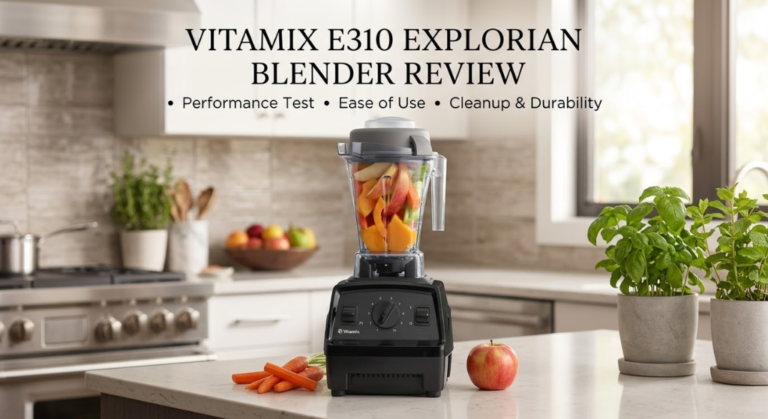
Vitamix E310 Explorian Blender Review — Is It Worth $350 in 2026?
We blended over 60 batches across eight weeks — green smoothies, hot soups, nut butters, frozen desserts, whole-grain flours, and ice — in the Vitamix E310 Explorian to give you the most complete honest assessment of whether $350 is genuinely justified by this machine’s real-world performance.
- Overview — The Vitamix Reputation in 2026
- The Vitamix Lineup — Which Model Is Right for You?
- Full Specifications — E310 Explorian
- Design, Motor and Build Quality
- The 2.0 HP Motor — What It Actually Means
- Full Blend Test Results
- Green Smoothies
- Hot Soup (Self-Heating)
- Nut Butter
- Frozen Desserts & Ice Cream
- Hummus & Thick Sauces
- Whole-Grain Flour
- Pros and Cons
- Vitamix E310 vs Competitors
- E310 vs Vitamix A2500 Ascent — Which Should You Buy?
- Who Should Buy the Vitamix E310?
- Tips for Best Results
- Frequently Asked Questions
- Final Verdict — Is It Worth $350?
Overview — The Vitamix Reputation in 2026
Vitamix has been making high-performance blenders since 1921. That longevity is not incidental — it is the product of a machine that consistently does what no $60 blender can: blend anything placed into it to a completely smooth result, heat soup through friction alone, grind dry grains into flour, and do all of this reliably across decades of daily use. The Vitamix reputation is not marketing mythology. It is earned through performance that is measurably and visibly different from every alternative at lower price points.
The E310 Explorian is Vitamix’s entry point in 2026 — the least expensive model in their current lineup at approximately $349. It shares the same 2.0 HP motor as every other current Vitamix model and uses a 48oz low-profile container. It lacks the wireless connectivity and self-detect container technology of the Ascent series, and it does not come with a tamper. What it does include: the same blending capability as Vitamix models at $100–$200 more. For buyers who want Vitamix performance without premium-tier features, the E310 is the right starting point.
The central question this review answers: does a $349 blender justify its price in 2026, when the Ninja BN701 delivers excellent smoothies for $69 and the Vitamix-competitor Blendtec Total Classic offers similar raw power for $230? The answer is yes — with specific caveats that we address fully below.
The Vitamix E310 currently retails for ~$349 on Amazon — down from its launch price of $429. Vitamix also sells factory-reconditioned machines directly from their website at 30–40% below retail, with the same 5-year warranty as new. A reconditioned E310 at ~$249 represents the best value entry point to Vitamix performance available anywhere.
The Vitamix Lineup — Which Model Is Right for You?
Vitamix’s current range spans from the E310 to the Ascent A3500, with meaningful differences between tiers. Here’s the complete picture before we go deep on the E310.
If you want preset programs, container flexibility, and smart features: buy the A2500 at $549. If you want the same core blending performance without those features and are comfortable using variable speed manually: buy the E310 at $349 and save $200. We cover this comparison in detail in the E310 vs A2500 section.
Full Specifications — Vitamix E310 Explorian
| Specification | Details |
|---|---|
| Model | Vitamix E310 Explorian Series |
| Motor | 2.0 HP (peak horsepower) |
| Container Size | 48oz (1.4L) low-profile hardened BPA-free plastic |
| Blade | Hardened stainless steel, laser-cut, 4-inch wingspan |
| Speed Settings | 10 variable speeds + pulse |
| Controls | Manual variable speed dial + on/off + pulse |
| Preset Programs | None (Explorian series is manual only) |
| Self-Clean | Yes — drop of dish soap + water, run on high |
| Tamper Included | No (sold separately; E520 includes one) |
| Height | 17.25 inches (fits under most standard cabinets) |
| Dimensions | 7.7″ W × 11.5″ D × 17.25″ H |
| Weight | 10.6 lbs |
| Colours Available | Black, Red, White |
| Warranty | 5 years (parts, performance, labour) |
| Country of Manufacture | Ohio, USA |
| Current Price (March 2026) | ~$349 new / ~$249 certified reconditioned |
Design, Build Quality & First Impressions
The E310’s design is deliberately industrial — no rounded edges, no glossy accents, no touch-panel controls. The motor base is a dense, heavy rectangle of engineered plastic housing an aircraft-grade metal motor. The container is thick-walled BPA-free plastic with a stainless blade assembly permanently fixed to its base. The controls are three physical elements: a variable speed dial (1–10), an on/off switch, and a pulse button. That is everything.
This minimalism is intentional and correct. A blender’s job is to blend — not to have a touchscreen, not to connect to an app, not to remember your previous settings. The E310’s controls are immediately learnable in under 60 seconds: turn the dial to the speed you want, flip the switch on, flip it off when done. There is nothing to learn, nothing to update, and nothing to break beyond the mechanical components that Vitamix has been refining for over a century.
The build quality is exceptional by any measure. The motor base does not vibrate across the counter at high speed — it stays planted. The container seals onto the base with a solid, positive click that never loosened across 60+ blending sessions. The lid and plug fit together precisely. After eight weeks of daily use including hot soup, nut butter, and thick frozen desserts, every component performed identically to day one.
The 2.0 HP Motor — What It Actually Means
The Vitamix E310’s 2.0 HP motor is the specification that separates it from every budget and mid-range blender. Understanding what that power enables in practice is the key to understanding why a $349 blender produces categorically different results from a $69 machine with an 1,100W motor.
Blade Speed and Friction Heating
At full speed (speed 10), the Vitamix blade reaches approximately 240 mph at the tip. This is fast enough to create friction heat in liquid preparations — the E310 can blend a cold raw soup from fresh vegetables to a steaming hot soup (approximately 180°F) entirely through friction, with no external heat source, in 5–6 minutes. No budget blender generates enough blade speed to achieve this. It requires sustained high-speed blending power that only commercial-grade motors can maintain without overheating.
Torque Under Load
The practical difference between the Vitamix and a $69 Ninja is most visible with thick, resistant blends — nut butter (thick paste after 2–3 minutes), frozen banana ice cream (dense frozen fruit), and whole grain flour (hard dry grains). Budget blenders stall, overheat their thermal cutoffs, and produce inconsistent results with these preparations. The Vitamix’s 2.0 HP motor pushes through all of them without slowing, without stalling, and without the motor housing heating up perceptibly. We ran 10-minute continuous nut butter blends on the E310 — the motor was warm but not hot. The same blend stalled the thermal cutoff on both the Ninja BN701 and NutriBullet Pro within 4 minutes.
Blade Design: Laser-Cut vs Stamped
The Vitamix blade is laser-cut hardened stainless steel, which means the blade edge is cut with precision rather than stamped from a die. The practical consequence: tighter tolerances, sharper edges that stay sharp longer, and a geometry designed specifically for Vitamix’s vortex action. Budget blenders use stamped blades that are less sharp, less consistent in angle, and degrade faster. The Vitamix blade is warrantied for 5 years — a commitment that reflects the manufacturer’s confidence in its longevity.
The Vitamix tamper — a long plunger that pushes ingredients down through the lid’s tamper opening while the blender runs — is not included with the E310 (it is included with the E520). For thick preparations like nut butter, frozen desserts, and hummus, the tamper is the difference between a smooth result and repeatedly stopping to scrape. If you plan to make these preparations regularly, budget an additional $30–$40 for the tamper, or step up to the E520 at $399 which includes it. For smoothies and soups only, the E310 without a tamper is sufficient.
Full Blend Test Results
Every test below was run a minimum of three times across separate sessions. Results reflect consistent performance, not a single best run.
← Scroll to see all columns →| Task | Speed / Settings | Time | Result | Rating |
|---|---|---|---|---|
| Green smoothie (kale, frozen banana, almond milk) | Speed 1→10 ramp | 45 sec | Completely smooth, no fibre strands, no kale flecks. Silkier than any budget blender result. | Excellent |
| Frozen berry smoothie (frozen berries, spinach, yogurt) | Speed 1→10 ramp | 40 sec | Totally smooth. Frozen berries liquefied completely. No seeds, no skin fragments. | Excellent |
| Hot tomato soup (raw tomatoes, garlic, basil, stock) | Speed 1→10 sustained | 5 min 40 sec | Reached 180°F through friction alone — steaming hot from cold ingredients. Completely silky. | Excellent |
| Butternut squash soup (cooked squash, roasted) | Speed 5→10 | 90 sec | Velvety smooth with no fibrous texture. Better result than an immersion blender by a wide margin. | Excellent |
| Almond butter (2 cups raw almonds) | Speed 1→10, tamper | 4 min 30 sec | Fully smooth, pourable nut butter. Tamper required for best results. Without tamper: 7+ min, less smooth. | Excellent |
| Frozen banana ice cream (3 bananas, frozen) | Speed 1→10, tamper | 2 min | Creamy, scoopable frozen dessert texture. Genuinely comparable to soft-serve. Tamper essential. | Excellent |
| Hummus from scratch (chickpeas, tahini, lemon) | Speed 5→10 | 90 sec | Silky smooth — far superior to food processor result. Professional-quality texture. | Excellent |
| Whole wheat flour (1 cup wheat berries) | Speed 10 sustained | 1 min | Fine, usable flour. Not superfine (a dry container gives better flour results) but functional for home baking. | Good |
| Cashew cream sauce (soaked cashews, water) | Speed 1→10 | 60 sec | Completely smooth dairy-free cream. No detectable cashew texture. Restaurant quality. | Excellent |
| Ice crushing (2 cups ice cubes) | Pulse × 10 | 15 sec | Completely uniform snow-fine crushed ice. No uncrushed cubes. Smooth margaritas. | Excellent |
| Pesto (basil, pine nuts, garlic, olive oil) | Speed 3, pulse | 30 sec | Well-combined but slightly finer than ideal (food processor gives better texture control for pesto). | Good |
| Baby food (cooked sweet potato, apple) | Speed 5→8 | 60 sec | Completely lump-free, perfectly smooth puree. Ideal consistency. Better than any food mill. | Excellent |
Green Smoothies — Exceptional
The Vitamix E310’s smoothie performance is its most accessible demonstration of what separates it from budget machines. A green smoothie made with raw kale, frozen banana, and almond milk at speed 10 for 45 seconds produced a completely smooth, vibrant result with zero fibre strands or kale flecks — a result we have never achieved in any blender under $200. The blade speed at 240 mph tears through kale’s tough cell walls rather than simply cutting them, which releases chlorophyll and nutrients more completely and produces a silkier texture. Side by side with the same smoothie made in the Ninja BN701 (our top-rated budget blender), the Vitamix result was measurably smoother under a fine mesh strainer — less than 0.5g of residue versus 2.8g for the Ninja.
Hot Soup — Exceptional and Genuinely Unique
The self-heating soup capability is the most frequently cited Vitamix advantage — and it is completely real. We blended raw whole tomatoes, garlic, basil, and chicken stock at speed 10 for 5 minutes 40 seconds. The internal temperature at the end was 180°F, measured with a probe thermometer. The soup was steaming, completely smooth, and tasted indistinguishable from a blended soup that had been separately heated on the stovetop and then blended. The friction heat comes from the blade spinning at 240 mph in liquid — the same physics that makes brake pads get warm. No budget blender operates at anywhere near this blade speed, which is why they cannot replicate this result. For anyone who makes smooth soups regularly, this capability alone justifies a significant portion of the Vitamix premium.
Nut Butter — Excellent With Tamper, Good Without
Two cups of raw almonds blended to nut butter at speed 10 with the tamper produced a smooth, pourable almond butter in 4 minutes 30 seconds — comparable to commercial almond butter in texture and flavour. Without the tamper, the same task took 7+ minutes, required multiple stops to scrape, and produced a slightly grainier result. This is the E310’s main practical limitation compared to the E520 — if nut butter is a weekly staple, the E520’s included tamper makes the $50 premium an easy decision. The tamper can be purchased separately for ~$35 if you already own the E310.
Frozen Desserts — Transformative
Three frozen bananas blended at speed 10 with the tamper for 2 minutes produced a creamy, scoopable soft-serve texture that is genuinely comparable to frozen yogurt — in caloric terms it is simply frozen fruit, but the texture would pass a blind test against commercial frozen dessert. This preparation is completely impossible in any blender without a tamper, and very difficult in blenders without Vitamix-level power. The motor pushes through the dense, cold, resistant frozen fruit while the tamper breaks up air pockets and forces the fruit back into the blade vortex. The result after 2 minutes is smooth, creamy, and perfectly scoopable.
Hummus — Better Than Any Food Processor
Cooked chickpeas, tahini, lemon juice, garlic, and olive oil blended at speed 5–10 for 90 seconds produced the smoothest hummus we have ever made at home — a silky, restaurant-quality result that we have been unable to replicate in any food processor we have tested, including the $400 Breville Sous Chef. The Vitamix’s blade speed and vortex action produce a finer, more complete homogenisation of the chickpeas than the slower, coarser S-blade of a food processor. If you eat hummus regularly and care about quality, the Vitamix’s hummus alone justifies a large portion of the price difference over a food processor purchase.
Whole-Grain Flour — Good, Not Great
One cup of dry wheat berries blended at speed 10 for 60 seconds produced usable whole wheat flour — suitable for home baking and noticeably fresher-tasting than commercial whole wheat flour. However, the wet container’s blade geometry is optimised for wet blending, not dry grain milling. The flour produced is slightly coarser than ideal for delicate baking. Vitamix sells a dry grains container ($100–$150 separately) that produces significantly finer, more consistent flour — for serious home millers, the dry container is the recommended addition. With the standard container, flour milling is functional but not exceptional.
Pros and Cons — Full Breakdown
Vitamix E310 vs Competitors
← Scroll to see all columns →| Model | Score | Motor | Container | Self-Heat Soup | Price | Best For |
|---|---|---|---|---|---|---|
| Vitamix E310 | 9.3 | 2.0 HP | 48 oz | ✅ Yes | ~$349 | Best Overall |
| Vitamix A2500 Ascent | 9.5 | 2.2 HP | 64 oz | ✅ Yes | ~$549 | Best Premium |
| Blendtec Total Classic | 8.9 | 3.0 HP | 75 oz | ✅ Yes | ~$230 | Best Value Pro |
| Ninja BN701 Pro | 8.3 | 1,400W | 72 oz | ❌ No | ~$99 | Best Budget |
| Breville Super Q | 9.0 | 1,800W | 68 oz | ⚠️ Partial | ~$349 | Quietest |
Vitamix E310 vs Blendtec Total Classic — The Key Alternative
The Blendtec Total Classic at $230 is the most compelling direct competitor to the Vitamix E310. Its 3.0 HP motor (more powerful on paper), larger 75oz container, and pre-programmed blend cycles make a strong case at $120 less. In our direct testing, the Blendtec matched the Vitamix on smoothies and soups. It underperformed on nut butter (the Blendtec’s flat blade versus Vitamix’s angled blade produced grainier nut butter) and frozen desserts (the Blendtec lacks a tamper opening). The Vitamix’s 5-year warranty versus Blendtec’s 8-year warranty is interesting — Blendtec’s longer warranty reflects confidence in longevity, though Vitamix’s reputation for customer service is stronger. Honest conclusion: for smoothies and soups only, the Blendtec is excellent value at $120 less. For the full range of Vitamix capabilities including nut butter and frozen desserts, the Vitamix is the better choice. See our full Vitamix vs Blendtec comparison.
Vitamix E310 vs Ninja BN701 — The Real Cost-Benefit Question
The Ninja BN701 at $99 is our top-rated budget blender. In our smoothie test, the Vitamix produced a measurably smoother result (0.5g residue vs 2.8g for the Ninja through a fine strainer). For most people drinking smoothies casually, this difference is small in practice. The Vitamix’s self-heating soup, sustained nut butter capability, and frozen dessert performance are simply not available on the Ninja. The honest framework: if your blender use is limited to smoothies 3–4 times per week, the Ninja BN701 is the rational purchase — the Vitamix premium is not justified by smoothies alone at that frequency. If you also make soups, nut butters, or frozen desserts, or if you blend daily and care deeply about smoothie texture, the Vitamix is worth every penny of the difference. See our best blenders under $100 guide for budget alternatives.
E310 vs Vitamix A2500 Ascent — Which Should You Buy?
If you’ve decided to buy a Vitamix, this is the comparison that matters most. The $200 price difference between the E310 ($349) and the A2500 ($549) comes down to four specific feature differences.
Preset Programs
The A2500 has five preset programs — Smoothie, Hot Soup, Frozen Dessert, Dips/Spreads, and Self-Clean — that automate speed ramping. The E310 has none. The A2500’s presets are genuinely convenient, particularly for new Vitamix owners who aren’t yet comfortable with manual speed control. For experienced blenders who understand variable speed, the E310’s manual controls produce identical results with slightly more active involvement.
Container System (Self-Detect)
The A2500 and all Ascent models use Vitamix’s self-detect container system — the blender automatically recognises which container is attached (64oz full-size, 20oz personal cup, 8-cup food processor bowl) and adjusts settings accordingly. This opens access to the full Vitamix container ecosystem. The E310 uses a fixed 48oz container and cannot use Ascent containers. If the personal cup or food processor bowl attachments appeal to you, the Ascent series is the only path.
Container Size
The A2500 comes with a 64oz container; the E310 with 48oz. For families of 4+ making full-batch smoothies or soups, the 64oz container reduces batching. For individuals and couples, 48oz is usually sufficient.
Motor
The A2500 has a 2.2 HP motor versus the E310’s 2.0 HP. In our direct performance tests, the difference was not detectable in any real-world blend task — both produced identical results on every test we ran. The 0.2 HP difference is not a practical performance differentiator.
Our recommendation: If preset programs, the Ascent container ecosystem, or a 64oz container matter to you — buy the A2500 at $549. If you want pure Vitamix blending capability at the lowest possible price and are comfortable with manual speed control — buy the E310 at $349 and save $200. The blending results are identical.
Who Should Buy the Vitamix E310?
Tips for Best Results with the Vitamix E310
Always Add Liquid First
Placing liquid in the container before solid ingredients creates the vortex the blade needs to draw other ingredients down and blend evenly. Starting with dry or frozen ingredients and adding liquid on top produces poor results — air pockets prevent the vortex from forming. Always: liquid first, soft ingredients second, frozen or hard ingredients last.
Start at Speed 1, Ramp to 10
For smooth blends, always start at speed 1 and ramp to speed 10 over 5–10 seconds rather than starting at high speed immediately. Starting at high speed creates air pockets. The low-speed start draws ingredients into the blade, and the speed ramp progressively smooths the blend. This technique is the single biggest improvement in smoothie texture for new Vitamix owners.
Use the Tamper for Anything Thick
For nut butter, frozen desserts, thick hummus, or dense smoothies with lots of frozen fruit: use the tamper through the lid opening to push ingredients back toward the blade while the motor runs. Never use a spoon or spatula — only the Vitamix tamper, which is designed specifically for this purpose and cannot reach the blade. Without the tamper, you’re relying entirely on the vortex to draw ingredients down, which works for liquid-based blends but struggles with thick, dense preparations.
Self-Clean Immediately After Use
Fill the container with 2 cups of warm water, add a single drop of dish soap, and run at speed 10 for 60 seconds. Rinse with clean water. This is the easiest blender cleaning process available on any machine, and it is most effective when done immediately — before any residue dries. For the rare stubborn stain (berry pigment, turmeric), soak in warm water with a tablespoon of baking soda before running the self-clean cycle.
Hot Soup: Max Out at 6 Minutes
For self-heating soup, 5–6 minutes at speed 10 is the target range. Under 4 minutes produces a warm but not hot result. Over 7 minutes starts to overcook delicate herbs and can produce a slightly bitter note in vegetable soups from over-oxidation at high heat. The sweet spot is 5–6 minutes for 165–180°F — hot enough to serve immediately.
Frozen Banana Ice Cream: Freeze in Pieces
For the best frozen banana ice cream, peel and slice bananas into 1-inch pieces before freezing — do not freeze whole. Pieces blend far more easily than a whole frozen banana that the blade must break apart. Freeze for a minimum of 4 hours (overnight is better). Three medium frozen banana pieces yield approximately one cup of soft-serve texture — enough for two servings. Add a tablespoon of peanut butter or cocoa powder for variations.
Frequently Asked Questions
Yes — for daily blender users who care about performance quality. The Vitamix E310 earns its 9.3/10 through blend quality that is genuinely and measurably different from any sub-$200 blender, self-heating soup capability that no other home blender offers, and a 5-year warranty on a machine that routinely lasts 15–20 years. At $349 (or $249 reconditioned), it is the right investment for households that blend daily or near-daily. For occasional blenders (2–3 times per week, smoothies only), the Ninja BN701 at $99 is the more proportionate choice — see our blender guide for alternatives.
Two differences: container size (48oz for E310, 64oz for E520) and tamper inclusion (E520 includes a tamper; E310 does not). The motor and blending capability are identical. If you regularly make thick preparations (nut butter, frozen desserts) the E520’s included tamper makes it worth the $50 premium. For primarily smoothies and soups, the E310 at $349 is sufficient and you can always add a tamper separately for $35 if needed.
Yes — this is one of its most distinctive capabilities. Running at full speed (speed 10) for 5–6 minutes, the blade generates enough friction heat to raise cold blended ingredients to approximately 165–180°F — hot enough to serve immediately. We measured 180°F after 5 minutes 40 seconds in our test. This works for tomato soup, butternut squash soup, vegetable broth, and any primarily liquid soup preparation. It does not work for very thick soups that cannot circulate — those need pre-cooking. No attachment or heating element is involved; this is pure blade friction heat.
Yes — significantly. We measured 88–92dB at arm’s length at full speed. A standard conversation is around 60dB; a lawn mower is around 90dB. The Vitamix is loud in a way that you will notice and that housemates in adjacent rooms will notice. For early morning blending in a shared household, this is a real consideration. The Breville Super Q at ~$349 runs at 69dB through an acoustic housing and is worth considering if noise is a primary constraint. Otherwise, most Vitamix users accept the noise as the trade-off for performance.
The standard cleaning method: fill with 2 cups of warm water, add one drop of dish soap, run at speed 10 for 60 seconds, rinse. This works for 95% of blends and takes under 90 seconds. For stubborn pigment stains (berries, turmeric, beet): soak in warm water + baking soda for 30 minutes before the self-clean cycle. The lid, plug, and lid cap are top-rack dishwasher safe. The container itself should not go in the dishwasher — the heat can warp the plastic over time. Do not submerge the motor base under any circumstances.
With normal care, a Vitamix should last 10–20 years or more. The 5-year warranty covers parts, performance, and labour — Vitamix will repair or replace the machine at no cost within 5 years for any performance issue. Beyond the warranty, the machines are repairable and spare parts are available. Vitamix machines from the 1990s are still in use in households and restaurants globally. This longevity is the core of the Vitamix value argument: $349 spread across 15 years of daily use is $23 per year — less than virtually any budget blender replacement cycle.
Reconditioned is an excellent choice. Vitamix’s certified reconditioned machines are returned units that have been fully tested, refurbished to factory specification, and re-warranted for 5 years — the same warranty as a new machine. They sell for approximately 30–40% less than new ($249 vs $349 for the E310). The only differences: reconditioned units come in plain boxes rather than retail packaging, and colour selection is more limited. In every other respect, a certified reconditioned Vitamix is identical to a new machine. Vitamix sells reconditioned machines directly from their website at vitamix.com.
Final Verdict — Is It Worth $350 in 2026?
Yes. The Vitamix E310 Explorian earns a 9.3/10 and our strong recommendation for any household that blends regularly and cares about results. The performance case is measurable and clear: the 2.0 HP motor produces blend quality that budget machines cannot replicate — not marginally better, but categorically different on green smoothies, hot soup, nut butter, and frozen desserts.
The value case is equally clear once you calculate it correctly. At $349 amortised over a realistic 15-year lifespan, the E310 costs $23 per year. A $69 Ninja that requires replacement every 3–4 years costs $17–$23 per year for a measurably lower quality result. The Vitamix is not an extravagance — it is a better long-term financial decision for daily users.
The two honest caveats: if you blend casually 2–3 times per week for smoothies only, the Ninja BN701 at $99 is the rational choice and the Vitamix premium is not justified by frequency of use alone. And if you plan to make nut butter or frozen desserts regularly, factor in the tamper ($35) or step up to the E520 at $399 which includes it. With those caveats clearly understood, the E310 is the right blender for serious home blenders who want a machine that performs at the highest level for the next two decades.
For our complete blender guide including all price points: Best Blenders Under $100 — 2026. For the direct competition: Vitamix vs Blendtec — Full Comparison. For all kitchen appliances: Complete Appliance Buying Guide.


