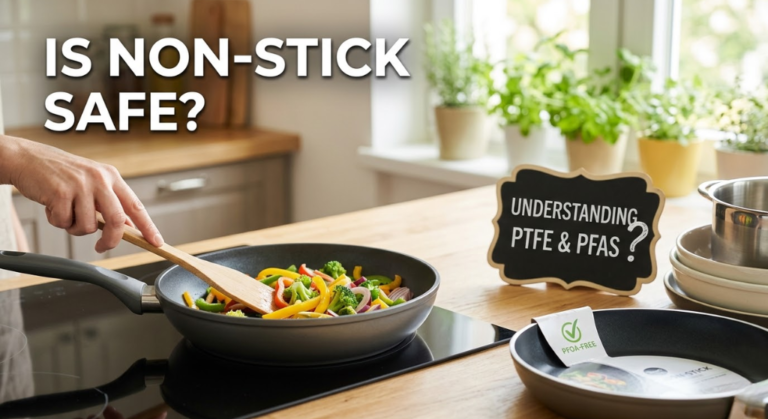
Is Non-Stick Cookware Safe? The Complete, Evidence-Based Answer
📋 What’s Covered
- What Non-Stick Coating Is
- PFOA — The Chemical That Was Banned
- PTFE Today — Is It Safe?
- PFAS — The Broader Family
- Overheating — The Real Risk
- Damaged Coatings — What Actually Happens
- Ceramic Non-Stick — Is It Better?
- All Non-Stick Coating Types Rated
- How to Use Non-Stick Safely
- When to Replace Your Pan
- Alternatives to Non-Stick
- Pet Bird Warning
- What to Look for When Buying
- FAQs
Non-stick cookware is the most widely used type in home kitchens worldwide — and also the most misunderstood from a safety perspective. The concerns are real but often misattributed to the wrong chemicals, overstated in ways that cause unnecessary anxiety, and in some cases genuinely important but under-communicated. This guide separates what the science actually says from what the internet amplifies.
What Non-Stick Coating Actually Is
PTFE — Polytetrafluoroethylene
The original and most common non-stick coating is PTFE — polytetrafluoroethylene — marketed by DuPont under the trade name Teflon from 1946 onwards. PTFE is a fluoropolymer: a plastic in which fluorine atoms are bonded to a carbon chain. The carbon-fluorine bond is one of the strongest in organic chemistry — which is why PTFE is extraordinarily chemically inert. It does not react with food, acids, bases, or most solvents at cooking temperatures. In its solid, intact state, PTFE is biologically inert and is even used in medical implants including cardiovascular grafts and surgical meshes.
PTFE’s non-stick properties come from its extremely low surface energy — the lowest of any solid material. Food simply cannot form strong adhesive bonds with the surface, which is why eggs slide off with minimal force.
How It Gets on the Pan
PTFE coating is applied to aluminium or stainless steel pans as a liquid suspension, then cured in a high-temperature oven (typically 750–900°F) that causes it to bond to the metal substrate and form a solid, polymerised coating. Quality cookware uses multiple layers — typically a primer, one or two mid-coats, and a topcoat — each separately cured. The number of layers directly affects durability: a 3-layer system lasts noticeably longer than a single-layer budget coating.
PFOA — The Chemical That Was Banned (and Is Now Gone)
Understanding the PFOA history is essential to understanding why older non-stick safety concerns were valid, and why the current situation is different.
What PFOA Was
PFOA (perfluorooctanoic acid) was a processing aid used during the manufacture of PTFE — not an ingredient in the finished coating, but a chemical used in the production process that could remain as a trace contaminant in the final product. PFOA is a member of the PFAS family (per- and polyfluoroalkyl substances) and is classified as a likely human carcinogen based on animal studies and epidemiological evidence from communities near PTFE manufacturing facilities.
Why It Was a Problem
PFOA is persistent in the environment and in human bodies — it does not break down and accumulates in tissue over time. Elevated rates of kidney cancer, testicular cancer, and thyroid disease were documented in communities in Parkersburg, West Virginia, near a DuPont PTFE manufacturing facility that had contaminated local water supplies with PFOA. These harms were real and serious — and were caused by industrial-scale PFOA exposure, not by cooking with PTFE-coated pans.
The Phase-Out and Elimination
The US EPA’s PFOA Stewardship Program required all major manufacturers to eliminate PFOA from their products and manufacturing processes by 2015. In practice, the transition was largely complete by 2013. As of 2016, PFOA is banned from manufacture and import in the United States and European Union. All PTFE non-stick cookware sold in the US, EU, UK, Australia, and most other major markets has been manufactured without PFOA since at least 2015.
PTFE Today — Is It Safe?
With PFOA removed from the manufacturing process, the safety question about modern PTFE cookware comes down to the PTFE polymer itself — and the answer, with one important caveat, is yes.
At Normal Cooking Temperatures
PTFE is stable and inert below 500°F (260°C). Normal cooking temperatures fall well within this range:
- Sautéing vegetables: 325–375°F (163–190°C)
- Frying eggs: 250–325°F (121–163°C)
- Searing chicken: 375–425°F (190–218°C)
- Pan frying at medium-high: 375–425°F (190–218°C)
All of these fall below 500°F. An empty, oil-free pan preheated on a gas burner at maximum heat for 2–5 minutes can reach 500°F — which is why the empty pan rule exists (discussed in the overheating section below).
Regulatory Status
PTFE is approved for food contact by the US FDA, the European Food Safety Authority (EFSA), and food safety authorities in the UK, Australia, Canada, and Japan. It has been in continuous food-contact use since the 1960s without documented health harms from the PTFE polymer itself under normal cooking conditions.
PFAS — The Broader Concern
PFAS (per- and polyfluoroalkyl substances) is a family of over 9,000 synthetic chemicals, of which PTFE and PFOA are both members. Not all PFAS are equally hazardous, but the family as a whole has attracted increasing regulatory scrutiny due to the persistence and bioaccumulation of many members.
What PFAS Means for Non-Stick Cookware
When manufacturers eliminated PFOA from PTFE production, some switched to alternative processing aids that are also members of the PFAS family — shorter-chain PFAS compounds like GenX (HFPO-DA) and PFBS. These shorter-chain alternatives were initially assumed to be safer than PFOA due to their lower persistence in the environment. More recent research suggests some shorter-chain PFAS also have biological effects, though generally considered less harmful than PFOA.
The European Chemicals Agency (ECHA) has been working toward broader restrictions on PFAS use across industries. Several EU member states submitted a joint restriction proposal in 2023 covering a wide range of PFAS applications. For cookware specifically, the regulatory trajectory is toward increasing restriction of fluoropolymer-based coatings — though no complete ban on PTFE cookware is in force in any major market as of early 2026.
What This Means Practically
The PFAS concern is a legitimate regulatory and environmental issue — particularly regarding industrial PFAS contamination of water supplies. For the home cook, the practical implication is that the longer-term regulatory environment may continue to shift away from fluoropolymer coatings, and that choosing PFAS-free alternatives (ceramic, cast iron, stainless steel) is a reasonable precautionary choice for those who want to reduce all PFAS exposure, even at the low levels associated with normal cooking.
Overheating — The Real, Specific Risk
This is the one genuine safety risk associated with PTFE cookware — and it is real, specific, and entirely avoidable.
What Happens When PTFE Overheats
Above 500°F (260°C), PTFE begins to decompose, releasing fluoropolymer fumes. The decomposition products at temperatures between 500–570°F include small amounts of gaseous PTFE particles and, at higher temperatures, more toxic fluorocarbon gases. Above 570°F (299°C), the decomposition accelerates and releases compounds including carbonyl fluoride and perfluoroisobutylene that are genuinely hazardous at sufficient concentrations.
In Practice: How Hot Does a Pan Actually Get?
The Practical Rule
Never preheat an empty non-stick pan on high heat. Never leave a non-stick pan on a burner unattended. Keep cooking temperature at medium or medium-high for most tasks — PTFE performs best at lower temperatures anyway, where its non-stick properties are most reliable. High-heat searing and charring are tasks better performed in cast iron or stainless steel, which have no temperature ceiling concern.
Damaged Coatings — What Actually Happens When You Eat Flakes
The question of flaking and scratched PTFE coating is one of the most common non-stick safety concerns — and the answer is more reassuring than most people expect.
What Happens If PTFE Flakes Into Food
PTFE in its solid state is chemically inert and is not absorbed by the gastrointestinal tract. Studies conducted specifically on ingested PTFE particles confirm that they pass through the digestive system without being absorbed — PTFE has no biological activity in the gut. The FDA has cleared PTFE for food contact on this basis.
This does not mean a heavily scratched, flaking pan should continue to be used — it should be replaced — but the reason to replace it is primarily because flaking coating reduces non-stick performance and exposes the aluminium substrate beneath, not because ingesting PTFE particles causes documented harm.
The Aluminium Exposure Concern
When PTFE coating is damaged down to the aluminium pan body, acidic foods (tomatoes, citrus, wine) can react with the exposed aluminium surface and leach aluminium into food. Aluminium leaching from damaged cookware is a more substantive concern than PTFE ingestion, particularly for individuals with kidney disease who have reduced aluminium clearance. This is the primary reason to replace damaged pans promptly — not PTFE ingestion.
Ceramic Non-Stick — Is It Actually Safer?
Ceramic non-stick cookware has been marketed heavily as a “PTFE-free” and “PFAS-free” safer alternative to traditional Teflon. The reality is more nuanced.
What Ceramic Coating Is
Despite the name, ceramic non-stick cookware is not made of ceramic in the traditional sense. The coating is a sol-gel (silica-based) coating applied to metal and cured to create a hard, smooth, non-reactive surface. It contains no PTFE and no fluoropolymers — making it genuinely PFAS-free in the coating itself.
The Performance Trade-Off
Ceramic coatings are less non-stick than PTFE at equivalent thicknesses, and they degrade significantly faster. The typical PTFE non-stick pan maintains good non-stick performance for 2–5 years with proper care. Ceramic non-stick pans typically show significant non-stick performance degradation within 1–2 years of regular use. The coating is harder than PTFE (more scratch-resistant) but more brittle — microfractures develop with thermal cycling, and the non-stick properties deteriorate from these microscopic surface changes rather than visible peeling.
Are Ceramic Pans Actually PFAS-Free?
The coating itself is PFAS-free, but independent testing has found PFAS compounds in some ceramic-coated cookware — likely from the manufacturing process or from PFAS-containing materials used in other pan components. A 2020 study in Environmental Science & Technology found detectable levels of fluorine (a PFAS marker) in several ceramic non-stick pans marketed as PFAS-free. This does not mean ceramic cookware is equivalent in PFAS content to PTFE cookware — it is not — but it does complicate the “completely PFAS-free” marketing claim.
Safety Assessment
Ceramic non-stick is safe by current evidence. It does not carry the overheating concerns of PTFE (the coating does not release hazardous fumes at overheating temperatures — it simply degrades in performance). It is genuinely free of PTFE. For buyers who want to avoid all PTFE exposure, ceramic is a reasonable alternative — with the caveat that it requires more frequent replacement.
All Non-Stick Coating Types — Safety Ratings
How to Use Non-Stick Cookware Safely
Following these rules eliminates the genuine risks associated with PTFE non-stick and extends the life of the pan significantly.
When to Replace Your Non-Stick Pan
Non-stick pans are consumables — they have a finite lifespan and should be replaced when they reach end-of-life, regardless of how well they look from the outside.
Expected Lifespan by Quality Tier
Alternatives to Non-Stick
If you want to avoid PTFE entirely, the two permanent, non-coating alternatives produce excellent results for different tasks — and both improve rather than degrade over time.
Seasoned Cast Iron
A well-seasoned cast iron skillet achieves genuine non-stick performance for eggs, fish, and pancakes through layers of polymerised oil baked into the iron surface. No synthetic chemicals, no coating to degrade, no temperature ceiling, no replacement schedule. The investment is time spent building seasoning through regular use — typically 6–12 months of weekly cooking to develop a reliably non-stick surface. Cast iron’s weight (5–8 lbs per skillet) is the primary practical limitation. See our Cast Iron vs Stainless Steel guide for full comparison.
Stainless Steel with Proper Technique
Stainless steel does not have non-stick properties in the traditional sense — food can and does stick if technique is wrong. But with the Leidenfrost preheating method (preheat the dry pan until a drop of water beads and skitters, then add oil), stainless steel handles eggs, fish, and chicken with minimal sticking. The technique requires 2–3 minutes of preheating and some practice, but the result is a pan with no coating, no temperature limitation, no replacement schedule, and dishwasher compatibility.
Enamelled Cast Iron
The enamel on Le Creuset and Staub Dutch ovens and skillets is a glass-like coating fired at very high temperatures — it is non-reactive with all foods (including acidic tomatoes and wines that bare cast iron cannot handle), requires no seasoning, and has no synthetic chemical concerns. The only practical limitation is cost — enamelled cast iron is significantly more expensive than PTFE alternatives.
Pet Bird Warning — Critically Important
This warning applies to all PTFE-containing cookware — including GreenPan, Tefal, and any pan marketed as “PTFE-coated” or “Teflon-coated” regardless of brand or PFOA status. The polymer fume fever risk does not require PFOA — it is intrinsic to PTFE decomposition. It also applies to self-cleaning oven cycles, which reach temperatures sufficient to decompose PTFE on any pans left inside the oven during cleaning.
What to Look for When Buying Non-Stick Cookware
The PFAS Landscape in 2026 — What the Latest Science Says
The regulatory and scientific conversation around PFAS has moved faster in the last three years than in the preceding decade. Understanding the current state of knowledge helps you make better-informed decisions than either the “Teflon is poison” camp or the “it’s completely fine” camp.
What PFAS Research Has Established
The strongest PFAS evidence relates to long-chain PFAS compounds — particularly PFOA (8-carbon chain) and PFOS (8-carbon sulfonyl). These have been extensively studied and are associated with: increased risk of kidney and testicular cancer, thyroid disease, immune system effects (reduced vaccine response in children), elevated cholesterol, and pregnancy complications at sufficient exposure levels. The evidence base for these specific compounds is substantial and the regulatory response (banning both in major markets) reflects it.
For shorter-chain PFAS that replaced PFOA in manufacturing, the evidence is less complete but not reassuring. GenX and PFBS, the most common PTFE processing replacements, show fewer bioaccumulation concerns than PFOA but have documented biological effects in animal studies. Research published in peer-reviewed journals between 2022 and 2025 has continued to find associations between shorter-chain PFAS exposure and health endpoints, though at levels typically associated with industrial contamination rather than cookware use.
The Exposure Pathway Question
A critical nuance often missing from non-stick safety discussions: the primary route of PFAS exposure for most people is not cookware — it is drinking water, food packaging, stain-resistant textiles, and contaminated soil near industrial sites. The EPA’s ongoing PFAS maximum contaminant levels (MCL) rulemaking for drinking water treats PFAS-contaminated water supplies as a serious public health issue affecting millions of Americans.
The relative contribution of PTFE cookware to total PFAS body burden is debated among researchers. Studies measuring PTFE release from cookware into food have found levels at or below detection limits under normal cooking conditions, suggesting that intact PTFE pans used at correct temperatures do not represent a meaningful PFAS exposure route compared to environmental sources.
The Precautionary Principle
For buyers who prefer a precautionary approach — reducing all PFAS exposure regardless of whether the specific pathway is confirmed as harmful — the logical cookware choice is stainless steel, seasoned cast iron, or enamelled cast iron. These alternatives have no PFAS in any component, perform excellently for most cooking tasks, and have century-long safety records. The trade-off is the absence of the frictionless non-stick surface that PTFE provides — a genuine practical consideration for eggs and delicate fish.
Non-Stick Brand Guide — What the Labels Mean
Non-stick cookware is sold under dozens of brand names and coating trade names. Here is what the most common marketing claims actually mean.
The Chemistry of Non-Stick Cooking — Why Low Heat Works Better
One of the most counterintuitive facts about non-stick cookware is that it performs better at lower temperatures — and understanding why helps explain both the safety guidelines and the cooking technique recommendations.
Why Non-Stick Is a Low-Heat Tool
PTFE’s non-stick properties come from its extremely low surface energy — it simply doesn’t attract other molecules strongly. But this surface energy relationship is most effective at lower temperatures. At high heat, the rapid kinetic energy of food molecules means more forceful contact with the pan surface, which can partly overcome PTFE’s low adhesion properties. The practical result: eggs slide perfectly in a PTFE pan at medium-low heat; they may stick at high heat.
This means the safety recommendation (medium heat maximum) and the performance recommendation (medium heat maximum) align completely. High-heat cooking tasks — searing steak, developing deep caramelisation, charring vegetables — are not only risky for PTFE from a safety perspective, they also produce inferior results in a non-stick pan compared to cast iron or stainless steel. The non-stick pan is not the right tool for high-heat tasks regardless of safety considerations.
What Non-Stick Excels At
The non-stick pan’s genuine domain is the category of foods that release easily at lower temperatures and where the non-stick surface provides a genuine advantage:
- Eggs — fried, scrambled, omelettes. The definitive non-stick use case.
- Delicate fish — thin fillets that would break apart when sticking to stainless or cast iron
- Pancakes and crepes — require even heat and easy release
- Sticky sauces and glazed proteins — honey-glazed chicken, teriyaki salmon
- Reheating — food that would require significant oil to prevent sticking in stainless
For all of these tasks, medium or medium-low heat is sufficient and preferable. A good non-stick pan kept at medium heat, used only for these specific tasks, will last significantly longer and never approach temperatures where PTFE decomposition is a concern.
Independent Lab Testing — What Third-Party Research Finds
Several independent organisations have tested non-stick cookware for PFAS release and safety. Their findings provide useful context beyond manufacturer claims.
Key Findings from Independent Testing
A 2021 study published in the journal Environmental Science and Technology tested 29 non-stick pans from major brands for PFAS content and release. Key findings: most modern pans labelled PFOA-free contained no detectable PFOA; however, several ceramic-labelled “PFAS-free” pans tested positive for fluorine compounds; and PTFE-based pans released no detectable PFAS into food under normal cooking conditions but showed measurable PTFE particle release when the coating was scratched before testing.
The Silent Spring Institute, a US non-profit research organisation focused on chemicals and health, has published extensive testing on PFAS in consumer products. Their cookware testing found that intact PTFE pans used at correct temperatures release negligible PFAS into food, while damaged pans release more — reinforcing the “replace damaged pans” guidance on grounds beyond just performance.
Consumer Reports has tested non-stick cookware periodically and generally confirms the PTFE safety profile: intact pans at normal temperatures are safe; the main risks are overheating empty pans and continuing to use heavily damaged coating.
What the Research Doesn’t Settle
The long-term cumulative effect of very low-level PFAS exposure from intact PTFE cookware over decades of daily use has not been comprehensively studied. Given the 60-year history of PTFE cookware use without documented population-level health harms attributable to cooking (as opposed to industrial PFOA exposure), the evidence suggests this cumulative exposure is not a major health driver — but the data is observational rather than controlled. For the risk-averse, this uncertainty is a reason to prefer PFAS-free alternatives regardless of the current evidence suggesting safety.
Frequently Asked Questions
Caring for Non-Stick to Maximise Safety and Lifespan
The vast majority of non-stick safety incidents and premature pan failures share a common cause: incorrect care. These specific habits extend the lifespan of any non-stick pan by years and keep it within safe operating parameters throughout its life.
The First Cook — Seasoning a New Non-Stick Pan
Many non-stick pan manufacturers recommend “seasoning” a new pan before its first use — not in the cast iron sense, but a simple conditioning step. Wash the pan with warm soapy water and dry completely. Rub a very thin coat of vegetable or sunflower oil into the cooking surface with a paper towel, then heat the pan over medium-low heat for 2–3 minutes. Remove from heat and allow to cool. Wipe away the oil residue. This step fills microscopic surface irregularities in the coating and improves initial non-stick performance. Skip this with ceramic coatings, which do not benefit from it.
Cooling Before Cleaning
Always allow a non-stick pan to cool to near room temperature before washing. Hot pans plunged into cold water or placed immediately in cold water in the sink undergo thermal shock — rapid, uneven contraction of the metal substrate causes micro-stresses at the coating-to-metal bond interface. Repeated thermal shock is one of the primary causes of premature coating delamination, particularly at the pan’s edges where the coating is thinnest. Two to three minutes of resting on a trivet or rack before washing is sufficient.
The Stuck Food Protocol
When food sticks to a non-stick pan — which happens to every pan eventually — the correct response is never to scrub. Instead: add hot water to the pan while it is still warm (not boiling hot), let it soak for 5–10 minutes, and the stuck residue will lift with a soft sponge or silicone spatula. For more stubborn residue, add water and a drop of dish soap and bring to a gentle simmer on the stovetop for 2 minutes — this loosens carbonised food without any abrasive contact with the coating surface.
Storage
Scratches from storage are underestimated as a cause of coating damage. When pans are stacked without protection, the bottom of the upper pan acts as an abrasive against the cooking surface of the lower pan every time it is moved. Use a felt pan protector, a folded cloth, or even a paper plate between stacked non-stick pans. For hanging storage, ensure pans are not resting against each other at the cooking surface. This takes zero additional time once the habit is established and preserves the coating surface from the type of cumulative scratching that most people never attribute to storage.
The Oil Type That Damages Coating
Aerosol cooking sprays deserve a specific mention because they are so commonly used with non-stick pans and so reliably damaging to them. Cooking sprays contain lecithin (an emulsifier), various propellants, and anti-foaming agents in addition to the oil itself. These additives polymerise onto the PTFE surface at cooking temperatures and build up as a sticky residue that is difficult to remove without abrasive cleaning — which then damages the coating. The result over dozens of uses is a coating that appears intact but is non-stick in name only. Use a refillable oil mister with pure oil instead, or add oil directly to the food rather than the pan. The aerosol spray problem is one of the most easily fixed non-stick care mistakes and one of the most consistently overlooked — switching to a refillable oil mister is the single highest-return cookware care change available to most home cooks who currently use spray cans regularly.
The High-Heat Foods That Belong in Different Pans
Knowing which foods should never be cooked in a non-stick pan — not for safety reasons alone but because the results are simply worse — prevents the accidental overheating that is the only serious risk of PTFE cookware. Steak searing, deep browning of onions or garlic until dark caramel, charring vegetables for maximum caramelisation, and anything requiring more than medium-high heat should always be done in cast iron or stainless steel. These are not just safety guidelines — they are cooking quality guidelines. Cast iron produces a steak crust that non-stick physically cannot achieve, and stainless steel creates the fond that forms the basis of every good pan sauce. Assigning these tasks to the correct pan improves both food quality and non-stick safety simultaneously, making the choice a straightforward one rather than a safety compromise. Matching the right pan to each task is the foundation of both good cooking and responsible cookware use. Every cooking vessel works best within its design parameters, and non-stick is no exception to that principle.
Related Guides
The two permanent non-toxic cookware materials — compared in full.
Complete your kitchen — the only three knives you actually need.
35 techniques every air fryer owner should know.
Top-rated air fryers of 2026 — tested and ranked.


