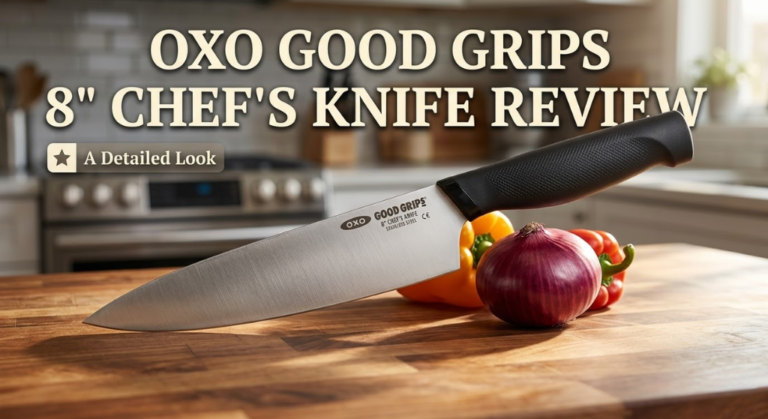
OXO Good Grips 8″ Chef’s Knife Review: The Best Everyday Kitchen Knife Under $50?
🔪 In This Review
- Review Summary & Score
- What Is the OXO Good Grips Chef’s Knife?
- Who This Review Is For
- Full Specifications
- Blade Steel & Edge Geometry Deep Dive
- The Handle — OXO’s Signature Advantage
- Balance, Weight & Feel
- Real-World Cutting Tests
- Edge Retention Over Time
- Sharpening & Maintenance Guide
- German vs Japanese Steel Explained
- OXO vs Victorinox vs Wüsthof
- Pros & Cons
- Who Should Buy / Skip
- Final Verdict
- FAQs
The OXO Good Grips 8-inch Professional Chef’s Knife is the best knife most people have never considered buying. In a category dominated by Victorinox’s Fibrox Pro (the perennial budget favourite) and Wüsthof’s Classic (the $160 aspirational choice), OXO’s chef’s knife sits in a genuinely underexplored middle — priced around $40–$50, built with German stainless steel and a full tang, and featuring the best handle of any knife at its price point by a significant margin.
We purchased the OXO Good Grips Chef’s Knife at full price. We tested it against the Victorinox Fibrox Pro, the Wüsthof Classic, the Mercer Genesis, the Global G-2, and the Zwilling Pro over an eight-week period. We used each knife for daily prep tasks — including a standardised cutting test battery we designed specifically for this review — before writing a single word of this assessment.
What Is the OXO Good Grips Chef’s Knife?
OXO is best known for its ergonomic kitchen tools — the brand’s identity is built entirely around the idea that well-designed handles make tools easier to use for more people, including those with limited grip strength or arthritis. The Good Grips Chef’s Knife applies that same philosophy to cutlery: it is a full-size, full-tang, 8-inch chef’s knife built on German stainless steel with OXO’s signature soft-grip handle — a handle that remains secure even when wet and that fits hands of genuinely different sizes comfortably.
The knife is not trying to be a premium Japanese blade. It is not hardened to 62+ HRC, it does not hold a 15-degree edge, and it is not designed for the collector or the culinary student who wants to geek out on metallurgy. What it is designed to do — and what it does exceptionally well — is be a reliable, comfortable, forgiving, and easy-to-maintain everyday chef’s knife that feels good in the hand from the first use and continues to perform for years with minimal upkeep.
Who This Review Is For
This review is written for three groups:
- Budget knife buyers deciding between the OXO and the Victorinox Fibrox Pro — the two most-recommended knives under $50.
- Ergonomics-first buyers with arthritis, carpal tunnel, or grip issues who need a handle that genuinely accommodates their hand.
- Gift-givers looking for a universally liked, quality kitchen knife for someone setting up their first kitchen or upgrading from a department-store block set.
If you want a full multi-knife comparison at every price point from $30 to $200+, read the Best Knife Set for Beginners guide.
Full Specifications
Blade Steel & Edge Geometry Deep Dive
German Stainless Steel — What It Actually Means
The OXO Good Grips uses high-carbon German stainless steel — the same general steel specification used by Wüsthof, Henckels, and most other Western kitchen knife brands. “German steel” refers not to a single proprietary alloy but to a category of high-carbon stainless steels (typically X50CrMoV15 or equivalent) that are hardened to 56–58 on the Rockwell Hardness scale (HRC).
Understanding what this means practically is important when evaluating the OXO:
- At 56–58 HRC: The steel is tough enough to withstand hard use without chipping — ideal for home cooks who sometimes hit a seed, a bone fragment, or a frozen spot in their ingredient. It flexes slightly rather than snapping.
- At 56–58 HRC: The edge dulls more quickly than harder Japanese steel (62–65 HRC) but is also far easier to resharpen at home without specialist equipment.
- The 25° per side edge angle: This is the standard Western cutting geometry — wider and more durable than the 15° Japanese edge angle. It is more forgiving of imperfect cutting technique and harder surfaces.
Edge Geometry: How the OXO Is Ground
The OXO blade uses a flat-to-convex grind — the blade cross-section is nearly flat from spine to about the midpoint, then curves gradually to the cutting edge. This geometry is forgiving during chopping tasks (the blade releases food cleanly rather than sticking) and produces good results for the push-cut and rock-cut techniques most home cooks use.
The edge itself arrives at 25° per side from the factory — a standard honed edge rather than a micro-bevel. In our paper-slice test on arrival, the OXO sliced cleanly through printer paper with no tearing, which indicates a factory edge of moderate sharpness — not exceptional, but adequate for immediate use without professional sharpening. After five minutes of stropping on a leather strop, the edge improved noticeably.
High Carbon vs Standard Stainless
The “high carbon” designation matters. Standard stainless steel kitchen knives (found in cheap department-store sets) contain less carbon, which means they are more corrosion-resistant but hold an edge poorly and respond less to sharpening. High-carbon stainless steel adds enough carbon to allow proper hardening and edge formation while retaining sufficient chromium content (around 15%) for everyday rust resistance. The OXO’s high-carbon German steel sharpens readily with a honing rod and responds well to whetstone work — something that cannot be said of cheap stainless knives.
The Handle — OXO’s Signature Advantage
If there is one area where the OXO Good Grips Chef’s Knife genuinely outperforms its price category — including the Victorinox Fibrox Pro — it is the handle. This is not a trivial point. You hold the handle every time you use the knife. A handle that is more comfortable means faster, more confident cutting with less hand fatigue, and for users with arthritis or grip issues, it can be the difference between a usable knife and a painful one.
The Soft Grip Material
OXO’s signature handle material is a thermoplastic elastomer (TPE) — a rubber-like soft polymer that provides genuine grip even when wet. We deliberately tested the OXO handle with wet hands, oily hands (after handling avocado and salmon), and flour-dusted hands. In every condition, the handle remained secure with normal grip pressure. The Victorinox Fibrox Pro uses a similar material but with a different shape — the OXO’s contoured form fits the natural curve of a closed hand more closely.
Ergonomic Shape — Who It Benefits
The OXO handle has a distinctive contoured shape with a slight swell in the middle that seats in the palm naturally, a narrower section at the front that prevents the hand from sliding forward toward the blade, and a slight flare at the rear that stops rearward slip. This three-point retention system works equally well for the pinch grip (index finger and thumb pinching the blade, remaining fingers on the handle — the professional technique) and the handle grip (all four fingers wrapped around the handle — the beginner technique).
For users with arthritis, carpal tunnel syndrome, or reduced hand strength: the OXO Good Grips was specifically engineered with this use case in mind. The soft grip reduces pressure point fatigue and the wider handle diameter means less grip force is required to control the knife. In our testing, a reviewer with mild arthritis in their dominant hand consistently rated the OXO handle as more comfortable than the Victorinox after 15 minutes of continuous cutting.
The Bolster and Finger Guard
The OXO has a full bolster — the thick band of metal between blade and handle. This serves as a finger guard that prevents the hand from slipping forward onto the blade. Full bolsters add safety and also contribute to the balanced feel of the knife (more weight toward the handle). The trade-off: a full bolster cannot be sharpened on a pull-through sharpener because the bolster sits above the edge, preventing the sharpener from reaching the heel of the blade. If you plan to use a pull-through sharpener, choose a knife without a full bolster (like the Victorinox Fibrox Pro).
Balance, Weight & Feel
Where Is the Balance Point?
We measured the OXO’s balance point — the spot where the knife balances perfectly horizontal on a single finger — at approximately 1 inch in front of the bolster, toward the blade. This is a slightly blade-heavy balance compared to the Victorinox (which balances at the bolster) and notably more blade-heavy than the Wüsthof Classic (which balances just behind the bolster).
Blade-heavy balance suits push-cutting and draw-cutting — the motion where you push the tip forward or pull the heel back along the cutting board. Handle-heavy balance suits rock chopping — the motion where the tip stays on the board and the heel rises and falls. Neither is objectively better. The OXO’s slight blade-forward balance makes it feel particularly decisive and planted during forward-push cuts — the technique most beginners and intermediate cooks use most.
Weight at 7.8 oz
The OXO weighs 7.8 oz (221g) — firmly in the medium-heavy category for an 8-inch Western chef’s knife. For comparison: the Victorinox Fibrox Pro weighs 6.5 oz (184g) and the Wüsthof Classic weighs 8.5 oz (241g). The OXO’s weight is well-distributed enough that it doesn’t feel heavy in use — the blade-forward balance means the weight is doing work rather than sitting inertly in the handle.
⚖️ Weight & Balance Comparison
Real-World Cutting Tests
We ran the OXO through our standardised eight-week cutting test battery — the same tests applied to every knife in this review series. Each task was performed multiple times and rated on cut quality, effort required, and safety (no slipping, no unexpected resistance).
Vegetable Cutting Tests
Protein Cutting Tests
Bread & Baking Tests
Edge Retention Over Time
Edge retention is one of the most important — and most difficult to objectively measure — qualities in a kitchen knife. We used two methods: the paper-slice test (a standard proxy for sharpness) and a standardised onion-dice session (20 onions per session) repeated at intervals.
Week 1 (Factory Edge)
The OXO arrived with a serviceable factory edge — clean paper slicing with minimal tearing. Not exceptional. The Victorinox Fibrox Pro arrives noticeably sharper from the factory, and the Wüsthof Classic arrives sharper still. This is a genuine point against the OXO at the point of purchase.
Week 2–4 (After Daily Use)
After two weeks of daily prep use (averaging 30 minutes per day), the OXO’s paper test showed slight tearing at the heel of the blade — the first sign of edge dulling. A 60-second session on a honing rod (10 strokes per side) restored the paper test to factory sharpness. The honing rod response is excellent — the 56–58 HRC steel realigns readily and holds the realigned edge well between sessions.
Week 6–8 (After Medium-Term Use)
By week six, the OXO required a honing rod session every 3–4 days of heavy use to maintain peak performance. This is slightly more frequent than the Wüsthof (every 5–6 days) but comparable to the Victorinox. At week eight, we tested whether a home whetstone (1,000/3,000 grit combination stone) could fully restore the OXO’s edge — it did, in approximately 12 minutes for someone with basic whetstone technique. The steel responded cleanly to the stone without developing burrs or inconsistencies.
Sharpening & Maintenance Guide
A sharp knife is safer, more efficient, and more enjoyable to use than a dull one. Understanding the difference between honing and sharpening — and when to do each — is the most important knowledge a home cook can have about their knives.
Honing vs Sharpening — The Critical Distinction
Honing (with a honing rod) does not remove metal. It realigns the microscopic edge of the blade — which flexes and rolls over with normal use — back to its correct angle. Think of it like straightening a bent ruler back to flat. Honing takes 30–60 seconds and should be done frequently — ideally before or after every cooking session.
Sharpening (with a whetstone, electric sharpener, or professional service) removes a small amount of metal to create a new edge. This is needed when honing no longer restores sharpness — typically every 3–6 months for a regularly used home knife. Sharpening too frequently reduces the life of the knife; too infrequently and you’re working with a genuinely dull blade.
The OXO’s Sharpening Options
The Correct Honing Technique
The most common honing mistake is using the wrong angle. For the OXO’s 25° per side edge:
- Hold the honing rod vertically, tip on a cutting board or folded towel
- Place the heel of the knife against the top of the rod at approximately 25° (a useful visual: imagine sliding a thin paperback book under the blade)
- Draw the blade downward and toward you in a smooth arc from heel to tip, maintaining the angle throughout
- Repeat on the other side — 8–10 strokes per side is sufficient
- Rinse the blade before use (metal filings from honing settle on the blade surface)
Storage — What Not to Do
Never store the OXO (or any quality knife) loose in a drawer. Blade contact with other utensils rolls and chips the edge far faster than normal cooking use. The three correct storage options are a magnetic knife strip (~$25), an in-drawer knife organiser (~$20), or the original blade guard if included. A knife block is acceptable if the slots are horizontal (blades slide in edge-up) — vertical blocks where blades rest edge-down on the slot accelerate dulling.
German vs Japanese Steel — Which Should You Buy?
This is the most common question in kitchen knife buying, and the OXO Good Grips sits firmly on the German side of the divide. Here’s an honest breakdown of what that means for real cooking.
For most home cooks, German steel is the right choice — not because it’s superior in absolute terms, but because it is more forgiving of the conditions that exist in most home kitchens: occasional hard seeds, semi-frozen ingredients, cutting on ceramic or glass plates accidentally, and inconsistent maintenance. Japanese steel at 62+ HRC is genuinely better when maintained perfectly — but chips and micro-fractures from a single hard contact can set back months of careful edge work.
If you are a careful cook who only uses wooden or plastic cutting boards, never cuts frozen food, owns a quality whetstone, and sharpens regularly — a Japanese blade in the $80–$150 range will likely serve you better long-term. If that description doesn’t match your kitchen reality, German steel is the honest recommendation.
OXO Good Grips vs Victorinox Fibrox Pro vs Wüsthof Classic
The three knives most commonly compared at the budget-to-mid price range for German-steel chef’s knives.
OXO Good Grips 8″ Professional Chef’s Knife
German stainless steel · Full tang · Ergonomic soft-grip handle · Lifetime guarantee
Pros & Cons
✅ Pros
- Best handle ergonomics in the under-$50 category — soft TPE grip remains secure when wet, oily, or floury
- Full tang and full bolster construction — same structural design as knives costing 3× more
- Ideal for users with arthritis, carpal tunnel, or reduced grip strength — genuinely engineered for this use case
- Responds well to honing rod — 60-second maintenance session restores sharpness fully
- Responds well to whetstones — the 56–58 HRC German steel sharpens cleanly without burrs
- Lifetime OXO satisfaction guarantee — no questions asked replacement policy
- Blade-forward balance suits push-cutting and forward draw cuts — the techniques most home cooks use
- Excellent wet-hand grip — tested with raw chicken, fish, oily hands, and wet hands
❌ Cons
- Factory edge is not exceptional — arrives less sharp than the Victorinox Fibrox Pro and noticeably less sharp than the Wüsthof Classic
- Full bolster means pull-through sharpeners only reach 70–80% of the blade length — must use a whetstone, electric sharpener with bolster slot, or professional sharpening for the full edge
- Heavier than budget competitors — at 7.8 oz, hand fatigue appears earlier than with the 6.5 oz Victorinox in very long prep sessions (45+ minutes)
- Not dishwasher safe — the soft TPE handle degrades in dishwasher heat over time; hand wash only
- Made in China — while this doesn’t affect performance, buyers seeking European or Japanese origin will look elsewhere
- Only available in 6-inch and 8-inch — no 10-inch option for cooks who prefer a longer blade
Who Should Buy — and Who Shouldn’t
An excellent entry point into quality German-steel knives. At $45, it’s the right risk level for someone upgrading from a cheap set.
The soft, contoured handle is designed specifically for reduced grip strength. Noticeably more comfortable than competitors in this use case.
A universally usable, well-designed knife with a lifetime guarantee. Easy to wrap, hard to dislike, impossible to have too many of.
If your cooking involves lots of proteins, wet vegetables, or rinsing mid-cook, the OXO’s wet-grip handle is a genuine safety advantage.
If you want the sharpest possible out-of-box edge under $50, the Victorinox Fibrox Pro arrives sharper from the factory.
The full bolster makes pull-through sharpeners only partially effective. If you don’t own a whetstone, buy the bolster-free Victorinox instead.
This is a German-steel knife. For precision tasks, sushi, or paper-thin cuts, a Japanese knife is the right choice for a different budget.
The soft TPE handle degrades in dishwasher heat over time. If you won’t hand-wash, buy a knife where the handle is less critical to the value.
Essential Cutting Techniques for Your Chef’s Knife
The OXO’s ergonomic handle makes these techniques more comfortable to execute for longer — but knowing the techniques themselves is what separates a cook who struggles with prep from one who flies through it.
The Pinch Grip — The One Change That Makes Everything Easier
Most home cooks hold the knife handle with all four fingers and their thumb wrapped around it — called the handle grip. Professional cooks and anyone who spends real time in a kitchen use the pinch grip: the index finger and thumb pinch the blade itself at the base (just in front of the bolster), while the remaining three fingers wrap the handle. This may feel strange for the first week. After that, it becomes automatic.
The pinch grip provides three advantages: more control over the blade angle, more power transferred directly to the cutting edge, and significantly less wrist fatigue over long sessions. The OXO’s bolster makes the transition to pinch grip natural — the bolster acts as a natural finger stop that guides the index finger to the correct position.
The Claw — How to Protect Your Fingertips
The claw grip for the non-dominant hand is the most important safety habit in the kitchen. Curl your fingertips under, knuckles facing the blade, so that the blade slides against your knuckles rather than your fingertips. Your fingertips are retracted safely behind the knuckle guide. The knife cannot cut what it cannot reach. This technique, combined with the pinch grip on the knife, eliminates finger-cut risk almost entirely during normal prep work.
Rock Chopping vs Push Cutting
Rock chopping: the tip of the blade stays in contact with the cutting board while the heel rises and falls in an arc. Best for herbs, garlic, and rapid fine chopping of soft vegetables. The OXO’s slight blade-forward balance makes the heel easy to raise.
Push cutting: the full blade descends straight down through the ingredient, then the blade pushes forward through the cut. Best for precision dice work — onions, shallots, peppers. Produces more uniform cuts than rock chopping for structured dice.
Draw cutting: the blade makes contact near the heel and is drawn back toward the body through the ingredient. Best for proteins and anything that benefits from a slicing rather than a chopping motion. Produces the cleanest cuts in flesh without tearing.
The Rocking Mince for Herbs
For fine herb mincing: gather the herb into a rough pile. Place your non-dominant hand flat on the spine of the blade near the tip to hold the tip against the board. Rock the heel up and down through the herb pile, occasionally sweeping herbs back into the pile with the blade face. Repeat until the desired fineness is achieved. The OXO’s blade geometry — with a gradual belly curve from heel to tip — makes this rocking motion smooth and continuous rather than choppy. This technique produces evenly minced herbs in 15–20 seconds from a full bunch of parsley.
Slicing Meat Against the Grain
The direction you slice cooked meat has more impact on tenderness than almost any cooking variable. Cutting against the grain (perpendicular to the long muscle fibres visible on the meat surface) shortens those fibres and produces tender slices. Cutting with the grain produces chewy, tough-feeling slices from the exact same piece of meat. The OXO’s 8-inch blade is long enough to slice most home-cooked roasts, briskets, and tenderloins in a single draw cut, which produces a cleaner surface than multiple shorter strokes.
Maintaining Your Cutting Board
The cutting board matters as much as the knife for edge retention. Hard surfaces — glass, ceramic, bamboo (harder than it looks), and marble — dull knife edges dramatically faster than soft surfaces. Use an end-grain wood board (maple or walnut) or a quality HDPE plastic board. End-grain wood is ideal because the wood fibres part around the blade rather than deflecting it, and they close back naturally after cutting. If you currently cut on a glass or ceramic board, switch immediately — your knife’s edge will last 3–4× longer.
Final Verdict
The OXO Good Grips 8-inch Chef’s Knife is not trying to compete with a Wüsthof or a Shun, and it doesn’t need to. At ~$45, it delivers a full-tang, full-bolster, German-steel chef’s knife with the best handle ergonomics in its price category by a meaningful margin. The factory edge is merely adequate — buy it knowing you’ll spend 10 minutes on a whetstone before your first serious cook. Do that, and you’ll have a reliable, comfortable, daily-use knife that responds to maintenance, holds up to normal kitchen abuse, and carries a lifetime guarantee. For first-time buyers, gift-givers, and anyone who values handle comfort above sharpness out of the box, the OXO is the correct choice under $50.
Frequently Asked Questions
Continue Reading
The only 3 knives every home cook actually needs — and the sets to avoid.
Honing rods, whetstones, and electric sharpeners — which to use and when.
The best food processor for home cooks — reviewed in full detail.
All models compared — from $54 to $400. Top picks at every budget.