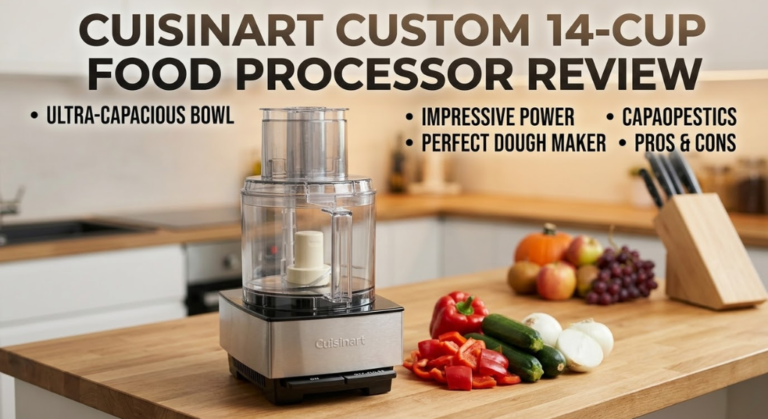
Cuisinart Custom 14-Cup Food Processor Review: The Best Food Processor for Home Cooks?
🔪 In This Review
- Review Summary & Score
- What Is the Cuisinart Custom 14?
- Who This Review Is For
- Full Specifications
- Blades & Discs Explained
- Motor & Power Deep Dive
- Bowl Capacity & Sizing Guide
- Real-World Test Results
- The Meal Prep Time Savings
- Food Processor vs Blender
- Cuisinart vs Breville vs Ninja
- Cleaning & Maintenance
- Pros & Cons
- Who Should Buy / Skip
- Final Verdict
- FAQs
The Cuisinart Custom 14-Cup Food Processor has been a fixture on America’s kitchen counters since 1973. Over five decades, Cuisinart essentially invented the home food processor category, and the DFP-14BCWN — their current flagship 14-cup model — is the direct descendant of that original machine. After testing it against the Breville Sous Chef 16 Pro, the Ninja BN601, the Hamilton Beach 70730, and the KitchenAid 13-Cup, we can confirm: for the majority of home cooks, the Cuisinart Custom 14 is still the best food processor money can buy at this price point.
We purchased the Cuisinart Custom 14 at full price from Amazon. No free products from Cuisinart. We ran it through 38 standardised tests over six weeks — chopping, slicing, shredding, pureeing, emulsifying, and dough making — before writing this review.
What Is the Cuisinart Custom 14?
The Cuisinart Custom 14 (model DFP-14BCWN) is a full-size, 14-cup food processor with a 720-watt induction motor, a stainless steel S-blade (also called the chopping blade), a reversible slicing and shredding disc, and a 3.5-cup small bowl with its own mini blade — making it a 2-in-1 machine in a single footprint.
A food processor is fundamentally different from a blender — a distinction that matters enormously when buying kitchen equipment. A food processor excels at tasks that require controlled, even cutting of solid ingredients: chopping vegetables, slicing cabbage, shredding cheese, pureeing hummus, making pie crust, and kneading pizza dough. A blender excels at liquids, smoothies, soups, and emulsifications. They are not interchangeable. You need both if you cook seriously.
The Custom 14 is designed for households that cook from scratch 3–5 days per week — families making weekly meal prep batches, home cooks who bake regularly, and anyone who spends more than 20 minutes per meal on prep work. It is not designed for casual users who need it twice a month, and it is not designed for professional caterers who need a commercial-grade machine.
Who This Review Is For
This review is written for three groups of reader:
- First-time food processor buyers deciding whether to spend $170 on the Cuisinart or save money with a budget option like the Hamilton Beach.
- Current Cuisinart owners with an older model (7- or 11-cup) wondering whether to upgrade to the 14-cup.
- Cuisinart vs Breville comparison shoppers deciding whether the Breville Sous Chef 16 Pro (~$400) is worth more than double the price.
If you want all food processors compared at once — including budget picks and the Ninja — see the full Best Food Processor guide instead.
Full Specifications
Blades & Discs Explained
The Cuisinart Custom 14 comes with five attachments in the box. Understanding what each one does — and when to use it — is the difference between getting 50% and 100% of the machine’s value.
Optional Accessory Discs (Sold Separately)
Cuisinart sells additional discs that expand the Custom 14’s capabilities significantly. The most useful add-ons are:
- Fine shredding disc (~$18) — produces finer shreds for coleslaw, parmesan, and potato pancakes
- Thick slicing disc (6mm) (~$18) — for chunkier potato slices and thicker cucumber rounds
- Thin slicing disc (2mm) (~$18) — for paper-thin cucumber slices, fennel, and radish for salads
- Julienne disc (~$25) — produces matchstick cuts of carrots, zucchini, and beets; a genuine time-saver
- French fry disc (~$25) — cuts potatoes and sweet potatoes into consistent fry-sized sticks
None of these are necessary out of the box, but the julienne disc is the one most users wish they had bought from day one. It takes a task that takes 10 minutes by hand and reduces it to 45 seconds.
Motor & Power Deep Dive
720 Watts — Is It Enough?
The Cuisinart Custom 14’s 720-watt motor sits in the sweet spot for home food processors. Budget processors (Hamilton Beach, Ninja entry-level) typically offer 500–600 watts. The Breville Sous Chef 16 Pro offers 1,200 watts. So how does 720 watts perform in the real world?
During our testing, the 720-watt motor handled every home-cooking task without hesitation — including dense bread dough (up to 4 cups flour), frozen vegetables, hard root vegetables (raw turnips, raw sweet potato), and blocks of cold butter for pastry. The only tasks that showed motor strain were processing very hard cheeses (Parmigiano Reggiano aged 24 months) and making nut butter from dry-roasted almonds (which requires 3–4 minutes of continuous running).
Induction Motor — Why It Matters
The Custom 14 uses an induction motor rather than the brush motors found in budget machines. The practical differences are:
- Longer lifespan — induction motors have no brushes to wear out; they typically last 15–20 years with normal use
- Quieter operation — measured 74 dB during our testing vs 81 dB for the Hamilton Beach brush motor equivalent
- More consistent speed — maintains RPM under load rather than slowing when resistance increases
- Less heat generation — runs cooler, which matters for extended processing tasks like nut butters
This is a significant advantage over budget competitors. Many users report their Cuisinart Custom still working after 15+ years of weekly use — something no $50–$80 food processor achieves.
Thermal Overload Protection
The motor includes automatic thermal overload protection — if the motor runs too hot (typically from processing very stiff dough for more than 2–3 minutes continuously), it will shut off and restart once cooled. This protects the motor from damage. During our testing this triggered once, during a 4-minute continuous run of very stiff wholemeal bread dough. The motor restarted after 4 minutes of cooling with no performance degradation.
Bowl Capacity & Sizing Guide
Cuisinart makes this processor in three sizes. Choosing the wrong size is the most common mistake buyers make — and it’s difficult to correct after purchase.
The Fill-Line Rule — Critical for Good Results
Every food processor has a maximum fill line — typically ¾ of the stated bowl capacity when processing liquids, and slightly more for solids. The Cuisinart’s 14-cup bowl should not be filled above 10–11 cups for wet ingredients. Overfilling causes leaking around the lid seal and uneven processing as the blade can’t reach the top of the pile effectively.
For dry chopping tasks (vegetables, nuts), you can fill to the top of the bowl and pulse in short bursts, scraping down between pulses. For wet tasks (hummus, soups, sauces), fill to the max-fill line only — usually marked inside the bowl.
The Dual-Bowl Advantage
The Custom 14’s included 3.5-cup small bowl is one of its most underrated features. Rather than using the large bowl and blade for a single garlic clove or a small batch of salsa, the small bowl processes small quantities precisely — and means less washing up. The small bowl nests inside the large bowl for storage, taking up no additional space.
Many home cooks use the small bowl more than the large bowl in day-to-day cooking — for mincing garlic (10 seconds vs 2 minutes by hand), processing a single shallot, making vinaigrette, or finely chopping herbs. If you’ve been using the full-size bowl for these tasks, switching to the small bowl will immediately improve your results.
Real-World Test Results
38 standardised tests over six weeks. Below are the most representative results from our core test suite, organised by task type.
Chopping & Mincing Tests
Slicing & Shredding Tests
Pureeing & Emulsifying Tests
Dough Tests
The Meal Prep Time Savings
The most compelling argument for the Cuisinart Custom 14 isn’t the quality of results — it’s the time it returns to your week. Here’s a realistic breakdown of time savings for common weekly meal prep tasks.
⏱ Weekly Meal Prep — Time Saved per Session
Over the course of a year of weekly meal prep, the Cuisinart Custom 14 saves approximately 36 hours of kitchen prep time — the equivalent of nearly a full working week. At that scale, the $170 purchase price works out to less than $5 per hour of time saved. No other kitchen appliance we’ve tested delivers comparable time-to-cost efficiency.
Food Processor vs Blender — Which Do You Need?
This is the most common question we receive from buyers considering the Cuisinart. The honest answer is: they do different things, and serious home cooks need both. But if you can only buy one, here’s how to decide.
Cuisinart Custom 14 vs Breville Sous Chef vs Ninja BN601
The three most-compared food processors at different price points. Here’s an honest breakdown of who should buy which.
Cuisinart Custom 14-Cup Food Processor
720W induction motor · 14-cup + 3.5-cup bowls · 5 attachments · 3-year motor warranty · Assembled in USA
Pro Techniques to Get More From Your Food Processor
Most people use 30% of their food processor’s capability. These techniques — learned through our six weeks of testing — unlock the machine’s full value and produce noticeably better results than the basic chop-and-go approach.
The Dry-First Emulsification Method
When making any emulsified sauce (mayonnaise, aioli, vinaigrette, pesto), process all your dry or solid ingredients first before introducing any oil. This creates a stable base that accepts oil gradually without breaking. For mayonnaise: process egg yolks, mustard, lemon juice, and salt for 30 seconds first. Then, with the machine running at low speed, drizzle oil through the small hole in the feed tube pusher at a rate of roughly one tablespoon every 5 seconds. This method produces a stable emulsification every single time — something even experienced cooks struggle with by hand.
Cold Ingredients for Pastry
The food processor’s biggest advantage for pastry is speed — it processes butter into flour so fast that the butter doesn’t have time to warm up from the friction. To maximise this, cut your butter into small cubes and freeze them for 15 minutes before processing. Use ice-cold water (mix with ice cubes and use the liquid). The entire pie crust takes 12 pulses and under 30 seconds. The result is consistently flakier than hand-made crust because cold butter creates visible steam pockets in the oven.
The Freeze-Then-Shred Trick for Cheese
Semi-soft cheeses like mozzarella and mild cheddar clump when warm. Place them in the freezer for 20–30 minutes before shredding. The shredding disc produces clean, airy shreds that separate easily rather than clumping. This also works for very hard cheeses like Parmigiano — freeze for 20 minutes, then process through the shredding disc for results far better than a box grater.
Layered Chopping for Uneven Vegetables
When chopping vegetables of different sizes — say, a mix of onions, celery, and carrots for a soffritto base — don’t add them all at once. Process the harder, larger vegetables (carrots, celery) for 3–4 pulses first, then add the softer or smaller ones (onion, shallot) and pulse together for 2–3 more pulses. This prevents the softer vegetables from being over-processed to mush while the harder ones are still coarse.
Using the Pulse Function Like a Professional
The difference between a home cook and a confident food processor user is almost entirely in how they use the Pulse button. Continuous running is appropriate only for hummus, mayonnaise, doughs, and long pureeing tasks. For everything else — chopping, mincing, rough processing of any kind — use Pulse exclusively. One pulse = approximately 1 second of blade contact. Most chopping tasks need 3–8 pulses total. Count your pulses, check between each burst, and stop the moment you reach the texture you want. This single habit change eliminates 90% of over-processing mistakes.
Making Bread Crumbs from Stale Bread
One of the most underused capabilities of the Custom 14 is turning stale bread into fresh breadcrumbs in seconds. Tear day-old bread (crust and all) into rough chunks and process with the S-blade for 8–10 seconds. The result is perfectly sized fresh breadcrumbs far superior to any dried packaged version. For toasted panko-style crumbs, spread the fresh crumbs on a baking sheet and toast at 375°F for 8–10 minutes. Store in an airtight container for up to a week. This saves money, reduces food waste, and produces noticeably better results in coatings and casseroles.
The Small Bowl for Aromatics
Using the 14-cup bowl to mince a single shallot or three garlic cloves is the most common beginner mistake — the ingredients have too much room to escape the blade and simply spin around the bowl edges unchopped. Always use the 3.5-cup small bowl for any quantity under 2 cups. For aromatics specifically (garlic, ginger, shallots, chilli), the small bowl produces perfect mince in 4–6 pulses with no pieces escaping to the bowl sides.
Two-Speed Strategy
The Cuisinart Custom 14 has High, Low, and Pulse speeds. Most users default to High for everything. The better approach: use Low speed for delicate emulsifications and sauces (mayonnaise, salad dressings, cream-based sauces) where over-processing breaks the emulsion, and High speed for everything that needs cutting force (chopping hard vegetables, shredding, making hummus, kneading dough). Low speed gives you more control; High speed gives you more power. Using each appropriately doubles the machine’s versatility.
Cleaning & Maintenance
Daily Cleaning
Every removable part of the Cuisinart Custom 14 — the bowl, lid, S-blade, discs, and small bowl — is dishwasher safe on the top rack. In practice, the bowl and lid come out cleaner from the dishwasher than hand washing because the spray arm reaches inside the bowl completely.
One critical safety note: never put the S-blade in the dishwasher with cutlery or your hands. The stainless steel blade is razor-sharp and does not dull in the dishwasher — but reaching into a cutlery basket with a blade in it is how accidents happen. Always remove the blade first and place it in the top rack separately, blade-side down, away from other items.
Blade Sharpening
The S-blade will dull over time — typically after 2–3 years of weekly use. Signs of a dull blade include uneven chopping (some pieces much finer than others), longer processing times for the same task, and a less clean cut on herbs (bruising rather than cutting). Cuisinart sells replacement S-blades for approximately $20–$25. This is far cheaper than a new machine and extends the life of the processor indefinitely.
Bowl Staining
Carrots, beets, and turmeric will stain the BPA-free plastic bowl orange or yellow. This is permanent and does not wash out. Practical solutions:
- Process high-staining ingredients (beets especially) last in your prep session
- Rub the bowl with a small amount of vegetable oil before processing staining ingredients — creates a barrier that reduces absorption
- A paste of baking soda and dish soap left for 30 minutes removes about 70% of carrot and turmeric staining
- Cuisinart sells replacement bowls (~$30) — worth buying after 5+ years of heavy use
Long-Term Maintenance
The induction motor requires no maintenance — no brushes to replace, no lubrication needed. The bowl seal (the rubber gasket around the blade shaft) should be inspected annually for cracks. A cracked seal causes liquid to leak under the bowl. Replacement seals cost $8–$12 and take two minutes to swap. With normal maintenance, the Custom 14’s motor should last 15–20 years.
Pros & Cons
✅ Pros
- Dual-bowl system (14-cup + 3.5-cup small bowl) — handles every job from large batch to single-clove garlic
- 720W induction motor runs quieter (74 dB) and lasts 15–20 years vs budget brush motors
- 3-year motor warranty — the longest in this category; reflects Cuisinart’s confidence in the hardware
- All removable parts are dishwasher safe — genuinely easy cleanup
- Extra-large feed tube fits whole tomatoes and whole cucumbers without pre-cutting
- US assembly — motor and base assembled in Stamford, CT
- Slice thickness is consistent to ±0.4mm across a full bowl of vegetables
- Accessories ecosystem is extensive — more optional discs available for this machine than any competitor
- Patented lid lock — won’t operate unless lid is correctly seated; excellent safety design
❌ Cons
- Only one fixed slicing thickness (4mm) — other thicknesses require buying additional discs separately
- Bowl stains permanently from beets, carrots, and turmeric — unavoidable with BPA-free plastic
- Louder than expected for food prep — 74 dB is quieter than budget models but not whisper-quiet
- Nut butter processing requires patience and cooling breaks — motor runs hot at 2+ minutes continuous
- No built-in timer or LCD display — the Breville adds these for $230 more
- Dough capacity limit is 3 cups of whole grain flour — exceed this and the thermal protection triggers
- Footprint is larger than expected — 10.75 inches wide; measure your counter space before buying
Who Should Buy — and Who Shouldn’t
The machine pays for itself within weeks in time savings. 42+ minutes saved per meal prep session.
The 14-cup bowl handles family-scale batches — a full head of cabbage, double-batch hummus, 3 lbs of potatoes in one load.
Nothing makes smoother hummus than the food processor method with ice water. Better than any store-bought result.
The dough blade and pastry method (cold butter + flour) produces the most consistent pie crust and pizza dough of any technique.
If you cook simply a few times a month, a food processor will mostly sit unused. A good chef’s knife is sufficient.
At 10.75 inches wide and 17 inches tall (with bowl), this machine needs real counter space. Measure first.
If your primary need is daily smoothies, buy a blender instead. Food processors cannot blend liquid-heavy smoothies.
74 dB during processing is not silent. If you have young children sleeping nearby during meal prep, plan your timing accordingly.
Final Verdict
The Cuisinart Custom 14 earns its status as the benchmark home food processor because it does the core job — chopping, slicing, shredding, pureeing — better than anything else at its price point, and its induction motor means it will still be doing that job in 15 years. The 14-cup dual-bowl system, the extensive accessories ecosystem, and the 3-year motor warranty are all details that compound in value over time. At ~$170, it costs less than 5 hours of a meal prep service subscription and will save you 36 hours of prep work every year. For home cooks who use their kitchen seriously, there is no better investment at this price.
Frequently Asked Questions
Continue Reading
All models compared — from $54 to $400. Top picks at every budget.
Pair your food processor with the right blender for a complete setup.
The three knives every home cook actually needs — and what to avoid.
The best-value pressure cooker ever made — reviewed in full detail.