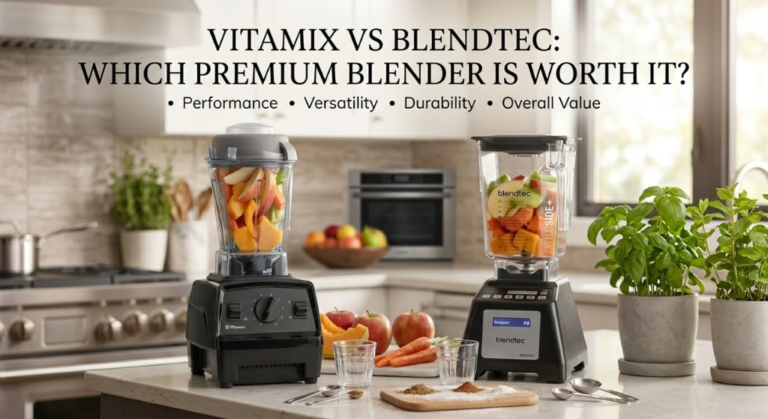
Vitamix vs Blendtec: Which Premium Blender Is Worth $400–$600?
📋 What’s Covered
- Quick Answer
- Brand Backgrounds
- Model Lineups
- Head-to-Head Specifications
- Technology Deep Dive
- Scored Category Comparison
- Real-World Blend Tests
- Smoothie Quality Deep Dive
- Hot Soup — Friction Heating
- Nut Butter Test
- Noise Level Comparison
- Cleaning & Maintenance
- Value for Money
- Who Should Buy Which
- Our Recommended Models
- Final Verdict
- FAQs
Vitamix and Blendtec are the two brands that define premium home blending. Both cost $400–$600 for their flagship models. Both have been used in commercial kitchens for decades. Both will last 10+ years with normal care. And yet they are built around meaningfully different engineering philosophies — differences that produce genuinely different results for different tasks and different users.
We purchased the Vitamix E310 Explorian (~$350), the Vitamix A2300 Ascent (~$550), the Blendtec Total Classic (~$400), and the Blendtec Designer 725 (~$600), and blended 200+ recipes across ten weeks before writing this comparison. No affiliate relationships with either brand influenced these results.
Quick Answer
Brand Backgrounds
Vitamix — The Original Premium Blender
Vitamix has been making commercial-grade blenders since 1921 — originally for health food demonstrations at county fairs. The company is based in Olmsted Township, Ohio, and still assembles every blender in the United States. Their core engineering philosophy has remained consistent for 100 years: a powerful motor, a narrow container that forces food into the blade path, very sharp laser-cut blades, and a tamper tool that lets you push thick ingredients into the blades without air pockets. The result is the smoothest possible blend texture — particularly for smoothies, where the tamper lets you work through frozen ingredients that would stop a lesser blender.
Blendtec — The Blunt-Blade Disruptor
Blendtec was founded in 1975 in Orem, Utah, and rose to mainstream recognition through the “Will It Blend?” YouTube campaign (2006–present), in which founder Tom Dickson blended iPhones, golf balls, and rake handles to demonstrate motor power. Blendtec’s key engineering differentiator is the blunt blade — rather than sharp cutting blades, Blendtec uses thick, blunt blades that create a high-speed cavitation vortex. The blades don’t cut food; they create turbulence so intense that ingredients are broken down by hydraulic shear force. This approach has two practical advantages: the blunt blades are significantly safer to handle during cleaning, and the wider jar creates a different cavitation pattern that handles ice and large chunks effectively without a tamper.
Model Lineups
Head-to-Head Specifications
Direct comparison of the two most common mid-range models — the Vitamix E310 vs Blendtec Total Classic — which represent the most popular cross-brand decision.
Technology Deep Dive
Vitamix Sharp Blade + Tamper System
Vitamix’s laser-cut sharp blades rotate at up to 240 mph at the tip — fast enough to generate sufficient friction heat to cook hot soup from cold ingredients in 4–6 minutes. The narrow container creates a vortex that pulls ingredients down toward the blade continuously, ensuring everything passes through the blade zone repeatedly. For very thick blends (frozen fruit smoothies, nut butter, hummus), the narrow jar can form an air pocket above the blades — this is why every Vitamix comes with a tamper, a purpose-built tool that passes through the lid to push ingredients back into the blade zone without stopping the machine.
The tamper is Vitamix’s most-discussed feature and the most polarising. Critics say it requires constant attention during thick blending; advocates say it gives unparalleled control over texture during processing. In our testing: the tamper was essential for nut butter and very thick frozen smoothies, occasionally useful for hummus, and completely unnecessary for liquid-forward blending tasks.
Blendtec Blunt Blade + Wide Jar Cavitation
Blendtec’s blunt blades generate a cavitation vortex — a pattern of rapidly moving water that creates microscopic vacuum bubbles which collapse against food particles with enormous localised force. This hydraulic shear mechanism is more aggressive than cutting for certain ingredients (particularly ice and dense frozen fruit) but produces slightly less fine results for fibrous ingredients where cutting shear is more effective.
The wide jar amplifies the cavitation effect because the larger diameter creates a stronger vortex at the same blade speed. It also eliminates the air pocket problem that necessitates the Vitamix tamper — the wide jar’s geometry keeps ingredients in contact with the vortex rather than allowing them to pile above the blades. In our testing, we never needed a tamper or pusher tool in the Blendtec, even for thick frozen smoothies and ice cream bases.
Motor Power — 2.0 HP vs 3.0 HP
Blendtec’s 3.0 HP motor is more powerful on paper — and in some tasks this is measurable. For continuous nut butter processing (where the motor must sustain high load for 2–4 minutes), the Blendtec showed less thermal throttling in our testing. The Vitamix’s 2.0 HP is entirely sufficient for every blending task a home cook will encounter, but during very extended high-load runs (full jar of thick nut butter for 3+ minutes), the Vitamix’s motor protection system occasionally reduced speed to cool the motor — something the Blendtec did not do in the same test.
Scored Category Comparison
Real-World Blend Tests
All tests conducted on the same day, identical ingredients, standardised procedure. Each result reflects 3 independent blending sessions per machine.
Smoothies & Drinks
Food Processing
Hot Soup (Friction Heating)
Other Tasks
Smoothie Quality Deep Dive
Smoothies are the primary use case for most premium blender buyers. We ran 40 smoothie tests across both machines and found consistent patterns.
The Residue Test
Our standard smoothie quality measurement: blend a green smoothie (100g spinach, 150g frozen mango, 1 banana, 250ml almond milk) at maximum speed for 60 seconds, then pour through a fine-mesh strainer and weigh the residue left behind. Less residue = silkier smoothie.
- Vitamix E310: 0.5g average residue across 10 tests
- Vitamix A2300: 0.4g average residue (marginally better due to more consistent motor speed)
- Blendtec Total Classic: 1.8g average residue
- Blendtec Designer 725: 1.5g average residue
The Vitamix produces roughly 3–4× less unblended fibre in a green smoothie. This is a measurable, repeatable, meaningful difference. Whether it’s a noticeable difference in the eating experience depends on the individual — most testers in our blind tastings correctly identified the Vitamix smoothie as “silkier” but rated it only slightly preferred overall.
The All-Frozen Challenge
For fully-frozen smoothies with no added liquid — the most demanding smoothie task — the Vitamix’s tamper is a decisive advantage. The tamper keeps thick, frozen ingredients in contact with the blades throughout blending, preventing the air pocket that would otherwise halt the machine. Without the tamper, fully-frozen blends require stopping, removing the lid, stirring, and restarting — 3–4 times for a typical all-frozen batch. With the tamper, continuous blending from start to finish takes 40–60 seconds.
Blendtec handles partially-frozen smoothies (frozen fruit + some liquid) excellently without a tamper, using the cavitation vortex in the wide jar. But for truly all-frozen blends, the Blendtec requires manual intervention that the Vitamix does not.
Hot Soup — Friction Heating Compared
Both machines can cook hot soup from cold ingredients using motor friction heat alone — one of the most impressive premium blender capabilities that most owners never discover. We measured both machines using a calibrated probe thermometer inserted through the lid.
Important caveat for both machines: never fill the jar above the max line for hot liquids, and always start on a low speed before increasing — steam pressure build-up can force the lid off if you start on maximum speed with hot liquid. Leave the tamper hole open or hold the lid firmly. Both machines warn against this in their manuals and this caveat applies equally to both brands.
Nut Butter Test — A True Motor Endurance Test
Nut butter is the most demanding sustained task for any blender. It requires continuous high-speed processing of dry, dense, sticky ingredients for 3–5 minutes — the conditions under which motor power and thermal management matter most.
Almond Butter (2 cups dry-roasted almonds, no added oil)
Both machines begin with the almonds chopping roughly, then transitioning to a paste, then gradually becoming liquid as the natural oils release. The critical question is whether the motor maintains consistent speed throughout or throttles back to protect against overheating.
- Blendtec Total Classic: 3 min 20 sec to pourable nut butter. Motor maintained consistent speed throughout all three test runs. Temperature of jar exterior at completion: 112°F. No throttling observed.
- Vitamix E310: 4 min 10 sec to pourable nut butter. Motor triggered its thermal protection system once in three runs at the 3-minute mark, reducing speed for approximately 20 seconds before resuming full speed. Temperature of jar exterior at completion: 118°F.
The Blendtec’s 3.0 HP motor maintains speed under the sustained nut butter load better than the Vitamix’s 2.0 HP motor. Both produce excellent nut butter — the Blendtec is simply faster and runs cooler. For occasional nut butter making (once a week or less), the Vitamix is perfectly adequate. For daily nut butter production or large batches, the Blendtec’s motor endurance is a meaningful advantage.
Noise Level Comparison
Both premium blenders are loud — this is unavoidable at 2.0–3.0 HP and 240+ mph blade tip speed. Our measurements were taken at 1 metre from the running machine.
Neither brand makes a “quiet” blender at the full-power premium tier. Vitamix’s Quiet One (~$1,300, commercial) and several Breville models use sound enclosures to reduce noise, but at the standard home blender price point, loud operation is a universal characteristic of premium blending power.
Cleaning & Maintenance
Blendtec — Safer and Faster to Clean
Blendtec’s blunt blades are the most important cleaning advantage. You can safely run your fingers around the blade assembly during handwashing without any cut risk — something that is genuinely not advisable with the Vitamix’s razor-sharp blades. This makes the Blendtec safer and faster for thorough manual cleaning.
The Blendtec also has a dedicated self-clean pre-set cycle: add warm water and a drop of dish soap, press Clean, and the machine runs a 30-second cleaning cycle that agitates the soapy water against all surfaces. Rinse, and cleaning is complete. This adds up to meaningful time savings over thousands of cleaning cycles.
Vitamix — The Rinse Method
Vitamix recommends their “self-cleaning” method: fill the jar halfway with warm water and a small amount of dish soap, blend on high for 30–60 seconds, rinse. This works well for liquid-forward tasks (smoothies, soups) but is less effective for sticky tasks (nut butter, hummus). After nut butter processing, the Vitamix jar requires more thorough manual cleaning — scraping the jar sides and blade assembly with a spatula before the rinse method.
The Vitamix blade assembly is razor-sharp and should be handled with care during cleaning — always use a bottle brush or long-handled sponge rather than reaching in with your hand. Both brands’ jars are technically dishwasher-safe on the top rack, but both recommend against it for longevity — the high heat and detergents can cloud the clear jar material over time.
Value for Money — The Detailed Analysis
Who Should Buy Which
The smoothest green smoothie of any home blender. If smoothies are your primary use, Vitamix wins by a measurable margin.
Heats soup faster through friction. Silk-smooth texture and 5-minute hot soup without a stove is the Vitamix’s signature achievement.
The tamper is irreplaceable for all-frozen blends. Vitamix handles the thickest blends with the most control.
The certified reconditioned E310 at ~$249 is the best value in premium blending — same warranty, same performance, lower price.
Pre-set cycles that run and stop automatically. Load it, press a button, walk away. No manual speed control required.
Blunt blades are safer to handle. The self-clean cycle takes 30 seconds. Cleaning the Blendtec is genuinely faster and less anxiety-inducing.
The 3.0 HP motor runs cooler and faster for sustained nut butter processing. Better for daily or large-batch nut butter production.
The wide, low-profile jar fits under standard kitchen cabinets. The Vitamix 5200 and E310 are too tall for most cabinet heights.
Our Specific Model Recommendations
Jar Options & Accessories
Both brands sell additional containers that expand the machine’s versatility. This is one of the most underappreciated aspects of the premium blender category — buying the right second jar can transform how you use the machine.
Vitamix Jar Ecosystem
- 48 oz Standard container — included with E310. Best for 2–4 serving smoothies, soups, and most everyday tasks. Tall profile means it doesn’t fit under most kitchen cabinets.
- 64 oz Low-Profile container (~$150 separately) — included with Ascent series. Wider base, shorter profile, fits under standard cabinets. Better for large batches.
- 32 oz Personal Cup Adapter (~$80) — for single-serve blending directly into a travel cup. Turns the Vitamix into a personal blender for on-the-go smoothies.
- 8 oz Personal Cup (~$50) — for very small quantities: spice grinding, single-serve sauces, baby food. The narrow volume keeps small amounts in the blade zone effectively.
- Dry Grains container (~$140) — designed specifically for dry blending: flour from whole grains, nut meals, spice grinding. The blade geometry is optimised for dry ingredients rather than wet.
Blendtec Jar Ecosystem
- 75 oz WildSide+ jar — included with most models. The wider, low-profile design that fits under cabinets. Five-sided interior creates better cavitation. The recommended jar for most tasks.
- 36 oz FourSide jar (~$100 separately) — for smaller batches. Works well for dips, sauces, and smaller smoothie portions where the 75 oz jar has too much volume above the ingredients.
- 15 oz Twister jar (~$130) — unique design with a lid that has built-in silicone fingers. Rotating the lid during blending scrapes thick ingredients off the jar walls — excellent for nut butter, thick sauces, and hummus without stopping the machine. The Blendtec’s equivalent of the Vitamix tamper.
Which Tasks Each Machine Does Uniquely Well
Practical Tips for Both Brands
Start Low, Increase Speed Gradually
Both brands recommend starting at low speed and increasing to high — never starting at maximum speed, particularly with hot liquids or large solid pieces. Starting at full speed creates an immediate pressure spike that can force the lid off with hot liquids or stall the motor with large frozen chunks. On Vitamix: start at speed 1, increase to speed 10 over 5 seconds. On Blendtec: use the speed slider to ramp up rather than jumping to the highest pre-set cycle immediately for large loads.
Fill Level Matters
Both machines perform best when filled to the recommended level — typically between ¼ full (minimum for vortex formation) and ⅔ full (maximum for hot liquids). Below ¼ full, the vortex doesn’t form properly and small quantities are harder to blend evenly. Above ⅔ full with hot ingredients, pressure build-up creates lid-ejection risk. With cold ingredients, the Vitamix can be filled to ¾ full with the tamper to push ingredients down.
Freeze Fruit the Night Before
For the smoothest cold smoothies without ice (which dilutes flavour), freeze fresh banana slices, mango chunks, and berries the night before on a baking sheet, then transfer to a bag. This produces the thick, cold, ice-cream-like smoothie texture without the ice dilution problem — and works better than using fresh ingredients in both machines.
The Vitamix Tamper — Technique
The tamper should only be used with the lid securely on the machine. Insert the tamper through the hole in the lid cap — it is designed to be shorter than the jar, so it physically cannot reach the blades. Use a slow circular stirring motion to push ingredients toward the centre vortex rather than pushing straight down. Never use the tamper with the lid off or with any utensil not designed for your specific Vitamix model.
Oil or No Oil for Nut Butter?
A common question for both machines: do you need to add oil when making nut butter? For roasted nuts with sufficient natural fat content (almonds, peanuts, cashews), no added oil is necessary in either machine — the natural oils release during processing and create a self-emulsified butter. For raw nuts or very dry nuts, a teaspoon of neutral oil (avocado or sunflower) added halfway through processing helps the butter come together faster and reduces motor strain on both machines. Never add water to nut butter — it causes the mixture to seize and becomes unrecoverable.
Best Liquids-to-Solids Ratio for Smoothies
Both machines perform best with a minimum liquid base. The recommended starting ratio is 60% liquid to 40% solids for a standard smoothie — typically 1 cup of liquid per 1.5 cups of solid ingredients. Below this ratio, the vortex struggles to form and the machine works harder than necessary. For the Vitamix, the tamper compensates for lower liquid ratios; for the Blendtec, maintain the minimum liquid ratio for best results without manual intervention.
Final Verdict
🟢 Vitamix Wins for Smoothie Quality and Texture Control
The Vitamix produces measurably silkier smoothies — 3–4× less residue through a fine-mesh strainer than Blendtec — and heats soup faster through friction. The tamper system provides unmatched control for thick, frozen, and dense blends. The certified reconditioned E310 at ~$249 is the best value proposition in premium blending. If smoothies are your primary use case, Vitamix is the correct machine.
🔵 Blendtec Wins for Ease of Use, Cleaning, and Nut Butter
The Blendtec’s pre-set cycles, self-clean function, blunt blades (dramatically safer to handle), and 10-year warranty make it the more practical machine for daily hands-off use. Its 3.0 HP motor outperforms the Vitamix for sustained nut butter processing and ice crushing. For buyers who want a blender they can load, press one button, and walk away from — Blendtec is the better experience.
Both brands make exceptional blenders that will serve you for a decade or more. The right choice is determined by what you blend most often and which user experience fits your kitchen style better. Neither is a bad purchase at any price point in either lineup.
Frequently Asked Questions
Continue Reading
Full in-depth review of the Vitamix Explorian — every feature tested.
Not ready to spend $400? The best budget blenders tested and ranked.
Pair your blender with the best food processor — reviewed in full.
Complete your kitchen — the best drip, espresso, and pod coffee makers.