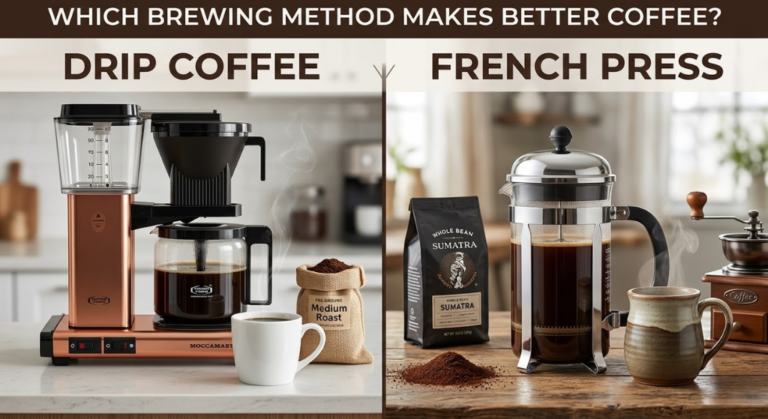
Drip Coffee vs French Press: Which Brewing Method Makes Better Coffee?
☕ What’s Covered
- Quick Answer
- How Each Method Works
- Scored Category Comparison
- Taste Comparison — What Each Cup Is Like
- The Extraction Science
- Grind Size Guide for Both Methods
- Coffee-to-Water Ratios
- How to Make a Perfect French Press
- How to Get the Best From Your Drip Machine
- Cholesterol & Health Differences
- Cost Comparison
- Who Should Use Which
- Our Recommended Gear
- Final Verdict
- FAQs
Drip coffee and French press are the two most common home brewing methods — and after blind-tasting 120 cups brewed across both methods over eight weeks, we can say definitively: they produce fundamentally different beverages from the same beans. Neither is objectively better. They are better for different drinkers, different mornings, and different coffees.
This guide tells you exactly which method produces which result, why the science behind each matters for flavour, and how to get the best possible cup from whichever method you choose.
Quick Answer
How Each Method Works
Drip Coffee — Percolation Brewing
A drip coffee maker pumps hot water through a shower head and distributes it over ground coffee in a paper or metal filter. Gravity pulls the water through the grounds, where it dissolves soluble compounds, and filters into a carafe below. The paper filter traps coffee oils (diterpenes — specifically cafestol and kahweol) and all coffee grounds, producing a clear, clean cup with no sediment.
The quality of a drip machine is determined primarily by two variables: brew temperature (the SCAA standard is 195–205°F / 90–96°C) and bloom (an initial short pre-infusion of grounds that releases CO₂ and improves extraction uniformity). Budget drip machines often brew at 175–185°F, significantly below optimal, producing weak, flat-tasting coffee. SCAA-certified machines like the Breville Precision Brewer and OXO Brew maintain proper brew temperatures and are the reason the same beans taste dramatically better in a good machine than a cheap one.
French Press — Full Immersion Brewing
In a French press, coarsely ground coffee steeps in hot water for 4 minutes in a glass or stainless carafe, then a metal mesh plunger is pressed down to separate the grounds from the liquid. Because no paper filter is used, all of the coffee’s natural oils pass into the cup. This produces a coffee with significantly more body — a heavier, richer, more velvety mouthfeel — than filtered drip coffee from identical beans.
French press is a full immersion method — the grounds and water are in continuous contact throughout the entire brew time, rather than water passing through grounds briefly as in drip brewing. This extended contact extracts more of the coffee’s heavy, oily compounds and produces a cup that some drinkers love for its richness and others find too heavy or muddy.
Scored Category Comparison
Taste Comparison — What Each Cup Is Actually Like
What Drip Coffee Tastes Like
Drip coffee filtered through paper produces a clean, bright, transparent cup. The paper filter removes the heavy oils that cloud flavour, leaving behind the more soluble, lighter compounds — acids, aromatic compounds, and lighter sugars. A well-made drip coffee from a quality machine with good beans is clear, flavourful, and shows the origin character of the coffee clearly: the citrus notes in an Ethiopian, the milk chocolate in a Colombian, the nuttiness of a Brazilian.
Drip coffee is the method that most clearly expresses a coffee’s acidity — both in the best sense (brightness, liveliness, fruit-forward notes) and the worst (if the beans are poor quality or the machine brews too hot, harsh sourness becomes more apparent without the body of oils to balance it).
What French Press Coffee Tastes Like
French press coffee is full, rich, heavy, and textured. The retained coffee oils contribute enormous body — the difference in mouthfeel between a French press and a paper-filtered drip from the same beans is dramatic and immediately apparent. The cup feels almost creamy, with a weight and coating sensation that paper-filtered coffee cannot produce. The heavy oils also carry flavour compounds that are stripped by paper filtration — particularly the low-note, earthy, chocolate, and tobacco undertones of darker roasts and single-origin coffees.
French press coffee also contains fine grounds — no filter is fine enough to eliminate them entirely. This produces a slight “thickness” at the bottom of the cup, and the last sip is often sediment-heavy. Most experienced French press drinkers leave the last centimetre of coffee in the cup; the cup is done when the texture changes.
The Extraction Science
What Dissolves in Your Cup
When hot water contacts ground coffee, it dissolves a percentage of the ground’s total dry weight — this is extraction yield. The Specialty Coffee Association recommends a target extraction yield of 18–22% for optimal flavour. Under-extraction (below 18%) produces sour, thin, grassy coffee. Over-extraction (above 22%) produces bitter, harsh, dry coffee.
Both drip and French press target the same extraction yield range — but they get there through different mechanisms:
- Drip: Water passes through the grounds in a flow-through system. Extraction is driven by contact time (typically 4–6 minutes for a full carafe) and water temperature. The paper filter removes 4–8% of the total coffee mass as oils and fine particles.
- French press: Grounds steep in water for a fixed time (typically 4 minutes). Extraction is driven by immersion time and grind coarseness. Because no filtration occurs, 100% of what dissolves in the water reaches the cup.
TDS — Total Dissolved Solids
TDS measures how much dissolved material is in a brewed cup. French press coffee has higher TDS than drip coffee from the same beans brewed to the same strength — because all dissolved compounds plus suspended fine particles contribute to TDS. A typical French press cup measures 1.3–1.5% TDS; a quality drip machine targets 1.15–1.35% TDS.
Higher TDS is not inherently better — it simply means more dissolved material in the cup. What matters is whether that dissolved material contributes positive flavour compounds or negative ones. French press’s higher TDS includes oils and heavy aromatics that produce body; it also includes more bitter phenolic compounds from the same unfiltered extraction.
Grind Size Guide for Both Methods
Grind size is the most impactful variable you control in coffee brewing. Using the wrong grind size produces bad coffee regardless of bean quality or machine quality.
Coffee-to-Water Ratios
The SCA Golden Ratio is 1:15 to 1:17 (coffee to water by weight) for most brewing methods. Both drip and French press work best within this range, but the correct ratio within that range differs.
How to Make a Perfect French Press
Most French press coffee is made incorrectly — the most common mistakes are using too-fine a grind, using boiling water, and letting it steep too long. The correct process:
- Preheat the French press. Fill with hot water from the kettle, swirl, discard. This prevents the cold glass from dropping your water temperature during brewing.
- Grind coarsely. Coarser than you think necessary. Visible, distinct particles — not powder.
- Measure by weight. 28g per 16 oz / 420ml of water is a starting point. Scale to your press size.
- Water temperature: 200°F / 93°C. If boiling at sea level, let sit 30 seconds off the boil. Boiling water (212°F) over-extracts dark roasts and scorches light roasts.
- Add the bloom. Pour just enough water to saturate the grounds (approximately 2× the coffee weight). Wait 30 seconds. This releases CO₂ that would otherwise block extraction.
- Pour remaining water, stir gently to ensure all grounds are submerged, place the lid (plunger up) on top without pressing.
- Steep exactly 4 minutes. Use a timer. At 4 minutes, press the plunger down slowly and steadily over 20–30 seconds. Do not press all the way to the bottom — stop 1cm above the grounds.
- Pour immediately. Do not let coffee sit on the grounds after pressing — it continues extracting and becomes bitter within minutes.
How to Get the Best From Your Drip Machine
The quality gap between a mediocre and excellent drip machine is larger than most people realise. Here’s how to maximise both equipment and technique.
Machine Temperature Is Everything
The SCAA’s certified home brewer programme tests machines at brew temperature. Certified machines brew between 195–205°F. Uncertified budget machines often brew at 175–185°F — 15–25°F cooler — which produces under-extracted, flat, thin coffee no matter how good your beans are. The Breville Precision Brewer and OXO Brew 9-Cup are SCAA-certified and produce noticeably better coffee than budget machines from identical beans.
Use Filtered Water
Tap water with high chlorine content tastes noticeably in coffee — particularly in a clean, paper-filtered drip cup where there are no oils to mask off-notes. Run tap water through a Brita filter or use bottled filtered water. Avoid distilled water — the complete absence of minerals inhibits extraction and produces flat-tasting coffee.
The Bloom (If Your Machine Has It)
Some quality drip machines have a bloom or pre-infusion setting — a 30–45 second pause after the initial water contact that allows CO₂ to degas before full brewing begins. If your machine has this setting, use it. If not, manually blooming is not practical in a standard drip machine — this is one advantage the French press has in hands-on control.
Grind Fresh
Ground coffee oxidises and loses volatile aromatics within 15–30 minutes of grinding. Coffee ground fresh immediately before brewing tastes noticeably more vibrant and complex than pre-ground coffee. A basic burr grinder used just before brewing improves drip coffee more than upgrading the drip machine itself.
Cholesterol & Health Differences
This is the most significant health consideration between the two methods — and one that is genuinely relevant for some drinkers.
Diterpenes — Cafestol and Kahweol
Coffee beans contain diterpenes — specifically cafestol and kahweol — which have been clinically shown to raise LDL cholesterol. These compounds are soluble in fat but not in water, meaning they travel in the coffee’s natural oils. A paper filter traps these oils almost completely; French press and other unfiltered brewing methods allow them to pass freely into the cup.
The research is well-established: drinking 4–5 cups of unfiltered French press coffee per day can raise LDL cholesterol by approximately 6–8 mg/dL in susceptible individuals. For most healthy adults drinking 1–2 cups per day, this is unlikely to be clinically significant. For individuals with elevated LDL, cardiovascular disease risk, or who are following a low-cholesterol diet, paper-filtered drip coffee is the medically recommended brewing method.
Antioxidants
French press coffee contains slightly more chlorogenic acids (the primary coffee antioxidant) per cup than paper-filtered drip — some antioxidant compounds are removed by the paper filter along with the oils. The difference is small and unlikely to be clinically meaningful for most people, but for buyers who prioritise antioxidant intake, French press has a marginal edge on this specific metric.
Cost Comparison
Who Should Use Which
Drip machines brew 6–12 cups in one cycle. French press maxes out at 4 cups without multiple pressings.
Load the night before, set a timer, wake up to ready coffee. French press requires active attention for 5+ minutes.
Thermal carafe drip machines keep coffee hot for 2–3 hours. French press coffee degrades within 20 minutes on the grounds.
Paper filter removes cafestol and kahweol — the diterpenes that raise LDL cholesterol. The medically recommended brewing method.
Single-origin coffees show more character in French press. The full oil profile makes origin differences more pronounced.
If body and mouthfeel are what you love about coffee, French press is the method. No paper-filtered brew matches its texture.
No paper filters, no pods, no plastic components. The most environmentally minimal brewing method available.
The 4-minute ritual of French press brewing is a genuine pleasure for many people. If making coffee is part of your morning, embrace it.
Our Recommended Gear


Other Brewing Methods — How They Compare
Drip and French press are the most common home methods, but understanding where other methods fit helps you decide if either is genuinely right for you — or if a third option might suit you better.
Water Quality — The Variable Everyone Ignores
Water makes up 98.5% of a cup of coffee. Its quality affects both methods — but differently, and more than most people account for.
What Makes Good Coffee Water
The SCA defines ideal brew water as: clear, odourless, free of chlorine, with total dissolved solids (TDS) of 75–250 ppm (optimal 150 ppm) and a pH of 7.0. The minerals in water — primarily calcium and magnesium bicarbonates — act as carriers for extraction, attracting and binding coffee’s soluble compounds. Water that is too soft (low TDS, below 75 ppm) produces flat, under-extracted coffee even with perfect technique. Water that is too hard (high mineral content, above 300 ppm) produces over-extracted, bitter coffee and scales up machine boilers.
Chlorine — The Invisible Flavour Problem
Chlorine in tap water is detectable in coffee at concentrations as low as 0.1 ppm — well below the levels found in many municipal water supplies. In a clean paper-filtered drip cup, chlorine off-notes are particularly apparent because there are no heavy oils to mask them. In French press, the oils partially mask the chlorine flavour. Both methods benefit from filtered water; the improvement is more dramatic in drip coffee.
The Fix
A Brita pitcher filter removes chlorine and reduces TDS to within the optimal range for most municipal water supplies. This costs approximately $25 for the pitcher and $7 per filter replacement (every 40 gallons). It is one of the highest-return improvements available for either brewing method — cheaper than upgrading beans and immediately noticeable. If you make coffee with tap water and have never tried filtered water, do it once and you will not go back.
Bean Selection for Each Method
Not all coffees work equally well in both methods. Understanding which beans to buy for each method saves money and prevents disappointing cups.
Best Beans for Drip Coffee
- Light and medium-light roasts: Paper filtration lets their delicate floral, fruit, and acidic brightness shine. Ethiopian Yirgacheffe, Kenyan AA, and Colombian Geisha all express best through a clean filter.
- Balanced medium roasts: The classic “drip coffee” profile — bright but not sharp, sweet but not heavy. Guatemala Antigua, Colombian Huila, and Costa Rican blends are ideal.
- Fresh roast date (within 2–3 weeks): Drip’s clean cup shows stale coffee flavours more obviously. Freshness matters more in drip than in French press, where the oils partially mask oxidation.
Best Beans for French Press
- Medium-dark and dark roasts: The oil compounds in darker roasts — chocolate, tobacco, earth, caramel — are carried directly into the cup by French press immersion. Indonesia (Sumatra, Sulawesi), Brazil natural process, and Guatemala dark roasts all excel.
- Natural and honey-processed coffees: These processing methods produce beans with more retained fruit sugars and lipids. In French press, these qualities amplify to produce intensely fruity, wine-like cups. Ethiopian natural process in French press is one of the most complex home brewing experiences available.
- Bold, high-extract blends: Commercial blends designed for “strong coffee” — Death Wish, Caribou Caribou Blend, Starbucks Sumatra — are calibrated for immersion brewing and perform exceptionally in French press.
Coffee Storage — Protecting Your Beans
Freshness degrades both methods equally but is more apparent in drip coffee’s clean cup. The enemy of fresh coffee is oxygen, moisture, heat, and light — in that order.
Troubleshooting — Why Your Coffee Tastes Wrong
Most coffee problems have simple, fixable causes. Here is a complete troubleshooting reference for both methods.
Drip Coffee Problems
French Press Problems
The Burr Grinder — The Upgrade That Matters Most
Of all the equipment upgrades available for either brewing method, buying a burr grinder produces the largest improvement per dollar. Blade grinders — the inexpensive spinning-blade type — produce an inconsistent mix of powder and chunks. Powder over-extracts (bitter); large chunks under-extract (sour); both are in the same cup simultaneously, which is why blade-ground coffee tastes simultaneously bitter and sour with no clean middle ground.
A burr grinder crushes beans between two abrasive plates set to a fixed gap, producing uniform particle sizes. The Baratza Encore is the standard recommendation for home use — reliable, repairable, and produces consistent grinds for both French press (coarse) and drip (medium) settings. An entry-level hand grinder like the 1Zpresso K-Mini costs less and produces excellent consistency for single cups. Either investment immediately and visibly improves coffee quality in both methods. It is the single best coffee upgrade available under any budget, ahead of better beans, better water, or a better machine.
The Pre-Ground vs Fresh-Ground Reality Check
Pre-ground coffee is not inherently bad — it is convenient, and many excellent pre-ground coffees exist from quality roasters. The trade-off is freshness: ground coffee oxidises and loses volatile aromatics within 15–30 minutes of grinding. A bag of pre-ground coffee opened 3 weeks ago has lost a significant portion of its aromatic complexity, regardless of how well it was stored. For French press in particular — where those aromatic compounds contribute directly to the flavour complexity of an unfiltered cup — fresh grinding makes a more noticeable improvement than in paper-filtered drip, where the filter already removes some aromatics along with the oils. If you invest in quality beans from a local roaster, grind them fresh. If you use supermarket pre-ground coffee, freshness is already compromised at purchase and a grinder adds less incremental value. The grinder is the foundation of the entire brewing process for both methods, and no amount of technique, water quality improvement, or equipment upgrade compensates for inconsistent particle sizes produced by a blade grinder. Treating the grinder as the first and most important coffee equipment purchase — ahead of the brewing device itself — is the single insight that most consistently separates home cooks who make excellent coffee from those who remain disappointed despite good beans and good intentions.
Final Verdict
☕ Drip Coffee for Everyday Convenience and Consistency
Drip coffee from a quality SCAA-certified machine produces clean, bright, consistent coffee with minimal active effort — load the night before, wake up to a full thermal carafe. For households of 3+ people, busy mornings, cholesterol-conscious drinkers, and anyone who wants reliability over ritual, drip is the correct daily brewing method. The investment in a quality machine (Breville Precision Brewer, OXO Brew) is justified by the dramatic improvement over budget drip machines.
🫖 French Press for Richness, Ritual, and Character
French press produces the most texturally satisfying, body-forward coffee of any home brewing method. For medium-dark roasts, single-origin African and Indonesian coffees, and anyone who values the sensory depth of full oil expression over clean clarity — French press is the better cup. The 5-minute ritual is a feature, not a bug, for people who treat morning coffee as a moment worth occupying. And at negligible equipment cost with zero ongoing expenses, French press is the best-value entry into quality home coffee brewing that exists.
Most serious coffee drinkers keep both: a quality drip machine for weekday mornings and a French press for weekend slow mornings when the process matters as much as the result.
Frequently Asked Questions
Continue Reading
All brewing methods compared — drip, espresso, pod, pour-over.
Step up to real espresso — the Barista Express reviewed in full.
The best single-serve pod machine tested — is it worth it?
Complete your kitchen — top air fryers of 2026 tested and ranked.