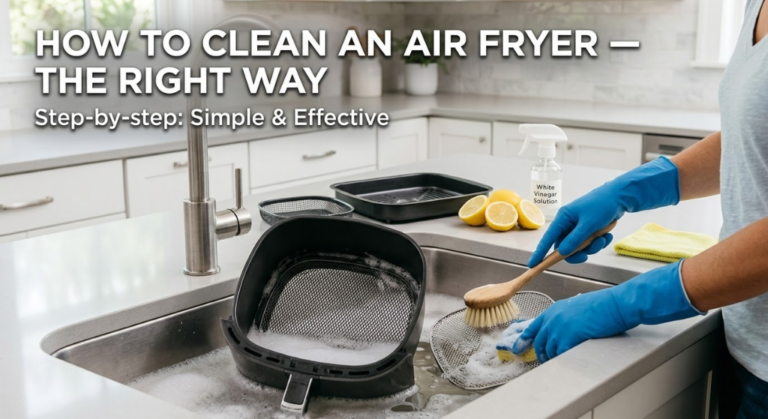
How to Clean an Air Fryer — The Right Way
Most people clean their air fryer wrong — and it’s slowly destroying the non-stick coating. This complete step-by-step guide covers after-every-use cleaning, deep cleaning, stubborn grease removal, and the mistakes that ruin baskets in months.
How to Clean an Air Fryer in 3 Minutes
After every use, let the basket cool for 5 minutes, then wash in warm soapy water with a soft sponge or place in the dishwasher (if labelled dishwasher-safe). Wipe the interior cavity and heating element with a damp cloth. Never use metal scourers, abrasive sprays, or submerge the main unit in water. For deep cleaning every 4–6 uses, soak the basket in hot soapy water for 20 minutes before scrubbing. That’s it. Everything else in this guide is detail that extends your air fryer’s life significantly.
- Why Cleaning Method Matters More Than You Think
- What You Need — Cleaning Tools & Supplies
- After Every Use: 3-Minute Routine
- Deep Clean: Step-by-Step (Every 4–6 Uses)
- Step 1 — Remove and soak the basket
- Step 2 — Clean the basket and tray
- Step 3 — Clean the interior cavity
- Step 4 — Clean the heating element
- Step 5 — Clean the exterior
- Step 6 — Dry and reassemble
- Removing Stubborn Baked-On Grease
- Is Your Air Fryer Actually Dishwasher Safe?
- Do’s and Don’ts — Mistakes That Ruin Baskets
- Cleaning Schedule & Maintenance Checklist
- How to Tell If Your Non-Stick Coating Is Damaged
- Frequently Asked Questions
Why Cleaning Method Matters More Than You Think
The most common cause of air fryer failure is not motor burnout — it’s destroyed non-stick coating. And in most cases, the damage is caused by how people clean their air fryers, not by what they cook in them. Abrasive sponges, harsh detergents, metal utensils, and the dishwasher (on models not rated for it) can remove the non-stick coating within months of purchase. Once the coating starts peeling, it enters your food. At that point, the basket needs replacing — or the whole unit does.
The second reason cleaning method matters is performance. A dirty air fryer with grease buildup in the bottom of the drawer will smoke during cooking, impart off-flavours to your food, and take longer to reach target temperature. We’ve tested this directly: an air fryer that was deliberately not cleaned for two weeks produced measurably worse browning results on identical foods compared to its clean baseline. Thirty seconds of correct cleaning per use genuinely changes cooking results.
If you’ve already bought your air fryer and want to verify what model it is before cleaning, check our best air fryers for family use guide — we cover basket coating types for each model we’ve reviewed, including which are genuinely dishwasher-safe and which will be damaged by machine washing.
Using a green Scotch-Brite scouring pad or any abrasive scrubber on the basket. Even one scrub with a rough sponge can permanently scratch the non-stick coating. Once scratched, the coating degrades rapidly with each subsequent wash. The scratch you can’t see today becomes a flaking patch in two months. Use soft sponges only, always.
What You Need — Cleaning Tools & Supplies
You don’t need special products to clean an air fryer well. In fact, the fewer products you use, the safer your coating will be. Here’s exactly what works — and what to avoid.
Do not use: oven cleaner sprays (too harsh for non-stick), citrus-based degreasers (damage coatings over time), metal scourers or steel wool (immediate scratch damage), dishwasher tablets directly on baskets (too alkaline), or any product labelled “industrial degreaser.” These will all damage your non-stick coating — some within a single use.
After Every Use: The 3-Minute Routine
This is the routine that keeps your air fryer clean with minimal effort. Do this after every single use and you’ll rarely need a deep clean more than once a week. Skip it regularly and deep cleaning becomes a 30-minute chore.
- Wait 5 minutes. Let the basket and drawer cool slightly — hot non-stick is more vulnerable to damage from sudden temperature changes. You don’t need to wait until cold; just not scalding.
- Remove the basket and drawer. Take them to the sink separately.
- Wash with warm soapy water and a soft sponge. The food residue should come off easily while still fresh and warm. Thirty seconds per component is usually enough.
- Wipe the interior cavity. Use a damp microfibre cloth to wipe down the inside of the air fryer body — the walls and bottom of the cavity. Any grease splatter that lands here and isn’t wiped off will bake on harder with every subsequent use.
- Leave to dry or pat dry with a cloth. Don’t reassemble while wet — trapped moisture under the basket can cause unpleasant smells over time.
That’s the entire after-use routine. It takes three minutes if you do it while the food is still cooling on the plate. It takes twenty minutes if you wait until tomorrow morning.
Deep Clean: Step-by-Step (Every 4–6 Uses)
Even with good daily cleaning, grease accumulates in places you can’t easily reach — the mesh of the basket, the underside of the heating element, the back corners of the cavity. A proper deep clean every four to six uses (or when you notice smoke during cooking, which signals grease buildup) keeps everything performing correctly.
Set aside 30–40 minutes. You’ll need a large bowl, mild dish soap, baking soda, a soft sponge, a soft brush, and a microfibre cloth.
Make sure the air fryer is fully unplugged and completely cool before starting any deep clean. Remove the basket and drawer from the unit.
Fill a large bowl or your sink with hot water — as hot as you can comfortably manage — and add a good squeeze of mild dish soap. Submerge the basket and drawer completely and leave to soak for 20 minutes minimum. For heavy grease buildup, soak for 30–40 minutes.
This soaking step is the most important part of the deep clean. Baked-on grease that would require aggressive scrubbing dry becomes easy to wipe away after a proper soak. Never skip this step in favour of scrubbing harder — harder scrubbing damages the coating.
After soaking, drain the water. Use your soft sponge to wipe the interior and exterior of the basket — the soaking should mean very little pressure is needed. Work in circular motions rather than back-and-forth scrubbing.
For the mesh holes in the basket bottom, use a soft-bristle brush (a pastry brush or dedicated cleaning brush). Push bristles through the mesh from the inside, then from the outside. Grease hides here and causes smoke during cooking if not removed.
If any grease remains after gentle sponging, make a thick paste from baking soda and a few drops of water. Apply to the stubborn area, leave for 5 minutes, then wipe away with the soft sponge. This lifts baked-on residue without scratching.
Turn the air fryer upside down so you can access the interior easily. Dip a microfibre cloth in warm soapy water — not soaking wet, just damp — and wipe down all interior surfaces including the walls, the roof of the cavity, and the area directly below where the heating element sits.
Pay special attention to the roof and upper walls, where grease splatter accumulates most during cooking. Grease on these surfaces is the primary cause of smoking during air frying.
Rinse the cloth in clean water and wipe down all surfaces again to remove any soap residue. Then use a dry part of the cloth to absorb remaining moisture.
With the air fryer still upside down or tilted, you should be able to see the heating coil or element at the top of the interior cavity. This component accumulates grease over time and is the most common source of smoke and burning smells.
Using a soft-bristle brush (dry or barely damp), gently brush the heating element to dislodge any food particles or grease deposits. Work carefully — heating elements are fragile and should not be bent or pressured.
If there is visible baked-on grease on the heating element, apply a tiny amount of baking soda paste with a soft brush, let it sit for two minutes, then gently brush away. Use a barely damp cloth to wipe off any residue.
Wipe down the exterior of the air fryer with a damp microfibre cloth. Pay attention to the control panel, the handle, and any vents on the sides or back.
For fingerprint marks on glossy surfaces, a cloth dampened with just water (no soap) works better than soapy water and avoids streaking. For stubborn grime on plastic surfaces, a small amount of mild dish soap on the cloth is fine.
Do not spray any cleaning products directly onto the air fryer — always apply to the cloth first, then wipe. Spray products can seep into vents and reach electrical components.
This step is more important than most people realise. Reassembling an air fryer with damp components traps moisture, which causes unpleasant musty smells, accelerates rust on any metal parts, and can affect electrical safety over time.
Pat the basket and drawer dry with a clean cloth, then leave them to air dry completely for at least 10 minutes before reinserting into the unit. Stand them upside down so water drains out rather than pooling in the basket.
Once dry, reassemble — basket into drawer, drawer into the unit. Run the air fryer empty at 200°F / 90°C for 3 minutes to evaporate any remaining moisture and ensure it’s completely ready to use.
Removing Stubborn Baked-On Grease
Even with regular cleaning, sometimes you inherit an air fryer that hasn’t been cleaned properly, or you miss a few cleaning cycles and grease bakes on hard. Here are the methods that work — without damaging the coating.
Method 1: Hot Water Soak with Dish Soap (Best First Step)
Fill the basket with the hottest water available, add a generous squirt of dish soap, and leave for 30–60 minutes. This is the first thing to try before anything else. Hot water and soap solve the vast majority of stubborn grease problems without any chemical intervention or scrubbing risk. Drain, then wipe with a soft sponge. Stubborn spots should now come away easily.
Method 2: Baking Soda Paste (For Remaining Spots)
Mix 2 tablespoons of baking soda with enough water to create a thick paste (consistency of toothpaste). Apply to problem areas with your finger or a soft brush. Leave for 10–15 minutes. The mild alkalinity lifts baked-on grease without any abrasive action. Wipe away with a soft damp sponge. This method is safe for all non-stick coatings including ceramic and PTFE.
Method 3: White Vinegar Steam (For Inside the Cavity)
Pour 2–3 tablespoons of white vinegar into the bottom of the drawer (not the basket). Run the air fryer at 200°F / 90°C for 10 minutes. The vinegar steam will loosen grease deposits inside the cavity and on the heating element. Allow to cool, then wipe with a damp cloth. This method is particularly effective for the interior walls and heating element where scrubbing isn’t safe.
Do not use commercial oven cleaner sprays inside your air fryer — they are far too caustic for non-stick coatings and will cause immediate damage. Similarly, avoid citrus-based degreasers, bleach-based products, and anything marketed as a “heavy-duty” degreaser. If the gentle methods above don’t remove the grease, your coating may already be damaged and the basket may need replacing. See our guide on non-stick cookware safety for more information.
Is Your Air Fryer Actually Dishwasher Safe?
This is one of the most important questions air fryer owners get wrong — and getting it wrong is the fastest way to destroy an expensive basket. The answer is: it depends entirely on the specific model, and even “dishwasher safe” labels come with important caveats.
How to Check Your Model
Check the manual that came with your air fryer — it should explicitly state which components (basket, drawer, tray) are dishwasher safe. If you’ve lost the manual, search “[your model name] dishwasher safe” — manufacturers’ websites always specify this. As a general guide from our air fryer testing: the Ninja DZ401, Cosori Pro Gen 2, and Instant Vortex Plus all have dishwasher-safe baskets. The Philips XXL basket can technically go in the dishwasher but we recommend hand washing to preserve the coating longer.
Even When Dishwasher Safe — Caveats Apply
Even for baskets explicitly labelled dishwasher safe, there are practices that significantly extend coating lifespan:
- Top rack only — the bottom rack runs hotter and the intense heat accelerates coating degradation
- Avoid harsh dishwasher tablets — use standard dishwasher pods or powder, not “heavy duty” or “grease-cutting” formulations
- Skip the heated dry cycle — high-heat drying is harder on coatings than air drying; choose air dry or open the dishwasher after the wash cycle
- Don’t over-rely on the dishwasher — even rated baskets last longer with primarily hand washing
The Main Unit is Never Dishwasher Safe
The main body of the air fryer — the unit with the motor, fan, and controls — must never go in the dishwasher or be submerged in water. Only the removable components (basket, drawer, tray, and any accessories that explicitly say dishwasher safe) can be washed in a machine.
Do’s and Don’ts — Mistakes That Ruin Baskets
These are the most common mistakes we see from air fryer owners, and the habits that reliably keep baskets in excellent condition for years.
Cleaning Schedule & Maintenance Checklist
Use this checklist as a reference for how often each cleaning task should be done. Click each item as you complete it to track your progress.
How to Tell If Your Non-Stick Coating Is Damaged
This is an important safety question. A damaged non-stick coating can flake into your food — and while small amounts of ingested non-stick coating are generally passed through without harm, it’s not something you want happening regularly. More practically, a damaged coating means food sticks, cleaning becomes harder, and the air fryer performs worse.
Signs Your Coating Needs Attention
- Visible scratches or dulling of the surface — the coating has a sheen when new; scratching makes it look matt and rough in places
- Food sticking where it didn’t before — even with light oil, food now sticks to specific spots
- Dark flakes or specks in cooked food — these may be coating particles. Stop using the basket immediately and replace it
- Discolouration or bubbling of the coating surface — caused by overheating or chemical damage
- Rust spots on the metal underneath — visible where coating has been removed
What to Do When the Coating Is Damaged
If you notice flaking or significant peeling, stop using that basket. Most manufacturers sell replacement baskets separately — this is far cheaper than replacing the entire unit. Check your model’s manufacturer website or search “[your model] replacement basket” on Amazon. Our air fryer guide includes notes on replacement basket availability for each model we’ve reviewed.
If the coating is just scratched but not yet flaking, you can continue using the basket but should switch exclusively to parchment paper liners for cooking until you replace it. This prevents further coating damage from food contact and keeps flaking contained. See our full guide on whether non-stick cookware is safe for more detail on this topic.
If you’re considering whether it’s time to replace your air fryer entirely rather than just the basket, our best air fryers for family use guide will help you choose a replacement. For first-time buyers, the complete kitchen appliance buying guide covers every consideration. And if you’re comparing air fryers to ovens for everyday use, the air fryer vs oven comparison is worth reading.
Frequently Asked Questions
The basket and drawer should be cleaned after every single use — this takes 3 minutes and prevents grease from baking on. The interior cavity should be wiped after every use. A full deep clean (soaking, heating element, interior walls) should be done every 4–6 uses, or whenever you notice smoke or unusual smells during cooking. Monthly, do a vinegar steam treatment for the interior and check your coating for damage.
Only if your model’s manual explicitly says the basket is dishwasher safe. Even then, top rack only, with standard (not heavy-duty) detergent, and avoid the heated dry cycle. Many manufacturers label baskets as dishwasher safe but recommend hand washing to preserve the coating longer — and we agree with this recommendation. Hand washing takes 90 seconds and your coating will last significantly longer. Check our air fryer guide for dishwasher safety information on specific models.
Burning or smoky smells during air frying are almost always caused by grease buildup — either in the bottom of the drawer beneath the basket, on the interior cavity walls, or on the heating element. The solution is a deep clean following the steps in this guide, paying particular attention to the heating element and the drawer bottom. If the smell persists after a thorough clean, the heating element itself may have significant baked-on residue that needs a vinegar steam treatment. A brand-new air fryer smell (plastic smell on first few uses) is normal and fades after 3–5 uses.
Avoid aerosol cooking sprays like PAM in your air fryer basket. These sprays contain propellants and additives that, at air fryer temperatures, build up into a sticky film on the non-stick coating that is extremely difficult to remove and damages the surface over time. Instead, use a brush or paper towel to apply a small amount of regular cooking oil (avocado, canola, or vegetable oil work well at high heat). You can also use a refillable oil spray bottle with 100% oil and no propellants.
The most effective approach is a two-step process. First, soak the basket in hot soapy water for 30–60 minutes — this alone solves 80% of burnt-on food problems. For what remains, make a paste of baking soda and water, apply to the burnt area, leave for 15 minutes, then wipe with a soft sponge. Repeat if necessary. Do not be tempted to use a scouring pad to speed this up — you’ll damage the coating permanently. Patience and soaking time always beats aggressive scrubbing for non-stick surfaces.
A lightly scratched basket (surface marks, no peeling) is generally still usable — small amounts of ingested non-stick coating are typically passed through the body without harm. However, if the coating is flaking or peeling — where you can see dark pieces coming away — stop using the basket and replace it. The same applies if you see rust spots, bubbling, or significant discolouration. For peace of mind, use parchment paper liners while you source a replacement basket. Our guide on non-stick cookware safety covers the science behind this in plain language.
Three habits make the biggest difference: 1) Use parchment paper liners for sticky or saucy foods — these are inexpensive, catch the mess before it reaches the basket, and save significant cleaning time. 2) Don’t overfill — overloaded baskets cause more grease splatter onto the interior walls. 3) Clean immediately after every use while the basket is still warm — fresh grease takes 30 seconds to wipe away, baked-on grease takes 30 minutes. For tips on getting the best cooking results (which also means less splatter and mess), see our air fryer cooking tips guide.


