What Is a Convection Oven? Everything You Need to Know
📋 What’s Covered
- Simple Definition
- How It Works — The Science
- Convection vs Standard Oven
- Types of Convection Ovens
- True vs European Convection
- When to Use Convection Mode
- When NOT to Use Convection
- Converting Standard Recipes
- Baking in a Convection Oven
- Roasting in a Convection Oven
- 15 Tips for Better Results
- Convection Oven vs Air Fryer
- Countertop Convection Ovens
- What to Look for When Buying
- FAQs
A convection oven is one of the most useful tools in the kitchen — and one of the most misunderstood. Walk into any reasonably equipped kitchen and you’ll find an oven with a “convection” or “fan” setting that rarely gets used because the owner isn’t sure when to turn it on or what it actually does differently.
This guide explains exactly what a convection oven is, why the fan makes a measurable difference to your cooking, which foods benefit from it, which foods don’t, and how to get the best results from one — whether you’re using a full-size built-in oven or a countertop convection toaster oven.
Simple Definition
That’s the complete answer. Everything else in this guide explains what that means in practice, when it helps, and when to turn the fan off.
How It Works — The Science
Heat Transfer in a Standard Oven
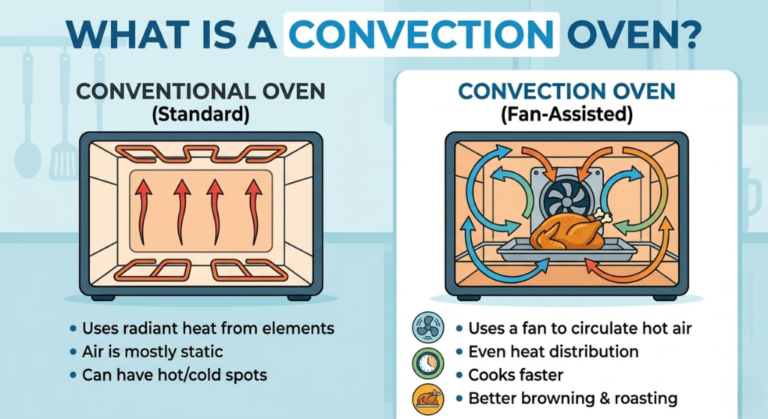
A standard oven heats food through two mechanisms: radiation (heat energy travelling directly from the hot oven walls and elements to the food surface) and natural convection (hot air rising and cooler air falling in a slow, passive cycle within the oven cavity). Natural convection is slow and uneven — the top of the oven is hotter than the bottom, the centre is cooler than the edges near the elements, and rotating racks mid-cook is standard practice to compensate for uneven heat distribution.
Heat Transfer in a Convection Oven
A convection oven adds a third mechanism: forced convection. A fan (positioned at the back of the oven cavity in most designs) circulates hot air continuously and rapidly across all surfaces of the food. This does two important things:
- Disrupts the boundary layer: Food in still air develops a thin layer of cooler air directly at its surface — this boundary layer insulates the food and slows heat transfer. The fan’s moving air disrupts this layer, exposing the food surface directly to hot air and significantly increasing the rate of heat transfer.
- Equalises temperature throughout the cavity: The fan distributes heat more evenly than natural convection, eliminating most hot spots and cold spots and allowing multiple racks to cook simultaneously with more consistent results.
The Practical Result
These two mechanisms produce three observable cooking differences: food cooks approximately 25% faster, browning occurs more evenly across the food’s surface, and the exterior of food dries more quickly — which produces crispier crusts on bread, cracklier skin on poultry, and better caramelisation on vegetables.
Imagine drying your hair with a standard towel versus a hand dryer. The towel absorbs moisture slowly; the dryer evaporates it instantly. The convection fan does the same thing to the moisture on food surfaces — it removes it faster, which allows the Maillard reaction (browning) to begin sooner and proceed more aggressively.
Convection vs Standard Oven — Side by Side
✅ Convection Mode (Fan On)
- Cooks 25–30% faster at the same temperature
- More even heat distribution across all racks
- Better browning and caramelisation
- Crispier surfaces on roasted meats and vegetables
- Multiple trays cook more evenly simultaneously
- Pastry shells hold shape better
- Roast chicken skin becomes crispier
- Less need to rotate trays mid-cook
✅ Standard Mode (Fan Off)
- Better for delicate rises (cakes, soufflés)
- Gentler for custards and egg-based dishes
- Less drying — better for moisture-retaining braises
- More predictable for established recipes
- Meringues won’t crack from air movement
- Cheesecakes cook more evenly without hot spots
- Bread with a soft crust benefits from still air
Types of Convection Ovens
True Convection vs Standard Convection — The Difference That Matters
If you’re shopping for a new oven, this distinction is the single most important specification to understand.
Standard Convection
Standard convection ovens add a fan to the back wall of a conventional oven cavity. The fan circulates air that is heated by the same top and bottom elements as a standard oven. The limitation: the circulated air has uneven temperature because it comes from different positions relative to the heating elements — air near the top element is hotter than air near the cooler back wall before it passes the fan.
True / European Convection
True convection (also called European convection or third-element convection) adds a dedicated heating element that wraps around or surrounds the fan itself. This means the fan circulates air that is heated immediately before it is distributed — producing air of more consistent temperature from the moment it leaves the fan. The result is more even heat distribution, particularly on the middle and lower racks that receive less direct radiation from the top element in standard convection.
When to Use Convection Mode
The convection setting improves results in a wider range of cooking tasks than most people realise. Use it for all of these:
When NOT to Use Convection
Convection is not universally better. For these tasks, turn the fan off:
Converting Standard Recipes to Convection
Any standard oven recipe can be adapted for convection mode with two adjustments. Understanding why these adjustments work helps you apply them confidently to any recipe.
The Two Universal Conversion Rules
The Third Option: Keep Time and Temperature and Accept Differences
Some experienced convection cooks use the same temperature and time as the original recipe but accept and embrace the differences that result: a darker, crispier exterior, a slightly drier surface, and faster browning. For roasted meats and vegetables, these differences are improvements. For baked goods, they’re usually not — apply the temperature and time reductions for baking.
Conversion Chart
Baking in a Convection Oven
Baking is where convection mode generates the most confusion — partly because some baked goods love convection and others are harmed by it, and the line between them is not always intuitive.
Baked Goods That Benefit from Convection
- Cookies: Convection is the definitive cookie-baking mode. Even heat distribution means both trays bake evenly simultaneously; the fan promotes quicker browning of the bottom and edges; and the slightly drying effect produces a crispier exterior with a chewy centre — the ideal texture for most cookies.
- Scones and biscuits: The fan drives out moisture quickly, producing a firmer, more evenly browned exterior. Scones in convection mode rise well and develop better colour than standard mode.
- Puff pastry and croissants: Convection produces dramatically better puff pastry results — faster puffing, more even colour, crispier layers. The fan-assisted moisture evaporation helps the laminated fat layers expand rather than stewing in steam.
- Biscotti: The double-bake, low-moisture biscuit style is ideal for convection — the fan accelerates the second bake that produces the hard, dry texture.
- Pizza crusts: A crispier base results from the fan’s ability to quickly dry the bottom surface of the dough.
- Choux pastry (profiteroles, éclairs): Convection produces better puff and more even shell development — but reduce temperature by 25°F to prevent the shells browning before the interior has dried fully.
Baked Goods That Need Standard Mode
- Layer cakes, pound cakes, sponge cakes: The fan creates turbulence that causes uneven rise, peaked tops, and premature surface setting. Use standard mode for any cake that requires a stable, even rise.
- Angel food and chiffon cakes: These foam-based cakes are particularly sensitive to air movement. Standard mode is essential.
- Quick breads (banana bread, zucchini bread): The fan can produce a cracked top and dry exterior before the interior cooks through. Standard mode at the recipe temperature.
- Yeast breads with soft crusts: Convection’s drying effect produces harder crusts than most soft bread recipes intend. Use standard mode; switch to convection for the final 10 minutes only if a crisper crust is desired.
- Custard-based tarts: Same reasoning as cheesecakes — slow, even, still heat is required for proper custard set.
Roasting in a Convection Oven
Roasting is where convection mode shines most clearly and most consistently. Nearly every roasting task benefits from turning the fan on.
Whole Roast Chicken
The convection oven is the single best tool for roast chicken at home. The fan circulates hot air around the entire bird simultaneously — including beneath the chicken (if elevated on a rack) — producing more even browning across the back, sides, and top than standard mode. The skin becomes crispier because the moving air continuously removes moisture from the surface. A 1.5 kg chicken in a convection oven at 375°F takes approximately 55–60 minutes; the same bird in standard mode at 375°F takes 75–80 minutes.
The technique: pat the bird completely dry with paper towels — critically important in convection mode, where wet surfaces steam rather than brown. Season generously (extra seasoning is needed as the fan dries the surface quickly). Elevate on a rack over a roasting tin to allow air circulation beneath the bird. Do not cover or tent with foil during convection roasting — that traps moisture and defeats the purpose.
Roast Vegetables
Convection mode produces roasted vegetables with properly caramelised, slightly crisp edges rather than the soft, steamed result common in standard oven roasting. The key difference: cut uniformly, toss in oil, spread in a single layer with space between pieces (overcrowding steams regardless of oven mode), and roast at 400–425°F. Broccoli, Brussels sprouts, cauliflower, carrots, and potatoes all produce dramatically better results in convection — the moving air dehydrates the cut surfaces quickly, concentrating flavour and accelerating Maillard browning.
Large Roasts (Beef, Pork, Lamb)
Convection is the correct mode for large roasts. The even heat distribution eliminates the problem of the outer surface overcooking while the interior lags behind — the consistent air temperature around the entire roast produces more even internal temperature gradients. This means less of the “grey band” (overcooked outer layer) common in standard oven roasts, and better colour development across the full roast surface.
15 Tips for Better Convection Oven Results
Five more tips worth knowing:
- Preheat fully: Convection ovens with a third element preheat faster than standard ovens — but still require a full preheat to reach temperature stability before food is added. Never skip the preheat, particularly for baking.
- Don’t crowd the oven: Even with convection, packing the oven with multiple large dishes restricts airflow and reduces the fan’s effectiveness. Leave at least 1–2 inches between dishes and the oven walls.
- Moisture-adding techniques still work: A small pan of water on the oven floor adds steam — useful for the first 15 minutes of bread baking (promotes oven spring) before being removed for the final crust-developing phase with the fan running.
- Lower racks cook better for pizza: Despite convection’s even heat, pizza benefits from the bottom rack’s proximity to the lower heating element, which crisps the base. Use convection mode on the bottom rack position.
- Check oven temperature with a separate thermometer: Many ovens run 15–25°F above or below their stated temperature. A separate oven thermometer confirms your actual temperature and explains any consistent over or under-browning results.
Convection Oven vs Air Fryer
The most common question about convection ovens in 2026 is how they compare to air fryers. The answer is more nuanced than most sources suggest.
Are They the Same Thing?
An air fryer is essentially a compact, very powerful convection oven — it uses the same hot circulating air principle. But the differences in chamber size and fan power produce meaningfully different results:
The most useful kitchen setup has both — a convection oven for batch cooking, large roasts, and baking, with an air fryer for weeknight quick cooks and anything that benefits from maximum crispiness at small scale. For a full comparison, see our Air Fryer vs Oven guide.
Countertop Convection Ovens
Countertop convection ovens offer the benefits of convection cooking in a compact, energy-efficient format that sits on the counter rather than being built into the kitchen. They are particularly useful for:
- Small households where a full-size oven is inefficient for 1–2 person meals
- Supplementary cooking capacity during holiday or entertaining cooking
- Renters who cannot install or modify built-in appliances
- Kitchens where the main oven lacks convection
Countertop Convection vs Full-Size Convection
Countertop models preheat dramatically faster (5–8 minutes vs 12–18 minutes for full-size) and use significantly less electricity per cook. The Breville Smart Oven Air Fryer Pro is the most tested and recommended countertop convection model — it offers 13 cooking functions including Air Fry, Bake, Roast, Broil, and Proof, handles up to a 13-inch pizza and a 9×13-inch casserole dish, and produces results comparable to full-size convection for everything that fits within its capacity. See our full Best Toaster Oven 2026 guide for detailed comparisons across all countertop models.
What to Look for When Buying a Convection Oven
Energy Efficiency — Does Convection Save Money?
Convection ovens are meaningfully more energy-efficient than standard ovens for the same cooking outcome — and the savings compound over years of daily use.
Why Convection Uses Less Energy
Because convection cooking is 25–30% faster, the oven runs for 25–30% less time to produce the same result. A roast that takes 90 minutes in standard mode and 65 minutes in convection mode uses roughly 28% less electricity for that cook. The lower temperature setting (25°F reduction) contributes additional savings — lower operating temperature means the heating elements cycle on less frequently to maintain the set temperature.
Over the course of a year of regular home cooking, this efficiency advantage is genuine and measurable — estimates from energy researchers suggest convection cooking saves between 20–30% of oven energy use compared to standard mode for equivalent cooking outcomes. In practical terms: a household using the oven 5 times per week saves approximately 50–80 kWh per year switching to convection for appropriate tasks, depending on local energy rates and cooking habits.
Countertop Convection Efficiency
Countertop convection ovens are far more energy-efficient than full-size ovens for small-batch cooking — they have smaller cavities to heat, shorter preheat times (5–8 minutes vs 12–18 minutes for a full oven), and better heat retention per cubic inch of cooking volume. For cooking tasks that fit within a countertop oven’s capacity, using the countertop unit instead of the full oven saves significant energy. The rule of thumb: if your food fits in the countertop oven, use it. Reserve the full-size oven for large roasts, multiple racks, and batches that exceed countertop capacity.
Convection Oven Troubleshooting
These are the most common problems reported by convection oven owners and their solutions.
Quick Reference: Convection Mode by Food Type
A fast reference for every common kitchen task — whether to use convection or standard mode.
Frequently Asked Questions
Understanding Your Oven’s Convection Settings
Modern ovens often have multiple convection-labelled modes whose differences are not clearly explained in the manual. Here is what the common settings actually mean.
Convection Bake
Uses the fan with the lower heating element as the primary heat source, and the upper element cycling on periodically. Best for baked goods — the bottom heat promotes even baking from below, and the fan distributes it evenly through the cavity. Use this mode for cookies, pastries, scones, and most baked items. This is the mode to use when you want the benefits of convection without aggressive top browning.
Convection Roast
Uses the fan with both elements active — the upper broil element cycles on and off more aggressively than in Convection Bake. The result is more intense surface browning and a faster-crisping exterior. Best for whole poultry, large beef roasts, and vegetables where deep exterior caramelisation is the goal. This is not the mode for baking — the active upper element will over-brown most baked goods.
Convection Broil
The broil element runs at full power while the fan circulates the intense heat. Produces faster, more even broiling than standard broil mode — particularly useful for browning the tops of gratins, finishing off roasted meats, and caramelising the sugar on crème brûlée (if you don’t have a kitchen torch). The fan’s air movement means the browning is more even across the full surface rather than concentrated directly under the element.
What to Do When Your Oven Only Says “Convection”
Many ovens — particularly older models and countertop units — have a single “Convection” setting without distinguishing between bake and roast modes. In this case the oven’s electronics automatically manage element usage based on the set temperature: lower temperatures favour the bottom element more (bake-style), while higher temperatures bring the top element in more actively (roast-style). Use this single convection setting with the standard temperature and time reductions and it will behave appropriately for the cooking task. Understanding exactly which mode is active at any moment — and why it uses the heating elements it does — removes the guesswork from convection cooking and allows you to make deliberate, informed choices for every task rather than relying on trial and error.
The Proof / Low-Heat Setting
Many convection ovens include a Proof setting (typically 80–100°F / 27–38°C) that uses the fan at very low speed to maintain a slightly warm, draft-free environment ideal for yeast dough proofing. This setting produces more consistent, faster rises than proofing at room temperature — particularly in cold kitchens. If your oven has it, use it for all yeasted bread and pizza dough recipes that call for room-temperature proofing. The Proof setting is one of the most practically useful low-profile oven features available, and the majority of owners who have it never use it simply because it is not prominently documented in most oven manuals.
Related Guides
Which wins for each cooking task? A 25-food side-by-side comparison.
The best countertop convection ovens — all models tested and ranked.
35 techniques every air fryer owner should know.
Top-rated air fryers tested at every price point.