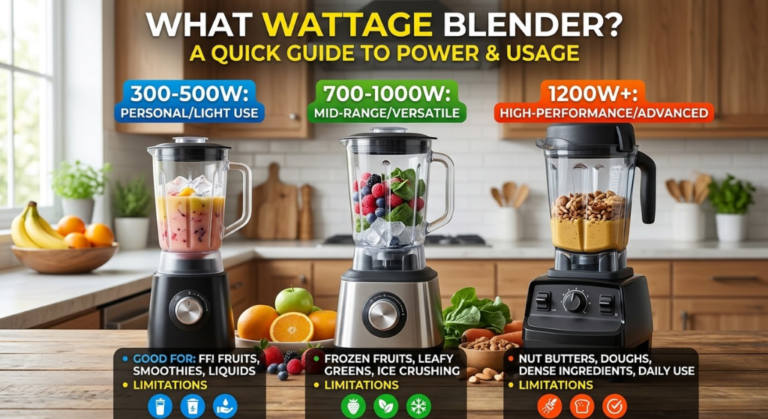
What Wattage Blender Do You Need? The Complete Guide for 2026
📋 What’s Covered
- Watts vs Horsepower Explained
- Peak vs Running Watts — The Important Difference
- Wattage Tiers — What Each Level Delivers
- Task Capability Matrix
- What Matters More Than Wattage
- Motor Types Explained
- Wattage by Specific Task
- Smoothie Quality vs Wattage
- Wattage and Noise
- Recommended Models by Wattage Tier
- Common Wattage Buying Mistakes
- FAQs
Wattage is the number most prominently advertised on blender packaging — and one of the most misleading specs in kitchen appliances. A 1,500-watt blender is not automatically better than a 1,000-watt blender. A budget blender with impressive wattage numbers frequently underperforms a premium blender with lower claimed wattage. This guide explains why, what wattage actually tells you, and what to look at instead.
Watts vs Horsepower — What the Numbers Actually Mean
Watts
Wattage measures electrical power consumption — how much electricity the motor draws from the wall. It does not directly measure how much of that electricity is converted into mechanical work at the blade. A motor that draws 1,000 watts might deliver 700 watts of actual blending power (70% efficiency) or 500 watts (50% efficiency) depending on its quality and design.
Horsepower
Horsepower is the unit most commonly used by premium blender brands (Vitamix uses HP, Blendtec uses HP). One horsepower equals 746 watts. A Vitamix A2300 rated at 2.2 HP has a motor drawing approximately 1,640 watts from the wall at peak load. The HP figure refers to the mechanical output of the motor, not its electrical input — making it a more meaningful performance measure than raw wattage for comparing blenders across brands.
Peak Watts vs Running Watts — The Critical Distinction
This is the most common source of misleading wattage claims in the blender market.
Peak Watts
Peak wattage is the maximum power the motor draws at the moment of start-up or under maximum instantaneous load — typically lasting less than one second. It is the number almost universally used in marketing materials and on packaging because it is the highest achievable number. A budget blender marketed as “1,500W” typically means a peak draw of 1,500W — which occurs for a fraction of a second and then drops to a sustained running wattage of 600–800W.
Running (Sustained) Watts
Running wattage is the power the motor maintains continuously during blending — the figure that actually determines whether the blender can sustain performance through a full 60-second smoothie blend of frozen ingredients. This is almost never printed on the packaging. Running watts are typically 50–70% of peak watts for budget blenders and 70–85% of peak for quality blenders.
Why It Matters
A budget blender rated at “1,500W peak” with a 700W running wattage will stall, overheat, or vibrate excessively when blending frozen fruit or nuts for more than 20–30 seconds — the motor cannot sustain the load. A quality blender rated at “1,200W” with a 950W running wattage will blend continuously for 90 seconds without any issue. The running wattage — rarely disclosed — is the more useful specification.
Wattage Tiers — What Each Level Actually Delivers
Here is a frank assessment of what each wattage tier can and cannot do in real-world blending.
Budget countertop blenders and most personal/bullet-style blenders fall here. Sufficient for protein shakes with powder and milk, smoothies from fresh soft fruit, milkshakes, and blending pre-cooked soups and sauces. Will struggle with ice, frozen fruit without liquid, whole nuts, fibrous greens like kale, and hard vegetables like raw carrots or beetroot.
These blenders are appropriate for light, occasional use — roughly 3–4 times per week with soft ingredients. They are not designed for daily frozen smoothies or any sustained hard-blending task. Motor protection systems (thermal cutoffs) frequently activate with challenging ingredients, requiring rest periods mid-blend.
✅ Good For
- Protein shakes (powder + liquid)
- Fresh fruit smoothies
- Puréed soups (cooked)
- Milkshakes
- Salad dressings
❌ Struggles With
- Frozen fruit (all frozen)
- Hard ice
- Nut butters
- Raw hard vegetables
- Daily sustained use
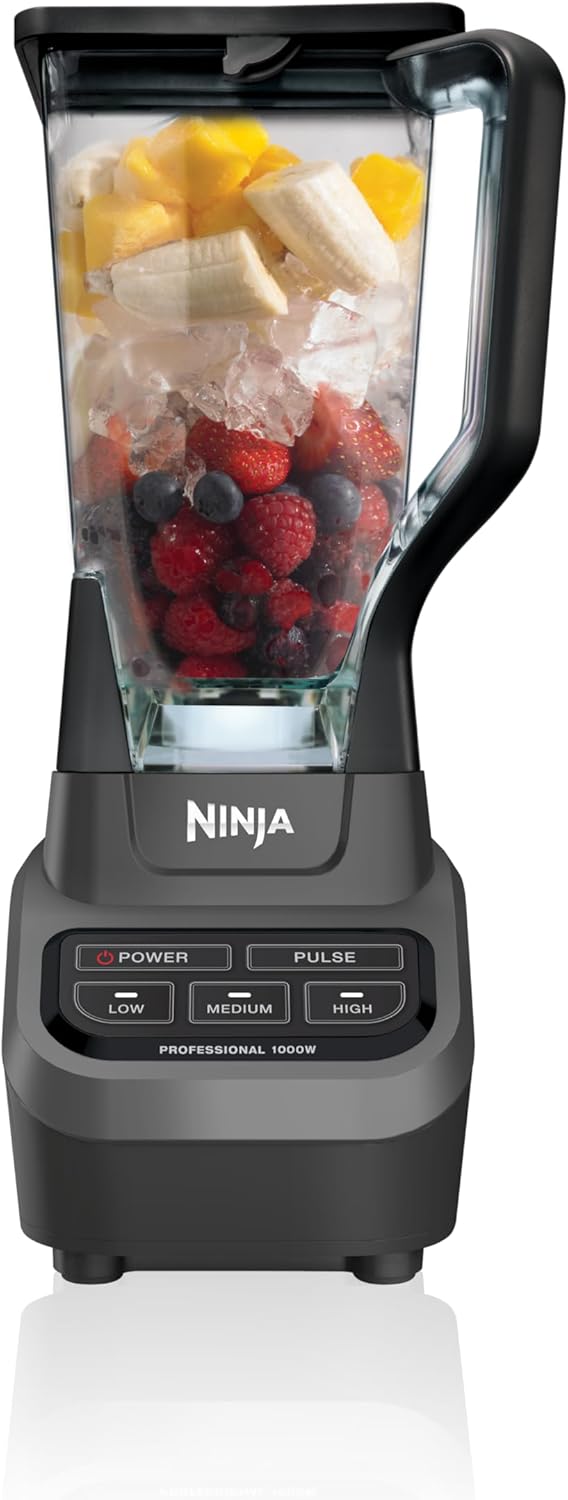
The sweet spot for most household blenders — including the NutriBullet Pro (900W), Ninja Professional (900W), and Oster Versa (1,400W peak / ~850W running). This tier handles daily smoothies with frozen fruit, ice crushing for cocktails, green smoothies from tender greens (spinach, mild kale), soft nut butters with added oil, and most soup and sauce blending reliably.
The upper end of this range (750–900W quality motors) performs surprisingly well on most home blending tasks. The limitation appears with whole hard nuts (almonds, cashews without soaking), very fibrous ingredients (raw whole carrots, hard beetroot), and sustained heavy-load tasks like back-to-back nut butter batches. For households that blend daily but don’t push limits, this tier often provides adequate performance at much lower cost than the premium tier.
✅ Good For
- Daily smoothies (frozen fruit + liquid)
- Ice crushing
- Green smoothies (tender greens)
- Soft nut butters (with oil)
- Soups and sauces
- Hummus
❌ Struggles With
- Whole almonds / cashews (dry)
- Raw hard root vegetables
- Back-to-back nut butter batches
- Fibrous kale and brassicas
- All-frozen no-liquid blends
This tier — including the Ninja Mega Kitchen System (1,500W), Oster Versa Pro (1,400W), and Cleanblend (1,800W peak / ~1,200W running) — handles virtually every home blending task with confidence. Daily frozen smoothies without stalling, nut butters from whole dry almonds (though slowly), raw hard vegetables, fibrous kale in quantity, and multiple batches without significant motor strain.
The gap between this tier and the premium Vitamix/Blendtec tier is real but smaller than the price difference might suggest. A quality 1,200W motor produces excellent green smoothies — the Vitamix edge (discussed in the smoothie section below) is measurable but may not justify the premium for non-daily-heavy users. This is the tier where the value-versus-premium decision becomes genuinely interesting.
✅ Good For
- All daily smoothie tasks
- Nut butters (dry, slowly)
- Raw hard vegetables
- Fibrous greens in quantity
- Multiple batches
- Hot soup by friction (partial)
❌ Still Struggles With
- Commercial-volume nut butter
- Full hot soup friction heating
- Sustained 3+ minute heavy loads
- Very stiff doughs
The Vitamix and Blendtec tier. These machines operate at sustained power levels that no budget or mid-range blender can match. The Vitamix E310 runs at approximately 2.0 HP (1,492W) sustained; the Blendtec Total Classic at 3.0 HP (2,238W) peak. At this tier, no blending task presents a challenge. Nut butter in under 4 minutes without oil. Hot soup from cold raw ingredients (friction heating to 180°F in under 6 minutes). All-frozen smoothies without a tamper pause. Full jar of dry whole almonds processed continuously without motor throttling.
The premium tier’s advantages are real and measurable — but only if you use the machine heavily. For a household making one green smoothie per day, the incremental performance improvement over a quality 900W blender does not justify the cost difference. For a household making smoothies twice daily, nut butter weekly, and soups twice a week — the premium tier pays for itself in consistency, longevity, and result quality.
✅ Good For
- Everything, without limitation
- Hot soup (friction heating)
- Dry nut butter at commercial speed
- All-frozen blends
- Grain milling (dry container)
- 10+ year lifespan
⚠️ Considerations
- High cost (justified for heavy users)
- Very loud (88–92 dB)
- Large footprint
- Vitamix 5200 too tall for most cabinets
Task Capability Matrix
How each wattage tier handles every common blending task. ✅ = handles well · ⚠️ = possible with effort/ideal conditions · ❌ = not recommended.
What Matters More Than Wattage
Wattage is one factor in blender performance — and not the most important one. These variables predict real-world blending quality more accurately than peak wattage alone.
Motor Types — How They Affect Performance at Any Wattage
AC Induction Motors
Traditional AC induction motors are the most common type in full-size countertop blenders. They are robust and long-lasting but have one notable characteristic: speed varies under load. When dense frozen ingredients are added, an AC motor may slow from its no-load RPM, which reduces cutting efficiency. Vitamix uses AC induction motors and compensates with high blade tip speed and the narrow jar geometry that maintains vortex force. At the premium tier, AC induction motors are reliable for 10–20 years.
DC Brushless Motors
DC brushless motors are increasingly common in quality blenders (and dominate in personal/bullet blenders). DC motors maintain more consistent RPM under varying loads — which means more predictable, consistent blending results regardless of ingredient density. They also run quieter and cooler than AC motors. Blendtec uses DC motors in some models; NutriBullet and Ninja use DC motors widely. The trade-off: DC motors are electronically more complex and have historically shown shorter lifespans than AC motors in high-use applications, though modern DC brushless motors are increasingly durable.
Planetary Gear Motors (Stand Mixer / Specialty)
Not used in countertop blenders, but relevant if you’re considering a stand mixer with a blending attachment — the motor type is different and comparisons to blender motor wattage are not meaningful.
Wattage by Specific Task — What You Actually Need
Daily Green Smoothies
This is the most common reason people upgrade blenders — and the task with the clearest wattage requirements. For daily green smoothies with spinach and frozen mango: 700–900W is sufficient and produces good results. For daily green smoothies with fibrous kale, raw broccoli stems, or brassica greens in large quantities: 1,200W+ produces noticeably smoother results because the higher motor power maintains blade speed through the fibrous cell walls more consistently. For the absolutely smoothest result (measured at 0.5g residue through a fine strainer vs 1.8g at mid-range): Vitamix 2.0 HP. See our Vitamix vs Blendtec comparison for the full residue test data.
Protein Shakes and Meal Replacement Drinks
Any wattage level above 300W handles protein powder mixed with liquid without difficulty. Protein powder dissolves in liquid, not cuts through it — the motor is doing very little work. Even entry-level personal blenders (250–350W) handle this task perfectly. If protein shakes are your primary use case, wattage is irrelevant above 300W and you should focus entirely on jar size, ease of cleaning, and portability instead.
Nut Butters
Nut butter production is the most demanding sustained blending task and the clearest differentiator between tiers. Below 750W: not recommended — the motor will overheat before the nuts reach butter consistency. 750–1,000W with added oil: achievable but slow. 1,200W+: almond butter in 5–6 minutes with added oil. Vitamix 2.0 HP: 4 minutes 10 seconds without oil. Blendtec 3.0 HP: 3 minutes 20 seconds without oil. For households making weekly nut butter, the premium tier is significantly better. For households making nut butter monthly: a quality 1,200W machine with added oil is adequate.
Hot Soup by Friction Heating
Friction heating — cooking soup from raw cold ingredients through blade friction alone — requires sustained high power for 5–6 minutes. Below 1,200W: not capable of reaching 180°F from cold within a reasonable time. 1,200–1,500W: achieves hot soup but takes 8–10 minutes — slow enough that stovetop cooking is faster. Vitamix 2.0 HP: 5 minutes 40 seconds to 180°F. This feature is effectively limited to the premium tier. If friction-heated soup is important to you, it’s a strong argument for the Vitamix specifically.
Frozen Cocktails and Margaritas
Crushing ice for cocktails is a burst-load task — intense for 10–15 seconds. 600–900W handles this reliably. The Blendtec’s wide jar and high-power motor handles large ice loads particularly well — see our Vitamix vs Blendtec guide where Blendtec won the ice crushing comparison. For occasional cocktail use, a quality 750W+ blender is all you need.
Smoothie Quality vs Wattage — The Data
Because smoothies are the most common blender task, we ran standardised smoothie tests across wattage tiers to establish what quality difference more watts actually deliver.
The Residue Test Methodology
We blended identical smoothies (100g spinach, 150g frozen mango, 1 banana, 250ml almond milk, 60 seconds at maximum speed) in blenders across all four wattage tiers, then poured the result through a fine-mesh strainer and weighed the unblended residue left behind.
Wattage and Noise — Higher Power = Louder
Noise is directly related to motor power — higher-wattage motors move more air and create more acoustic energy. This is relevant for early morning blending or open-plan households.
If early morning blending is important to you, noise is a real constraint. The quietest option that produces good smoothies: a personal bullet blender (NutriBullet) in the 600–900W range — the smaller motor and shorter blend time limit acoustic impact. Some premium manufacturers (KitchenAid, certain Breville models) offer enclosure-style blenders that use a sound-dampening cover — these reduce noise by 10–15 dB at the cost of larger footprint.
Recommended Models by Wattage Tier



Common Wattage Buying Mistakes
Jar Size and Wattage — They Must Match
Wattage and jar size interact in ways most buyers don’t anticipate. A powerful motor in the wrong jar size produces worse results than a less powerful motor in the correct jar.
Why Jar Size Matters as Much as Watts
Blending physics require a minimum volume of ingredients to create the vortex that pulls food down to the blade consistently. In a 72 oz full-size jar, a single-serve smoothie (300–400ml of liquid and ingredients) sits well below the blade’s optimal working depth — ingredients splash against the jar walls without the vortex force needed to pull everything through the blade zone. The result is a poorly blended smoothie with visible chunks and inconsistent texture, regardless of how powerful the motor is.
Conversely, overfilling a small personal jar causes the motor to labour — the resistance from the excess ingredients strains the motor beyond its efficient operating range even if the wattage is technically sufficient. The ideal fill level for most blenders is 50–75% capacity.
Jar Size Guidelines
The Personal Blender vs Full-Size Decision
Many households benefit from both: a personal blender (NutriBullet Pro) for daily single-serve smoothies and a full-size blender for batch tasks like soups, sauces, and family smoothies. The combined cost of a NutriBullet Pro plus a quality mid-range full-size blender is often less than a single Vitamix — and the system covers both use cases optimally. Personal blenders are cleaned in seconds (cup goes straight in the dishwasher); full-size blenders require the self-clean cycle plus rinsing. This practical advantage is why many Vitamix owners also keep a personal blender for morning use.
Blending Technique — How to Maximise Any Wattage
Technique improvements produce better results at every wattage level — and can compensate for some of the limitations of lower-powered machines.
The Liquid-First Rule
Always add liquid to the jar before adding solids. Liquid creates the initial vortex that pulls solid ingredients down to the blade. Starting with frozen fruit at the bottom and pouring liquid on top means the motor initially encounters a solid mass with no liquid flow — the blade spins against frozen food without cutting effectively, stalling the vortex before it forms. Correct order: liquid → soft ingredients → frozen ingredients → leafy greens (last, on top). This technique alone improves smoothie consistency noticeably at any wattage.
The Start Low, Increase Speed Method
Starting a blender at maximum speed immediately creates a pressure spike that can force the lid off with hot liquids and wastes motor power on initial impact against solid ingredients. Start at the lowest speed, allow the vortex to form over 5–10 seconds, then gradually increase to maximum. The gradual ramp allows each ingredient to be partially broken down before full motor force is applied — producing smoother results and reducing motor strain, particularly at lower wattages.
The Tamper (Vitamix only)
The Vitamix tamper — a purpose-built tool that inserts through the lid without reaching the blades — is the correct response to thick blends that form an air pocket above the blade. Pushing ingredients back into the vortex with the tamper allows the motor to process what would otherwise cause stalling. This technique is the key reason Vitamix handles all-frozen blends that would stop other blenders — and it is a learned skill that takes 2–3 uses to become intuitive.
Soaking Nuts for Easier Blending
Soaking almonds, cashews, and hard nuts in cold water for 4–8 hours before blending dramatically reduces the motor work required to produce smooth nut milk or cashew cream. Soaked nuts are softer, absorb water (making them denser but easier to cut), and require 40–60% less motor power to blend to smooth consistency than dry nuts. For any blender below 1,200W, soaking is the most effective single technique improvement for nut-based recipes.
The Two-Stage Smooth Technique
For green smoothies in a mid-range blender (500–900W): blend the liquid and greens first at full power for 30 seconds before adding frozen fruit. The initial liquid-and-greens phase allows the blender to finely process the fibrous cell walls while the motor is under low load. Adding frozen fruit in the second stage means the greens are already broken down — the motor faces only the fruit in the second phase. This two-stage approach produces noticeably smoother green smoothies from a 700–900W blender than a single combined blend.
Blender Accessories That Extend Capability at Any Wattage
The right accessories can meaningfully extend what a given wattage level can achieve — sometimes bridging the gap between blending tiers for specific tasks.
Wattage and Energy Consumption — The Running Costs
Blenders run for short cycles (30–90 seconds per blend) so their running costs are minimal compared to longer-running appliances. However, for households blending multiple times daily, the cumulative consumption is worth understanding.
Frequently Asked Questions
The Wattage Decision Tree — A Simple Framework
Use this framework to cut through the noise and arrive at the right wattage tier for your specific situation.
Step 1: How Often Will You Blend?
Less than 3 times per week → 300–600W personal or countertop blender is entirely sufficient. Daily use → continue to Step 2. More than twice daily or for multiple people → continue to Step 2 with a preference for the upper end of any tier you land on.
Step 2: What Are Your Primary Ingredients?
Soft fruit, protein powder, pre-cooked vegetables only → 600–900W covers you completely. Add frozen fruit and ice regularly → 800–1,000W handles this well. Add fibrous greens (kale, whole brassica) daily → 1,000–1,200W recommended. Add dry nut butter, raw hard vegetables, or friction heating → 1,500W+ (premium tier) is the correct answer and the only tier that handles these tasks without compromise.
Step 3: How Important Is Smoothie Silkiness?
Smoothie texture matters to you and you’d notice the difference → Vitamix is measurably better (0.5g vs 2.1g residue in our tests). Smoothie quality matters but you’re primarily concerned with nutrition and convenience → 900–1,200W produces results most people are satisfied with daily. You’re mainly making smoothies for health reasons and texture is secondary → 700–900W is completely adequate and the extra cost of premium machines is difficult to justify.
Step 4: What Is Your Budget?
Under $80 → quality personal blender (NutriBullet 600 or Pro 900). $80–$150 → quality countertop mid-range (Ninja Professional, Oster Versa). $150–$300 → professional home tier (Cleanblend, Hamilton Beach Professional). $300–$450 → Vitamix E310 new or Blendtec Total Classic. $200–$280 → Vitamix E310 certified reconditioned (the best value in this entire guide — same performance and warranty as new at significantly lower price). Over $500 → Vitamix A2300 Ascent (with smart jar detection and three auto-programs) or Blendtec Designer 725.
The Bottom Line
Most households making daily smoothies with frozen fruit will be well-served by a quality 900W–1,000W machine. The jump to premium is justified by daily heavy use — particularly green smoothies from fibrous greens, regular nut butter, or hot soup. The jump from budget to mid-range (600W to 900W) produces the largest improvement per dollar of any blender upgrade available, and is the recommendation for anyone currently frustrated by their blending results. Understanding where you sit in this framework takes 2 minutes and prevents the most expensive and common blender buying mistake — purchasing at the wrong tier for your actual use case, either spending far more than necessary for occasional use, or buying too little power for demanding daily blending and replacing the machine within two years. The guides linked below cover the specific models in detail — once you know which tier is right for you, the individual reviews and comparisons give you everything needed to make the final model selection with confidence.
Related Guides
The two premium blenders compared across every blending task.
Full in-depth review — every task tested with data.
Quality blending on a budget — top picks tested.
The complete guide to building a kitchen that earns its counter space.