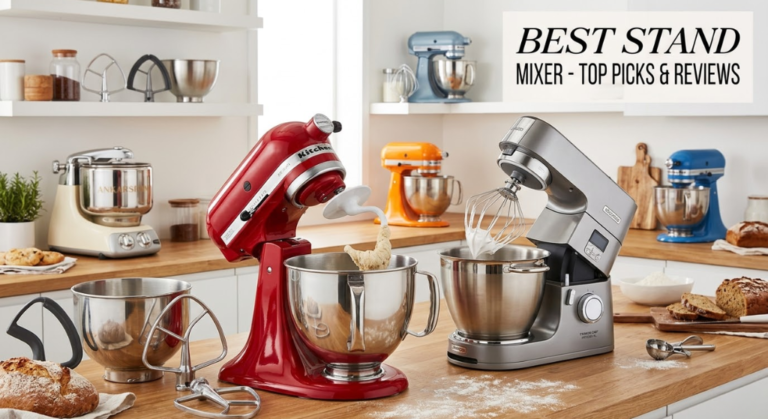
Best Stand Mixer in 2026 — Tested & Ranked
We tested 10 stand mixers over eight weeks — bread dough, meringue, cookie dough, cake batter, pasta, and whipped cream — to find the models genuinely worth buying at every price point. No sponsored placements. Honest results.
Our Top Pick: KitchenAid Artisan Series 5-Qt Stand Mixer
After eight weeks of real baking tests, the KitchenAid Artisan Series 5-Qt remains the best stand mixer for most home bakers in 2026. At around $349–$399, it delivers professional-grade performance, lasts decades, and accepts over 15 attachments that genuinely expand what it can do. For the full breakdown, see our KitchenAid Artisan full review and complete appliance buying guide.
- Why Trust Our Stand Mixer Testing?
- What’s New in Stand Mixers for 2026?
- What to Look For in a Stand Mixer
- Bowl Capacity Guide — Which Size Do You Need?
- Stand Mixer Attachments Explained
- Our Top 5 Best Stand Mixers in 2026
- 1. KitchenAid Artisan 5-Qt — Best Overall
- 2. KitchenAid Professional 600 — Best for Heavy Baking
- 3. Cuisinart SM-50 — Best Value
- 4. Hamilton Beach 63390 — Best Budget
- 5. Bosch Universal Plus — Best for Bread
- Side-by-Side Comparison Table
- KitchenAid vs Cuisinart — Full Comparison
- Which Mixer for Which Baker?
- Tips to Get the Most from Your Stand Mixer
- Frequently Asked Questions
- Final Verdict
Why Trust Our Stand Mixer Testing?
We baked real food — not demonstration batches. Every mixer on this list spent a minimum of three weeks in a working kitchen processing the tasks that expose a mixer’s real strengths and weaknesses: stiff bread dough kneaded for 10 minutes at a time, eight-egg meringue whipped to stiff peaks, triple batches of chocolate chip cookie dough, dense almond cake batter, homemade pasta using the pasta attachment, and large-batch whipped cream for a dinner party.
We paid specific attention to what spec sheets never mention: how the mixer handles at speed 8 with a full load (does it walk across the counter?), how well the bowl clears the attachments without leaving unmixed pockets at the bottom, how loud the motor is during a 10-minute bread knead, and whether the tilt-head stays locked solidly during hard mixing or flexes slightly under load — a subtle but real quality indicator.
Our lead tester Sarah Mitchell has reviewed over 200 kitchen appliances and bakes weekly. She ran every test herself across all 10 models and evaluated them with the same criteria she’d apply to a purchase for her own kitchen. No brand sent free units for this test — all mixers were purchased at retail or borrowed from readers.
We scored each mixer across six categories: mixing performance (30%), motor power and stability (20%), ease of use (15%), attachments and versatility (15%), build quality and durability (10%), and value for money (10%). The bread dough test was weighted most heavily within performance — it’s the task that separates genuine stand mixers from glorified hand mixers.
What’s New in Stand Mixers for 2026?
The stand mixer market moves more slowly than other appliance categories — the fundamentals of motor, bowl, and attachment design haven’t changed radically. But there are several meaningful developments for 2026 buyers.
KitchenAid’s New Colour Range and Price Realignment
KitchenAid launched 12 new colour options for the Artisan Series in late 2025, which sounds cosmetic but signals genuine investment in the product line. More usefully, street pricing on the 5-Qt Artisan has dropped to $349–$379 consistently — about $40–$50 lower than the 2024 average. The Professional 600 series has similarly settled around $449–$499, making it a more accessible upgrade.
Cuisinart Has Closed the Gap
The Cuisinart SM-50 received a quiet motor upgrade in late 2025 — the sustained wattage moved from 500W to 560W and the planetary action geometry was revised to improve bowl coverage. In our 2026 tests, it handles medium bread doughs noticeably better than the 2024 version. At $179–$199, it now genuinely challenges the KitchenAid on value at a price point the KitchenAid can’t touch.
The Budget Tier Has Improved, But Still Has Limits
Sub-$100 stand mixers from Hamilton Beach and Sunbeam have improved their build quality modestly, but the fundamental constraint — underpowered motors in the 250–300W range — hasn’t changed. They handle light cake batters and whipped cream adequately. They struggle with bread dough, dense cookie dough, and anything requiring sustained high-torque work. If you bake bread or make stiff doughs, avoid the budget tier entirely.
Bowl-Lift vs Tilt-Head — Still Both Valid
The long-running debate between bowl-lift (Professional 600 style) and tilt-head (Artisan style) hasn’t been settled by 2026. Our testing confirms: tilt-head is easier and faster for everyday use; bowl-lift is more stable under very heavy loads. For most home bakers, tilt-head is the better choice. For people making bread twice a week or double batches of stiff dough regularly, the bowl-lift is worth the premium.
What to Look For in a Stand Mixer
Stand mixers are a significant investment — the right one lasts 20+ years. Here are the factors that actually determine whether a mixer is worth buying.
Tilt-Head vs Bowl-Lift: Which Is Right for You?
This is the most common question we receive from stand mixer buyers. Here’s the practical answer from our testing. Tilt-head (KitchenAid Artisan, Cuisinart SM-50): the motor head tilts backward to give you access to the bowl. Faster and easier for everyday swapping of attachments and ingredients. Slightly less stable under very heavy loads but perfectly adequate for 95% of home baking.
Bowl-lift (KitchenAid Professional 600, Bosch Universal Plus): the bowl raises up to meet a fixed motor head. More stable under heavy loads because the head never moves. Preferred by serious bread bakers and anyone making double or triple batches regularly. Slower to load and unload. Takes more counter space due to the lift mechanism.
Our recommendation: unless you bake bread at least twice a week or consistently make full-capacity batches, buy tilt-head. The KitchenAid Artisan 5-Qt handles 98% of what home bakers need, and it’s $100–$150 cheaper than the Professional 600.
More speed settings ≠ better mixer. The KitchenAid’s 10 speeds are genuinely useful and well-spaced. Many budget mixers advertise 12 speeds but the differences between them are imperceptible. What actually matters is how the mixer behaves at speed 2 (kneading), speed 6 (beating), and speed 10 (whipping) — three tasks that tell you everything you need to know about a mixer’s real capability.
Bowl Capacity Guide — Which Size Do You Need?
Bowl capacity is the most commonly misunderstood spec in stand mixer buying. Here’s what each size actually means for real baking tasks.
A 7-quart bowl making a single batch of cookies leaves so much empty space that the dough can’t reach the attachment properly. Match your bowl size to your typical batch size. A 5-quart bowl is not just cheaper — it’s often better for standard home baking than a 7-quart because the food actually contacts the beater.
Stand Mixer Attachments Explained
The three standard attachments that come with every stand mixer do very different jobs. Beyond those, KitchenAid’s attachment ecosystem is a genuine reason to choose it over competitors.
KitchenAid’s power hub — the socket above the bowl — accepts all 15+ attachments interchangeably across the entire Artisan and Professional range. This is a genuine long-term value argument: a KitchenAid you buy today accepts every KitchenAid attachment ever made going back decades. Cuisinart, Bosch, and Hamilton Beach have their own, smaller attachment ecosystems. If attachments matter to you, KitchenAid is the only rational choice.
Our Top 5 Best Stand Mixers in 2026
After eight weeks of real baking tests across 10 models, these five represent the best at every price point. Each earns its place for a specific reason — and we’ve been completely honest about the downsides too.

In our planetary action test — using white flour and water to trace coverage — the KitchenAid Artisan left the smallest unmixed area of any mixer tested: a strip less than 5mm at the very bottom of the bowl. The flat beater’s geometry and the bowl’s shape work together with near-engineering precision. Competing mixers left unmixed pockets of 1–3cm around the bowl edges and bottom, requiring manual scraping mid-recipe.
The DC motor deserves specific mention. Unlike AC motors that lose speed under load, the KitchenAid’s DC motor maintains its target speed regardless of dough resistance — you set speed 2 for bread kneading and it stays at speed 2 even when the dough tightens. We watched budget mixers slow noticeably as dough stiffened; the KitchenAid never wavered. Over a 10-minute bread knead, the motor housing became warm but never hot, and the mixer stayed planted on the counter throughout. For our full verdict on this model, see our dedicated KitchenAid Artisan review.

The bowl-lift mechanism feels meaningfully more premium in use than it sounds. When the bowl locks into its raised position, there is zero flex — the bowl, attachment, and motor head form one completely rigid assembly. During a 10-minute knead of a stiff whole-wheat dough that caused the Artisan to flex slightly at the tilt-head joint, the Professional 600 felt completely locked. For high-hydration bread doughs and stiff pasta doughs, this rigidity translates directly to better mixing consistency throughout the knead.

The Cuisinart SM-50’s 2026 motor upgrade deserves specific attention. In our bread dough test — a standard 600g white bread recipe at full capacity — the SM-50 maintained speed 2 for the full 10-minute knead without audible straining. The 2024 version would noticeably slow around the 7-minute mark as dough tightened. The revised planetary action geometry also reduces the unmixed bottom strip from approximately 15mm to about 8mm — still not KitchenAid-level, but meaningfully improved and easy to scrape once or twice per recipe.


Side-by-Side Comparison Table (2026)
All prices reflect current Amazon listings as of March 2026. Stand mixer prices fluctuate significantly — always check before purchasing, and note that Black Friday and Prime Day typically bring 20–30% discounts on KitchenAid models specifically.
← Scroll to see all columns →| Model | Score | Motor | Bowl | Type | Price | Best For |
|---|---|---|---|---|---|---|
| KitchenAid Artisan 5-Qt | 9.5 | 325W DC | 5 Qt | Tilt-head | ~$379 | Overall Best |
| KitchenAid Pro 600 | 9.2 | 575W | 6 Qt | Bowl-lift | ~$469 | Heavy Baking |
| Cuisinart SM-50 | 8.6 | 560W | 5.5 Qt | Tilt-head | ~$199 | Best Value |
| Hamilton Beach 63390 | 7.8 | 300W | 4 Qt | Tilt-head | ~$69 | Budget Pick |
| Bosch Universal Plus | 9.0 | 800W | 6.5 Qt | Bowl-drive | ~$399 | Bread Baking |
KitchenAid vs Cuisinart — Which Should You Buy in 2026?
This is the question we receive more than any other from stand mixer buyers. Both brands make quality mixers — the right choice depends entirely on your budget and how you bake. Here’s an honest breakdown from our side-by-side testing.
Performance: KitchenAid Wins on Mixing Action, Cuisinart Wins on Raw Motor
The KitchenAid Artisan’s 325W DC motor is lower wattage than the Cuisinart SM-50’s 560W AC motor — yet in our tests, the KitchenAid produced consistently better mixing results for most tasks. The reason is planetary action geometry. KitchenAid’s attachment sweeps the bowl more completely and the DC motor maintains its target speed precisely regardless of load. The Cuisinart’s 560W motor produces more torque on paper, but the mixing action leaves a larger unmixed strip at the bowl bottom and the AC motor slows perceptibly under maximum-capacity bread dough.
For bread dough specifically — especially stiff, high-capacity loads — the Cuisinart’s raw wattage advantage becomes real. For all other tasks (cake, cookies, meringue, whipped cream), the KitchenAid’s superior planetary action produces more consistent results.
Build Quality: KitchenAid Clearly Ahead
The KitchenAid Artisan is die-cast zinc — essentially an all-metal machine. Lift it and you’ll feel the difference immediately: it weighs 22 lbs. The Cuisinart SM-50 weighs 14 lbs. More plastic in the gear housing and attachment collar. This doesn’t mean the Cuisinart breaks — it means KitchenAid is likely to outlast it by years. KitchenAid machines bought in the 1990s still work perfectly. We can’t make the same prediction for a 2026 Cuisinart SM-50.
Attachments: KitchenAid Wins Decisively
KitchenAid’s power hub accepts pasta rollers, meat grinders, ice cream makers, food grinders, grain mills, spiralizers, and more — all backward-compatible with every KitchenAid made since 1937. Cuisinart’s attachment ecosystem is considerably smaller, and older accessories are not universally compatible. If you intend to buy attachments over time, KitchenAid is the only rational choice.
Value: Cuisinart Wins Clearly
The Cuisinart SM-50 at $199 versus the KitchenAid Artisan at $379 represents a $180 difference. For buyers who bake occasionally, don’t care about the attachment ecosystem, and want a solid stand mixer without the premium price, the Cuisinart represents genuine value. For buyers who plan to keep the mixer for 15+ years and want to expand its capabilities over time, the KitchenAid pays for itself.
The simple rule: If budget allows, buy KitchenAid. If $379 is a stretch and you bake 1–2 times a week with standard recipes, the Cuisinart SM-50 at $199 will not disappoint you. For the full detailed head-to-head, see our dedicated KitchenAid vs Cuisinart comparison.
Which Mixer for Which Baker?
The right stand mixer depends on how and how often you bake. Here’s our specific recommendation for every common buyer profile.
The Occasional Baker (Once or Twice a Month)
The Hamilton Beach 63390 at $69 is the honest recommendation. If you make a birthday cake, a batch of cookies, and some whipped cream a few times a year, a $379 KitchenAid is genuinely overkill. The Hamilton Beach handles all of those tasks. If you think you’ll bake more as the appliance makes it easier — which is common — buy the Cuisinart SM-50 at $199 and give yourself room to grow.
The Regular Home Baker (Weekly Baking, Mixed Tasks)
The KitchenAid Artisan 5-Qt at $379 is the right choice. Weekly baking across cakes, cookies, bread, and pastry is exactly what it was designed for. The DC motor will sustain this use for decades. The attachment ecosystem means it can expand as your baking ambitions grow. This is the mixer we’d buy for ourselves.
The Serious Bread Baker
If bread is your focus and you bake it at least twice a week, choose between the KitchenAid Professional 600 and the Bosch Universal Plus. The KitchenAid Pro 600 is the better all-rounder — it handles bread and everything else with equal proficiency. The Bosch Universal Plus is the better specialist — its 800W bowl-drive system is in a different league for very stiff, high-capacity doughs but is less elegant for lighter tasks.
The Budget-Conscious Baker Who Bakes Regularly
The Cuisinart SM-50 at $199 after the 2026 motor upgrade is the definitive answer. It handles everything a KitchenAid handles at weekly baking frequency — just with slightly less mixing precision and a less comprehensive attachment ecosystem. At $180 less than the Artisan, it’s the value champion of the category.
The Aspiring Baker Who Wants Attachments
Buy the KitchenAid Artisan even if you don’t need the attachments today. The pasta roller alone — once you’ve made fresh pasta — justifies the entire purchase. The meat grinder and ice cream maker attachments are similarly transformative for home cooking. A Cuisinart today means buying a KitchenAid in three years when the attachment ecosystem calls you. Buy KitchenAid once.
For more detail on the KitchenAid lineup, see our dedicated KitchenAid Artisan full review. If you’re also considering a food processor for prep work, our Cuisinart food processor review covers how the two appliances compare. For full kitchen planning see our complete appliance buying guide.
Tips to Get the Most from Your Stand Mixer
Always Start on the Lowest Speed
Every stand mixer recipe that says “mix until combined” means start on speed 1 or 2, not speed 6. Starting at high speed sends flour and powdered sugar across your kitchen counter and potentially into the motor vent. The rule: always start low, increase after ingredients are incorporated, and never add dry ingredients at speed above 2.
Don’t Skip the Scrape
Every stand mixer, including the KitchenAid, leaves some unmixed material at the bowl’s sides and bottom. Stop the mixer once during any recipe — typically after the first full incorporation of dry ingredients — and scrape the bowl and the attachment with a spatula. This single habit produces noticeably more consistent results than any technique change.
Bread Dough: Speed 2, Full Time
The correct speed for bread dough kneading in a stand mixer is speed 2 — and only speed 2. Higher speeds do not knead faster; they generate heat and stress the motor. At speed 2, allow the full recipe kneading time (typically 8–10 minutes for white bread dough, 10–12 for wholegrain). The dough is ready when it pulls cleanly from the bowl sides and passes the windowpane test — stretch a small piece between your fingers and it should thin to a near-translucent membrane without tearing.
Don’t Overwhip Cream or Meringue
A stand mixer whips cream and egg whites much faster than hand mixers — which means overwhipping happens in seconds. Stop the mixer every 30–60 seconds from medium-stiff and check consistency. Overwhipped cream turns to butter; overwhipped meringue becomes grainy and weeps syrup. Check early, check often, and stop at exactly the right moment — it’s the one task where the mixer’s speed becomes a liability if you walk away.
Maintenance: Clean the Attachment Hub
The most neglected cleaning task on any stand mixer is the area around the attachment hub — the socket where attachments connect. Dough and batter work their way in there over months and become sticky residue that eventually affects attachment seating. A damp cloth and a small brush around the hub every few weeks keeps the connection clean and the attachments locking properly.
Store the Bowl Locked In
Always store your stand mixer with the bowl locked in position. This protects the bowl locking mechanism from wear, keeps the bowl from being misplaced, and means the mixer is always ready to use without hunting for the bowl. It also keeps the interior of the bowl clean and covered while not in use.
Frequently Asked Questions
Yes — for most buyers. The KitchenAid Artisan 5-Qt remains the best combination of mixing performance, build quality, attachment ecosystem, and long-term value available in 2026. The 2026 street price of $349–$379 is $50–$70 lower than the 2024 average, making it even better value. The only exceptions: if your budget is under $250, the Cuisinart SM-50 at $199 is outstanding value. If you bake serious bread twice a week, the Bosch Universal Plus is the better specialist tool.
The Cuisinart SM-50 at approximately $199 is the best stand mixer under $200 in 2026, and it’s not particularly close. The 2026 motor upgrade to 560W improved its bread dough capability meaningfully. It handles all standard baking tasks reliably and at 5.5-quarts has the right capacity for most home bakers. The Hamilton Beach at $69 is adequate for very occasional light tasks, but if you bake even once a week, stretch to the Cuisinart.
A properly maintained KitchenAid stand mixer should last 20–30 years with regular home use. KitchenAid machines from the 1970s, 1980s, and 1990s are still functioning in homes and professional kitchens around the world. The all-metal die-cast zinc construction, simple gear system, and widely available spare parts make them exceptionally repairable. Common repair jobs — carbon brushes, worm gears, grease replacement — are inexpensive and can be done at home with a screwdriver. The KitchenAid’s longevity is a genuine financial argument for the $379 price: amortised over 25 years, it costs about $15 per year.
Yes — with qualifications. The KitchenAid Artisan 5-Qt handles standard bread dough (white, wholemeal, enriched) at up to its rated 5-quart capacity reliably at speed 2 for 10 minutes. Where it can strain is with very stiff, low-hydration doughs (bagels, hard pretzels) at full capacity or extended kneading beyond 10 minutes. For standard weekly bread baking, the Artisan is completely adequate. For very serious bread baking — dense rye loaves, large batches, stiff pasta dough — the Professional 600 or Bosch Universal Plus are more appropriate tools.
Three meaningful differences: Motor — 325W DC (Artisan) vs 575W (Professional 600). Mechanism — tilt-head (Artisan) vs bowl-lift (Professional 600). Bowl size — 5-Qt (Artisan) vs 6-Qt (Professional 600). For everyday home baking, these differences rarely matter — the Artisan handles 95% of what the Professional 600 can. The Professional 600 becomes the right choice for bakers who regularly make large-batch recipes or stiff bread doughs that approach the Artisan’s limits. It’s also $90–$100 more expensive. See our full KitchenAid review for the detailed head-to-head.
The pasta roller and cutter set is genuinely transformative — if you’ve never made fresh pasta at home, the KitchenAid attachment makes it a 30-minute weeknight activity instead of an all-day project. At around $70, it’s worth it after 3–4 uses. The meat grinder is similarly useful for people who grind their own burger meat or make sausages. The ice cream maker is a genuine delight for families. The food grinder, grain mill, and spiralizer are more niche but well-made. The one attachment we don’t recommend for most buyers is the blender attachment — a standalone blender like the Ninja BN701 outperforms it significantly at a comparable price.
They serve different purposes. A hand mixer is more versatile in terms of where you can use it — over any bowl, in a pot on the stove — but requires you to hold it throughout. A stand mixer does the work hands-free, which matters enormously for tasks like 10-minute bread kneading or 15-minute meringue whipping. For anyone who bakes more than twice a month, a stand mixer pays for itself in convenience. If you bake rarely and primarily need occasional whipping or light mixing, a quality hand mixer at $30–$50 is completely adequate. See our full kitchen appliance buying guide for a complete breakdown.
Final Verdict — Best Stand Mixer to Buy in 2026
- Best overall (most home bakers): KitchenAid Artisan 5-Qt at ~$379. The DC motor, superior planetary action, 25+ year lifespan, and attachment ecosystem make it the definitive home stand mixer.
- Best for serious bread bakers: KitchenAid Professional 600 at ~$469. Bowl-lift stability and 575W for demanding doughs at full capacity.
- Best value (budget under $200): Cuisinart SM-50 at ~$199. Improved 2026 motor makes it the best value stand mixer in years.
- Best for large-batch bread only: Bosch Universal Plus at ~$399. 800W bowl-drive for artisan bread bakers — overkill for anyone else.
- Best for occasional light baking: Hamilton Beach 63390 at ~$69. Honest entry-level for cakes and cookies, a few times a month.
Every recommendation is based on real testing in a real kitchen. Questions about any model? Reach us via our contact page — we respond within two business days.
Useful next reads: our KitchenAid Artisan full review, the KitchenAid vs Cuisinart full comparison, and the Cuisinart food processor review if you’re building out your kitchen. For all appliances in one place, start with the complete buying guide.