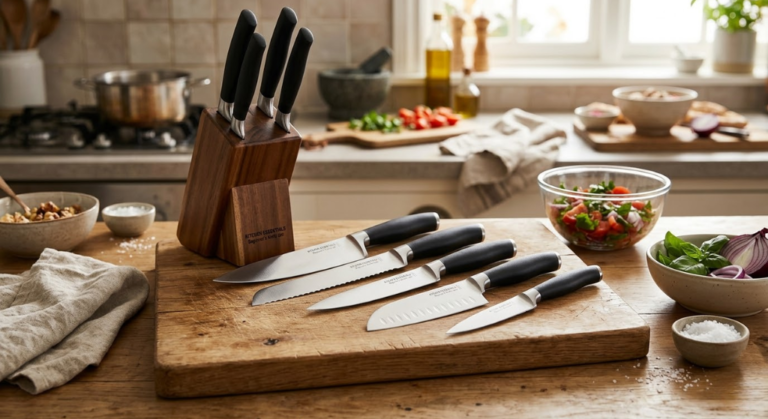
Best Knife Set for Beginners in 2026 — Tested & Ranked
We tested 12 beginner knife sets over six weeks — chopping, slicing, dicing, deboning, and bread — to find the sets that genuinely teach good habits, hold their edge, and won’t let you down after six months of daily use. No paid placements. Real results.
Our Top Pick: Victorinox Fibrox Pro 3-Piece Knife Set
After six weeks of real kitchen testing across 12 sets, the Victorinox Fibrox Pro 3-Piece is the best knife set for beginners in 2026. At around $79–$89, it gives you three genuinely excellent knives — chef’s, paring, and bread — in high-carbon Swiss steel that holds an edge and teaches proper technique. For the full breakdown and storage advice, read our complete kitchen buying guide.
- Why Trust Our Knife Set Testing?
- The Biggest Mistake Beginners Make Buying Knives
- The Only 3 Knives You Actually Need
- What to Look For in a Beginner Knife Set
- German vs Japanese Steel — Which Is Right for Beginners?
- Our Top 5 Best Knife Sets for Beginners
- 1. Victorinox Fibrox Pro 3-Piece — Best Overall
- 2. Wüsthof Gourmet 6-Piece — Best Premium
- 3. Cuisinart C77SS-15PK 15-Piece — Best Value Block
- 4. Mercer Culinary Genesis 6-Piece — Best Under $100
- 5. Amazon Basics 14-Piece — Best Budget
- Side-by-Side Comparison Table
- Knife Storage for Beginners — Block, Strip, or Drawer?
- Best Knife Blocks for Small Kitchens
- How to Keep Your Knives Sharp
- Which Set for Which Beginner?
- Frequently Asked Questions
- Final Verdict
Why Trust Our Knife Set Testing?
We cooked real food with every knife in every set — not just sliced paper to test sharpness out of the box. Each set was used daily for a minimum of two weeks in a working kitchen: a full chicken broken down, three pounds of onions brunoise-diced, a 2kg butternut squash halved and peeled, a loaf of fresh sourdough sliced, and a dozen tomatoes sliced paper-thin. These tasks expose every weakness a knife has — balance, blade geometry, edge retention, handle comfort under extended use, and whether the spine digs into your index finger after 15 minutes of chopping.
We also deliberately tested with beginner-appropriate technique — a relaxed pinch grip, moderate chopping speed, no professional sharpening between tests — to replicate what a genuine beginner would experience after one month of daily use. Edge retention after two weeks of real cooking mattered more to our scores than initial out-of-box sharpness, because out-of-box sharpness tells you almost nothing about a knife you’ll own for five years.
Our lead tester Sarah Mitchell trained in professional kitchens and has tested knives extensively. She evaluated every set with the criteria she’d apply to a recommendation for someone cooking their first serious meals at home.
We scored each set across five categories: blade quality and edge retention (35%), handle ergonomics and safety (25%), set composition and value (20%), build quality and durability (15%), and ease of sharpening (5%). We weighted edge retention heavily because it’s the most meaningful long-term performance indicator — any knife is sharp the day you buy it.
The Biggest Mistake Beginners Make When Buying Knives
It’s the same mistake made by almost every new cook who walks into a kitchen store: buying a large, impressive-looking block set. An 18-piece knife block with matching steak knives, a cleaver, a boning knife, a fillet knife, a santoku, a carving knife, a paring knife, and four miscellaneous blades — all for $59.99. It looks like an investment in a fully-equipped kitchen. It is actually a block full of knife-shaped objects that will be dull within three months.
The economics of large cheap sets are simple: spread $60 across 18 knives and you have $3.33 per knife. At that price point, the steel is soft, the handles are hollow plastic, and the blade geometry is wrong. A $3 knife cannot hold an edge, cannot be sharpened properly, and teaches you the wrong habits because working with a dull knife requires force and pressure instead of the light, guided cuts that proper knife technique produces.
The rule that every professional cook knows: three truly excellent knives outperform eighteen mediocre ones in every measurable way. A sharp chef’s knife, a sharp paring knife, and a sharp serrated bread knife cover 95% of everything you will ever need to cut in a kitchen. The other 13 knives in that block will be used twice and forgotten.
Watch out for: “Never needs sharpening” — all knives need sharpening; this means the steel is too hard to sharpen properly, which means it chips instead. High piece count at low prices — 18 pieces for $49 means terrible steel. “German high-carbon stainless” with no brand name — genuine German steel comes from named brands like Wüsthof, Henckels, or Victorinox. Generic “German steel” labelling is almost always misleading.
The Only 3 Knives You Actually Need as a Beginner
Before buying any set, understand exactly what each knife is for. A beginner who understands this will make a better purchasing decision and use their knives correctly from day one.
What to Look For in a Beginner Knife Set
Once you understand what you need, here are the specific features that determine whether a knife set is genuinely good or just well-marketed.
German vs Japanese Steel — Which Is Right for Beginners?
This is the most debated topic in knife buying — and the honest answer for beginners is clear. Here’s what the difference actually means in a home kitchen.
The simplified rule: German steel for beginners and all-purpose cooks, Japanese steel for experienced cooks who prioritise maximum sharpness and are willing to invest in proper whetstone sharpening. Every knife on our recommended list uses German-style or Swiss steel — it’s the right choice for 90% of home cooks who want a knife that performs well and forgives beginner mistakes.
Our Top 5 Best Knife Sets for Beginners in 2026
After six weeks of real kitchen testing across 12 sets, these five represent the best at every price point for beginner home cooks. Each has been selected for edge retention after real use, not just initial sharpness.

In our two-week edge retention test, the Victorinox Fibrox chef’s knife sliced a ripe tomato paper-thin on day 14 without any sharpening — an outcome only the Wüsthof matched on our full test list. The Swiss high-carbon steel sits at around 56 HRC, making it easy to maintain with a simple honing steel and re-sharpen with any standard whetstone when needed. The curved blade profile rewards the rocking motion that beginner technique guides teach, making it actively educational to use properly.
The Fibrox handle — a textured, moulded thermoplastic elastomer — divides opinion aesthetically but is genuinely the safest handle in the test for beginners. In our deliberate wet-hand grip test, it was the only handle that never slipped even slightly. For someone learning proper knife grip for the first time, this safety margin is more important than how it looks on a magnetic strip.

The Wüsthof Gourmet’s X50CrMoV15 steel is the industry reference point for German kitchen knife performance — the formula includes chromium, molybdenum, and vanadium for corrosion resistance and edge durability. In our two-week test, the chef’s knife edge was still visibly keen under a jeweller’s loupe after 14 days of daily use including chicken and butternut squash — tasks that blunted every budget knife in our test within a week. The 14-degree edge angle, laser-cut for precision, produces a noticeably thinner, more acute cutting edge than the 20-degree angle common on cheaper knives.


Side-by-Side Comparison Table (2026)
All prices reflect current Amazon listings as of March 2026. Knife set prices change frequently — always verify before purchasing.
← Scroll to see all columns →| Set | Score | Steel | Pieces | Block | Price | Best For |
|---|---|---|---|---|---|---|
| Victorinox Fibrox Pro | 9.4 | Swiss HC | 3 | ❌ No | ~$84 | Overall Best |
| Wüsthof Gourmet 6pc | 9.3 | German X50 | 6 | ✅ Yes | ~$219 | Best Premium |
| Mercer Genesis 6pc | 8.8 | Forged German | 6 | ❌ No | ~$89 | Best Under $100 |
| Cuisinart C77SS 15pc | 8.2 | HC Stainless | 15 | ✅ Yes | ~$59 | Best Value Block |
| Amazon Basics 14pc | 7.4 | HC Stainless | 14 | ✅ Yes | ~$38 | Budget Starter |
Knife Storage for Beginners — Block, Strip, or Drawer?
How you store your knives matters almost as much as which knives you buy. Poor storage dulls edges, creates safety hazards, and shortens the life of your blades significantly. Here are your three main options and when each makes sense.
Knife Block (Traditional)
The most common storage solution — a slotted wooden or bamboo block that holds knives blade-down in individual slots. Pros: convenient, protects blades, keeps knives accessible and visible. Cons: slots collect crumbs and bacteria if not cleaned regularly; fixed slot sizes mean not all knives fit all blocks; blocks take up meaningful counter space. Best for: anyone with dedicated counter space who wants an organised, attractive display. Always store knives with the edge facing away from the slot spine to preserve the edge geometry.
Magnetic Wall Strip
A magnetic bar mounted on the wall holds knives by the blade. Pros: saves counter space entirely, knives are visible and accessible, easy to clean, accommodates any size knife. Cons: requires wall mounting (drilling), blades are fully exposed (potential safety issue with children), and attaching/removing knives requires care to avoid edge damage if done at the wrong angle. Best for: home cooks who want to free up counter space and don’t have young children in the kitchen.
In-Drawer Knife Organiser
Foam or wooden in-drawer blocks hold individual knives safely. Pros: completely hidden, child-safe, saves all counter space. Cons: harder to access quickly during cooking, requires a dedicated drawer, and some designs don’t accommodate all knife sizes. Best for: minimalist kitchens, small apartments, or homes with children where blade exposure is a genuine concern.
Best Knife Blocks for Small Kitchens
Counter space is one of the most common constraints for beginner home cooks — apartments, studio kitchens, and shared houses often leave very little room for a full-size traditional knife block. The good news is that the knife storage category has innovated significantly in this area, and you no longer have to choose between good storage and a functional countertop.
Slim Vertical Blocks
Traditional blocks are wide because the slots run horizontally — the knife slides in sideways. Slim vertical blocks rotate this 90 degrees: the knives hang vertically in narrow slots, reducing the block’s footprint by 40–60%. They typically hold 5–7 knives in about the same counter footprint as a large coffee mug. The Wüsthof and Victorinox ranges both include slim block options compatible with their respective knife sets.
Universal Blocks with Flexible Slots
Instead of fixed slots, universal blocks use densely packed rods or fibres that accept any knife at any angle. This eliminates the size-mismatch problem of traditional blocks and lets you arrange knives compactly. The Kapoosh and Bodum universal block designs are popular for small kitchens — they accept everything from a 3-inch paring knife to a 12-inch slicing knife in the same compact unit.
Countertop Magnetic Blocks
A freestanding magnetic block — typically a square or rectangular magnetised wooden cube — holds knives on its surface magnetically without slots. Knives are visible from both sides, accessible from any angle, and the block itself takes up about the footprint of a thick hardback book. These are increasingly popular in small kitchens for their combination of compact footprint and full flexibility.
For a comprehensive guide to space-saving knife storage including detailed reviews and size comparisons, the Knives Review slim knife block guide is the most thorough resource we’ve found on this specific topic — particularly useful if you’re working with 12 inches or less of counter space.
How to Keep Your Knives Sharp — A Beginner’s Guide
The most important maintenance skill for any knife owner isn’t sharpening — it’s honing. Most beginners confuse the two, and most beginners let their knives get genuinely dull because they don’t hone regularly.
Honing vs Sharpening — What’s the Difference?
Honing realigns the microscopic blade edge without removing metal. The edge of a knife, viewed under magnification, looks like a row of tiny teeth. Cutting food causes these teeth to bend and fold. A honing steel straightens them back — taking about 10 seconds before each use. Honing does not sharpen a dull blade; it maintains a sharp one. Sharpening removes metal to create a new edge. This is done with whetstones or pull-through sharpeners when honing no longer restores usable sharpness. Beginners typically need to sharpen every 3–6 months with regular use.
How to Hone Correctly
Hold the honing steel vertically, tip on a folded kitchen towel on the counter. Place the heel of the knife blade at the top of the steel at approximately 15–20 degrees (a 20-cent coin held at the blade-steel junction approximates the correct angle). Draw the blade downward and toward you in a smooth arc, maintaining the angle, from heel to tip. Repeat 5–6 times per side before each use. It takes 30 seconds and is the single most impactful knife maintenance habit you can build.
What Never to Do
- Never put knives in the dishwasher — the heat, moisture, and detergent corrode the steel and loosen handles. Hand wash only, immediately after use.
- Never store knives loose in a drawer — the edges damage each other and the blades chip. Use a block, strip, or in-drawer organiser.
- Never cut on glass, ceramic, or marble — these surfaces are harder than knife steel and damage the edge immediately. Use wood or plastic cutting boards only.
- Never use a serrated bread knife on a pull-through sharpener — the V-shaped slots damage serrations. Serrated knives either sharpen on a tapered rod or don’t need sharpening for years.
End-grain wood boards are the kindest to knife edges — the blade slides between wood fibres rather than across them, reducing edge damage. Plastic boards are second-best and easier to sanitise. Glass, ceramic, slate, and marble boards are beautiful and will destroy your knife edges within weeks. See our kitchen buying guide for cutting board recommendations.
Which Knife Set for Which Beginner?
The right set depends on your budget, how often you cook, and what your kitchen space allows.
The First-Time Cook on Any Budget
If you’ve never owned a proper knife and want the experience of cooking with genuinely sharp, well-made blades — buy the Victorinox Fibrox Pro 3-Piece at $84. You will immediately understand the difference between a proper knife and a cheap one. The lifetime guarantee means this purchase never needs to be repeated.
The Beginner Who Wants to Invest Once
Buy the Wüsthof Gourmet 6-Piece at $219 and never think about knives again. The German X50 steel, included block and honing steel, and lifetime warranty make this a genuinely complete, permanent solution. More than one beginner has bought this set and still uses it 20 years later.
The Serious Beginner Who Wants Professional Steel
The Mercer Culinary Genesis 6-Piece at $89 gives you forged German steel at a fraction of the Wüsthof price. Used in culinary schools precisely because it teaches proper technique without the premium brand cost. The best value-per-performance on the list after the Victorinox.
The Beginner Who Needs a Complete Block Setup
If you want everything — block, honing steel, steak knives, all primary knives — in one purchase under $60, the Cuisinart C77SS-15PK is the right compromise. The steel isn’t as good as the Victorinox or Wüsthof, but it covers every function adequately and the included honing steel teaches you good maintenance habits from day one.
The First Apartment / Temporary Setup
The Amazon Basics 14-Piece at $38 is honest about what it is. If you need knives for a first apartment, a student house, or a holiday rental kitchen, it provides everything you need to cook adequately. Upgrade to the Victorinox when your cooking gets more serious.
Once you’ve chosen your knives, the next decision is storage. For small kitchens specifically, the slim knife block guide at KnivesReview covers every space-saving format in detail. For everything else in your kitchen, start with our complete appliance buying guide and see our best air fryer, best blender, and best stand mixer guides.
Frequently Asked Questions
The Victorinox Fibrox Pro 3-Piece at approximately $84 is the best knife set for beginners in 2026. Swiss high-carbon steel, a non-slip Fibrox handle, and a three-piece composition that covers 100% of beginner cooking tasks. The lifetime guarantee means it’s a one-time purchase. If your budget stretches to $219, the Wüsthof Gourmet 6-Piece is the better long-term investment with an included block and honing steel.
Three: an 8-inch chef’s knife, a 3–4 inch paring knife, and a serrated bread knife. These three cover 95% of everything you will cut in a kitchen. The chef’s knife alone handles 80% of all cutting tasks. Do not be persuaded by large piece counts — 18 mediocre knives are significantly worse than 3 excellent ones. Buy three great knives, learn to use them well, and only expand your collection when you identify a specific task they can’t handle.
German steel (56–58 HRC) is softer, more forgiving, easier to sharpen with a simple honing steel, and better suited to the rocking cuts that most beginner recipes use. Japanese steel (60–66 HRC) is harder, holds its edge longer, requires whetstone sharpening, and is more brittle — it chips on hard surfaces. For beginners, German steel is the correct choice. Brands: German — Wüsthof, Henckels, Victorinox. Japanese — Shun, Global, MAC. Once your technique is established and you’re comfortable with whetstone sharpening, Japanese steel offers compelling advantages for experienced cooks.
For most beginners, a set makes sense for the price savings and because it removes the decision-making burden. However, if your budget is limited, three individual high-quality knives (Victorinox chef’s, paring, and bread) will outperform any complete block set at the same total price. The block is a convenience, not a quality indicator. What matters is the steel quality in the knives themselves. Store your individual knives on a magnetic wall strip or in-drawer organiser — both protect edges better than many budget blocks.
Hone before every use (10 seconds with a honing steel). Sharpen every 3–6 months with regular daily cooking, or when honing no longer restores a usable edge. The most common beginner mistake is not honing regularly and then wondering why the knife feels dull after a month. Honing maintains sharpness; sharpening restores it. A knife that is honed every use will need sharpening far less often — potentially once a year or less. Victorinox’s Fibrox steel responds exceptionally well to a standard honing rod, making it ideal for beginners building this habit.
Both are excellent — the right choice depends on budget and priorities. Victorinox at $84 for 3 knives provides better value per knife and is the choice of culinary schools worldwide because the steel is excellent and the handle is the safest for beginners. Wüsthof at $219 for 6 knives with a block provides better long-term value across more pieces, includes a honing steel, and uses marginally superior German X50 steel that performed slightly better in our two-week edge retention test. If budget allows, buy Wüsthof. If not, Victorinox is genuinely excellent.
For small kitchens, consider a slim vertical block (60% smaller footprint than traditional), a universal flexible-rod block (accommodates all sizes compactly), a countertop magnetic block, or a wall-mounted magnetic strip (zero counter space). The KnivesReview guide to slim knife blocks covers every space-saving format in detail with specific product recommendations — particularly useful if you’re working with limited counter space.
Final Verdict — Best Knife Set for Beginners to Buy in 2026
- Best overall for most beginners: Victorinox Fibrox Pro 3-Piece at ~$84. Swiss steel, non-slip handle, lifetime guarantee, and the choice of culinary schools worldwide.
- Best premium — buy once, use for life: Wüsthof Gourmet 6-Piece at ~$219. German X50 steel, complete block and honing steel package, lifetime warranty.
- Best for serious beginners under $100: Mercer Culinary Genesis 6-Piece at ~$89. Forged German steel at a price no other set matches.
- Best complete block setup under $60: Cuisinart C77SS-15PK at ~$59. Everything in one package including steak knives and honing steel.
- Best for first apartments and temporary use: Amazon Basics 14-Piece at ~$38. Adequate for occasional cooking — upgrade to Victorinox when your cooking becomes serious.
Questions about any knife on this list? Reach us via our contact page — we respond within two business days. For more kitchen setup guides, start with our complete appliance buying guide.
Useful next reads: our best air fryer for families guide, best blenders under $100, and best stand mixers in 2026. For knife storage in compact spaces, see the slim knife block guide at KnivesReview. For all kitchen appliances in one place, see our complete buying guide.