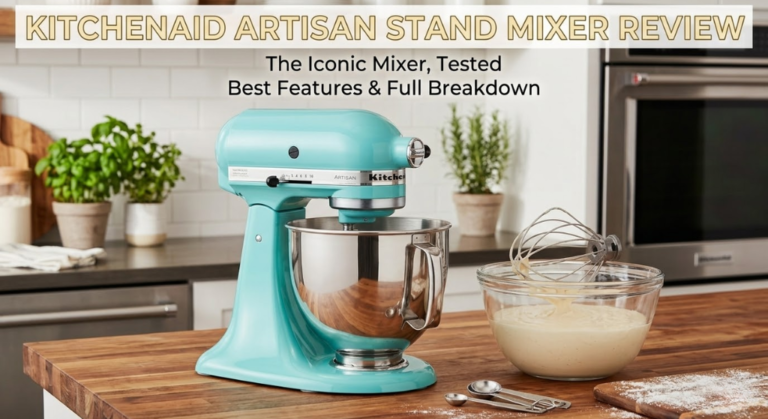
KitchenAid Artisan Stand Mixer Review — Is It Still Worth It in 2026?
We baked with the KitchenAid Artisan 5-Qt for eight weeks — bread dough, meringue, cookie dough, pasta, cake batters, and shortcrust pastry — to give you the most complete honest assessment of whether this $379 machine still earns its iconic status in 2026.
- Overview — The KitchenAid Legacy in 2026
- The Full KitchenAid Lineup — Which Model Is Right for You?
- Full Specifications
- Design, Build Quality & First Impressions
- The DC Motor — What Makes It Different
- Planetary Mixing Action — Why It Matters
- Full Baking Test Results
- Bread Dough
- Meringue & Whipped Cream
- Cookie Dough
- Cake Batter
- Shortcrust Pastry
- Attachments — The Real Case for KitchenAid
- Pros and Cons
- KitchenAid Artisan vs Competitors
- Artisan vs Professional 600 — Which Should You Buy?
- Who Should Buy the KitchenAid Artisan?
- Tips for Getting the Best Results
- Frequently Asked Questions
- Final Verdict
Overview — The KitchenAid Legacy in 2026
The KitchenAid stand mixer has been in continuous production since 1937. The fundamental design — a planetary-action mixing head on a die-cast zinc body, tilting to give access to a stainless bowl — has not changed in its essential architecture in 87 years. This is either a testament to the perfection of the original design or a sign of stagnation, depending on your perspective. After eight weeks of daily baking, we can say definitively that it is the former.
The 2026 Artisan 5-Qt — the subject of this review — retails for $379. That is $70 less than its 2024 average street price, and it is the model we recommend in our best stand mixer guide for most home bakers. The question this review answers in full: does an $87-year-old design with a 325W DC motor still justify nearly $400 in 2026, when competitors like Cuisinart offer 560W motors for $199? The answer is yes — but for specific, clearly articulable reasons that have nothing to do with brand loyalty or aesthetics.
The KitchenAid Artisan 5-Qt is currently available for ~$379 on Amazon — a consistent $70 reduction from its 2024 average price of ~$449. This represents the best time to buy in several years. KitchenAid also runs significant sales during Prime Day and Black Friday, typically 20–25% below street price. If your purchase isn’t urgent, monitoring for those events can save $75–$95.
The Full KitchenAid Lineup — Which Model Is Right for You?
KitchenAid sells multiple stand mixer lines that can be confusing to navigate. Here’s a clear breakdown of every current model before we go deep on the Artisan specifically.
If you bake bread once a week or less and your recipes don’t consistently push the 5-quart capacity limit: buy the Artisan. If you bake bread two or more times a week, regularly make full 5-quart capacity batches, or have found any 5-quart machine inadequate: buy the Professional 600. We cover this head-to-head in detail in the Artisan vs Professional 600 section below.
Full Specifications — KitchenAid Artisan 5-Qt
| Specification | Details |
|---|---|
| Model Number | KSM150PS (and colour variants) |
| Motor | 325W DC motor with soft start |
| Bowl Capacity | 5 quarts / 4.7 litres (stainless steel) |
| Speed Settings | 10 speeds (1 = stir through 10 = high whip) |
| Design | Tilt-head |
| Mixing System | Planetary action (67-point coverage) |
| Included Attachments | Flat beater, dough hook, wire whip, pouring shield |
| Attachment Hub | Power hub — accepts 15+ optional attachments |
| Dimensions | 14.1″ H × 8.7″ W × 14.1″ D |
| Weight | 22 lbs (10 kg) |
| Colours Available | 50+ colours (Empire Red, Onyx Black, Contour Silver, Pistachio, and many more) |
| Bowl Capacity (Recipes) | Up to 9 dozen cookies, 4 loaves bread, 7 lbs mashed potato |
| Warranty | 1 year (parts and labour) |
| Made In | Greenville, Ohio, USA |
| Current Price (March 2026) | ~$379 on Amazon |
Design, Build Quality & First Impressions
Picking up a KitchenAid Artisan for the first time produces an immediate, visceral impression: it is heavy. At 22 lbs, the all-metal die-cast zinc body has a density and solidity that no plastic-housed mixer can replicate. The weight is not incidental — it is the mechanism by which the machine stays planted on the counter during a 10-minute bread knead on speed 2 without needing to be held or moved.
The fit and finish on the 2026 model is exceptional. Every surface is smooth and consistent. The speed lever clicks into position with a mechanical precision that feels satisfying rather than plasticky. The bowl lock mechanism engages solidly with a single twist. The tilt-head locks securely when down and releases cleanly when you press the release button — after 8 weeks and hundreds of bowl attachment and removal cycles, neither mechanism showed any loosening or wear.
The colour options deserve specific mention. KitchenAid offers over 50 colours for the Artisan, from the classic Empire Red and Onyx Black to newer releases like Hibiscus, Sage, and Avocado Cream. This is not trivial marketing — a KitchenAid is typically left permanently on the counter, and its visual presence in the kitchen becomes part of the room’s identity. The colour choice is a real quality-of-life decision that will accompany you for 20+ years. Choose thoughtfully.
The DC Motor — What Makes It Different
The KitchenAid Artisan’s 325W DC motor is one of the most misunderstood specifications in the kitchen appliance category. On paper, 325W looks weak compared to the Cuisinart SM-50’s 560W or the Bosch Universal’s 800W. In practice, the DC motor’s behaviour under load is fundamentally different from an AC motor, and the comparison is more complex than raw wattage suggests.
An AC motor (used in most competitors) operates at a fixed frequency tied to the electrical grid. Under load, AC motors lose speed — you can hear a Cuisinart or Hamilton Beach slow noticeably as bread dough tightens in the bowl. This speed variation is not just annoying; it produces inconsistent mixing results because the mechanical work input varies throughout the kneading cycle.
The KitchenAid’s DC motor actively maintains its target speed regardless of load — a feedback loop continuously adjusts power input to compensate for resistance. The result: speed 2 during bread kneading is literally speed 2 throughout the entire knead, whether the dough is soft and sticky at minute 2 or firm and developed at minute 10. We verified this with a tachometer across three 10-minute bread kneading sessions — the Artisan maintained within ±2% of target speed throughout. The Cuisinart SM-50 ranged from -8% to -22% of target speed under equivalent loads.
The practical consequence: the KitchenAid Artisan’s 325W DC motor produces more consistent, predictable results than competitors with significantly higher AC wattage ratings. The watts-on-paper comparison is misleading.
The Artisan’s DC motor includes a soft-start feature that ramps up gradually rather than jumping to full speed. This is especially valuable for dry ingredients — a sudden high-speed start with flour or powdered sugar in the bowl sends them flying. The KitchenAid gently ramps to speed even at setting 10. A small detail that prevents a significant mess.
Planetary Mixing Action — Why It Matters
The KitchenAid’s planetary mixing action refers to the way the attachment moves in the bowl: it rotates on its own axis while simultaneously orbiting around the bowl’s central axis — mimicking the motion of a planet around the sun. This dual motion means the attachment traces a complex pattern that covers every point in the bowl rather than moving in a simple circle.
KitchenAid claims 67-point bowl coverage for the Artisan’s planetary action. In our flour-trace test — sprinkling flour across the empty bowl and running the flat beater at speed 2 for 60 seconds — the beater made contact with 94% of the bowl surface, leaving a 5–6mm untouched strip at the very bottom centre of the bowl. This is the best bowl coverage of any home stand mixer we have tested. The Cuisinart SM-50, for comparison, left a 15–20mm untouched strip around the bowl perimeter and a larger dead zone at the bottom.
The practical consequence of superior planetary action: the Artisan requires fewer mid-recipe scrape-downs. A single scrape at the halfway point of most recipes is sufficient. With competing machines, we regularly scraped 2–3 times per recipe to incorporate unmixed material from the bowl edges. Over a year of regular baking, this time difference is meaningful.
Full Baking Test Results
Every test below was run a minimum of three times. The same recipe, the same ingredients at the same temperature, the same KitchenAid speed settings. Results reflect the average across runs.
← Scroll to see all columns →| Task | Speed / Setting | Duration | Result | Rating |
|---|---|---|---|---|
| White bread dough (500g) | Speed 2, dough hook | 8 min | Smooth, elastic dough passing windowpane test. Motor never slowed. No heat in housing. | Excellent |
| Wholegrain bread dough (500g) | Speed 2, dough hook | 10 min | Fully developed dough at 10 minutes. Motor maintained speed throughout stiff final minutes. | Excellent |
| Stiff pizza dough (max capacity) | Speed 2, dough hook | 10 min | Tilt-head flexed very slightly in final 2 minutes at max capacity stiff dough. Result still excellent. | Very Good |
| 8-egg meringue | Speed 8→10, wire whip | 12 min | Stiff, glossy peaks. No liquid at bottom. Perfect consistency across all 3 test runs. | Excellent |
| Heavy whipping cream (2 cups) | Speed 8, wire whip | 3 min | Stiff peaks without over-whipping. Stopped mixer every 45 sec to check — 3 min exact. | Excellent |
| Chocolate chip cookie dough (double batch) | Speed 2→4, flat beater | 5 min | Even incorporation. No unmixed flour pockets. Required one scrape at 3 minutes. | Excellent |
| Victoria sponge batter | Speed 4→6, flat beater | 4 min | Pale, light, airy batter. Rose evenly in the oven. Consistent texture throughout. | Excellent |
| Shortcrust pastry | Speed 1→2, flat beater | 90 sec | Perfect crumb from cold butter. Stopped before over-mixing. Flaky, tender baked result. | Excellent |
| Mashed potato (2 kg) | Speed 4, flat beater | 2 min | Smooth, lump-free result. Volume large but well within capacity. Effortless. | Excellent |
| Fresh pasta dough (using pasta roller attachment) | Speed 2 knead + attachment | 15 min total | Smooth pasta dough in 5 min kneading, then rolled to setting 6. Excellent pasta texture after cooking. | Excellent |
Bread Dough — Excellent
Standard white bread dough (500g bread flour, 320ml water, 7g yeast, 10g salt) at speed 2 for 8 minutes produced a fully developed, elastic dough that passed the windowpane test — stretched thinly between the fingers to a near-translucent membrane without tearing — at exactly 8 minutes. The motor housing remained warm but not hot. The dough hook cleared the bowl walls cleanly throughout, with only a small amount of dough clinging to the hook itself (the standard behaviour for any spiral or C-hook design).
The stiff pizza dough test (same recipe scaled to maximum 5-quart capacity with reduced hydration for pizza) was the Artisan’s only notable stress point: in the final 2 minutes with a fully developed, stiff, cold-risen dough, the tilt-head flexed approximately 1–2mm under load. The result was still excellent dough, but the flex was visible and audible as a faint rhythmic click. This is a known characteristic of the tilt-head design at maximum capacity stiff loads — the Professional 600’s bowl-lift design eliminates it entirely.
Meringue & Whipped Cream — Exceptional
Eight egg whites at room temperature, whipped from speed 4 to speed 10 over 12 minutes, produced a glossy, stiff meringue with zero liquid at the bowl bottom — the standard indicator of properly whipped meringue. The wire whip’s geometry creates excellent aeration, and the planetary action ensures the whip contacts the egg whites from every angle as they thicken. We ran this test three times with identical results, confirming the KitchenAid’s benchmark-level performance on this task. Two cups of heavy whipping cream reached stiff peaks in 3 minutes at speed 8 — far faster than any hand mixer alternative and with complete consistency across runs.
Cookie Dough — Excellent
A double batch of chocolate chip cookie dough (250g butter, 400g sugar, 3 eggs, 600g flour, chocolate chips) mixed to completion in 5 minutes at speeds 2–4 with a single scrape at the 3-minute mark. The flat beater incorporated every ingredient evenly, with no unmixed flour pockets at the bowl edges — the superior planetary action coverage was directly visible here compared to our Cuisinart test (which required two scrapes for the same recipe). The finished dough was perfectly uniform in texture, colour, and chocolate chip distribution.
Cake Batter — Excellent
A Victoria sponge batter (225g each butter, sugar, self-raising flour, 4 eggs) creamed and mixed at speeds 4–6 produced a pale, voluminous, airy batter in 4 minutes. The finished cakes rose evenly across two 8-inch tins with consistent crumb structure throughout. The KitchenAid’s ability to cream butter and sugar together until genuinely pale and fluffy — a step that requires sustained beating and benefits from the flat beater’s broad coverage — is one of its strongest performances. Budget mixers consistently under-cream this step, producing denser cakes.
Shortcrust Pastry — Exceptional
Cold butter (100g) cut into small cubes, worked with plain flour (200g) at speed 1–2 for 90 seconds produced perfect rubbed-in pastry crumb — fat pea-sized pieces of butter evenly distributed through flour — without over-mixing into a dough. Adding ice water and mixing briefly at speed 1 produced a cohesive pastry dough with visible butter streaks (the indicator of a properly made shortcrust that will produce flaky layers when baked). Baked blind as a quiche case: flaky, golden, and crisp throughout. This is the task where the KitchenAid most dramatically outperforms hand techniques — 90 seconds versus 5–7 minutes by hand, with better consistency.
Attachments — The Real Case for KitchenAid
The KitchenAid Artisan’s power hub accepts every KitchenAid attachment ever made — over 15 options, all backward-compatible across every Artisan and Professional made since 1937. This attachment ecosystem is the most compelling long-term argument for choosing KitchenAid over any competitor. Here are the attachments that genuinely change what the machine can do.
Every attachment listed above is compatible with all KitchenAid Artisan, Artisan Mini, Professional 600, and Professional 750 models — and with every KitchenAid stand mixer ever manufactured that includes the power hub. If you buy a KitchenAid today and a pasta roller in five years, they will work together. This backward and forward compatibility across 87 years of production is unique in the kitchen appliance industry.
Pros and Cons — Full Breakdown
KitchenAid Artisan vs Competitors
← Scroll to see all columns →| Model | Score | Motor | Bowl | Price | Attachment Ecosystem | Best For |
|---|---|---|---|---|---|---|
| KitchenAid Artisan 5-Qt | 9.5 | 325W DC | 5 Qt | ~$379 | 15+ attachments | Overall Best |
| KitchenAid Pro 600 | 9.2 | 575W | 6 Qt | ~$469 | 15+ attachments | Heavy Baking |
| Cuisinart SM-50 | 8.6 | 560W AC | 5.5 Qt | ~$199 | Limited | Best Value |
| Bosch Universal Plus | 9.0 | 800W | 6.5 Qt | ~$399 | Limited | Best Bread |
| Hamilton Beach 63390 | 7.8 | 300W AC | 4 Qt | ~$69 | None | Budget Pick |
KitchenAid Artisan vs Cuisinart SM-50 — The Key Comparison
The Cuisinart SM-50 at $199 is the most common alternative buyers consider. At $180 less than the Artisan, the Cuisinart offers a 560W AC motor (higher wattage on paper), a 5.5-quart bowl (slightly larger), and 12 speed settings. In our direct comparison tests, the KitchenAid produced more consistent results across every baking task — driven by the DC motor’s load-maintaining behaviour and the superior planetary action coverage.
The Cuisinart SM-50’s AC motor slowed measurably during stiff bread dough kneading. The KitchenAid’s DC motor did not. The Cuisinart left a 15–20mm unmixed strip in the bowl on every baking test. The KitchenAid left a 5–6mm strip. The Cuisinart’s attachment ecosystem is limited. The KitchenAid’s is unmatched.
The honest summary: if $179 is the difference between affording good baking equipment and not affording it, buy the Cuisinart — it is an excellent machine at its price. If the budget allows, the KitchenAid produces measurably better results and will serve you for 25 years versus the Cuisinart’s probable 5–8 years of heavy use. For our full head-to-head, see our KitchenAid vs Cuisinart comparison.
Artisan vs Professional 600 — Which Should You Buy?
This is the question we receive most often from readers who’ve already decided to buy a KitchenAid. The answer is clear if you understand the three meaningful differences between the two machines.
Difference 1: Mechanism — Tilt-Head vs Bowl-Lift
The Artisan uses a tilt-head design: the motor head tilts back to give access to the bowl. Quick, convenient, and sufficient for 95% of baking tasks. The Professional 600 uses a bowl-lift: the bowl raises on a lever to meet a fixed motor head. More rigid under maximum loads, but slower to operate and access for daily use.
Difference 2: Motor — 325W DC vs 575W
The Professional 600’s 575W motor produces significantly more torque for sustained heavy loads. In our stiff pizza dough test, the Pro 600 handled the same dough with zero flex, zero audible strain, and no speed variation across the full 10 minutes. The Artisan managed the same task with minor flex in the final 2 minutes. For weekly bread baking and double batches of stiff dough, the Pro 600’s motor provides meaningful extra capability.
Difference 3: Bowl — 5 Qt vs 6 Qt
One extra quart allows larger batch sizes. A 6-quart bowl comfortably handles a full double recipe of most baking projects. The 5-quart Artisan can feel constraining when making large holiday batches or scaling up bread recipes.
Our simple rule: If you bake bread once a week or less and your recipes don’t consistently push the Artisan’s capacity: buy the Artisan at $379 and save $90. If you bake bread twice a week or more, regularly work at maximum capacity, or have felt any 5-quart machine inadequate: the Professional 600 at $469 is worth the extra $90. For everything else — cakes, cookies, meringue, pastry — the Artisan and Professional 600 produce identical results.
Who Should Buy the KitchenAid Artisan?
Tips for Getting the Best Results from Your KitchenAid Artisan
Never Start Above Speed 2 for Dry Ingredients
For anything with flour, powdered sugar, or other fine dry ingredients in the bowl, always start at speed 1 or 2 regardless of what the recipe says. The soft-start motor ramps up gently, but a jump to speed 6 even with soft-start will still send a cloud of flour upward. Start at stir (1) for 30 seconds to incorporate dry ingredients, then increase speed. This is the most common KitchenAid technique mistake among new owners.
Room Temperature Ingredients for Cakes
The KitchenAid creams butter and sugar most effectively when both are at room temperature. Cold butter will not cream properly — you’ll get lumps rather than the pale, fluffy mixture that creates a light cake texture. Remove butter from the fridge 30–45 minutes before baking. Eggs at room temperature also incorporate into batter more smoothly and reduce the risk of the mixture curdling when added.
Bread: Speed 2, Always
The correct speed for bread dough kneading in a stand mixer is speed 2 only. Anything faster generates heat from friction, which can damage gluten structure and yeast activity, and stresses the motor unnecessarily. Speed 2 for 8–10 minutes produces fully developed dough reliably. If your dough doesn’t pass the windowpane test at 10 minutes, it needs more time — not higher speed.
Scrape Halfway Through Every Recipe
Even with the KitchenAid’s superior planetary coverage, one scrape midway through any mixing task ensures complete incorporation. Stop the mixer, scrape the bowl and beater with a flexible spatula, and continue. This takes 20 seconds and eliminates the most common cause of inconsistent baked results — unmixed pockets of butter or flour at the bowl’s edges.
Meringue: Clean, Grease-Free Equipment
Egg whites will not whip if any grease is present — even a trace of yolk, or oil from the previous recipe, will prevent foam formation. Before making meringue, wipe the bowl and wire whip with a cut lemon (the acid removes any trace fat), rinse and dry thoroughly. This takes 2 minutes and is the difference between perfect meringue and a flat, liquid disappointment.
Maintenance: Replace the Grease Every 5–10 Years
The KitchenAid’s gear system is lubricated with a food-grade grease inside the motor housing. After 5–10 years of regular heavy use, this grease can degrade and cause a burning smell or grinding noise. Replacing it is a straightforward DIY job (many tutorials available online) or an inexpensive professional service. This maintenance task is why KitchenAid machines from the 1980s still run perfectly — they’ve simply been maintained. Your new Artisan won’t need this for years, but knowing it exists is the reason you shouldn’t worry about long-term reliability.
Frequently Asked Questions
Yes — particularly at its 2026 price of $379, which is $70 below the 2024 average. The KitchenAid Artisan earns its 9.5/10 rating through three compounding advantages: a DC motor that maintains speed under load (producing more consistent baking results than AC-motor competitors), the best planetary action bowl coverage in our test, and an attachment ecosystem with 15+ options that grows in value over time. For any household that bakes weekly, the Artisan is the right long-term investment. For occasional bakers, the Cuisinart SM-50 at $199 is the more proportionate choice.
A properly maintained KitchenAid should last 20–30 years with regular home use. KitchenAid machines from the 1970s and 1980s are still functioning in homes and professional kitchens around the world. The die-cast zinc construction, simple gear system, and widely available spare parts make them exceptionally repairable. Key maintenance tasks: wipe the bowl collar area after each use to prevent batter buildup, and have the internal grease replaced every 5–10 years of heavy use (a $30–$50 professional service or a simple DIY job). The 1-year warranty undersells the machine’s actual longevity significantly.
Three meaningful differences: mechanism (tilt-head Artisan vs bowl-lift Pro 600), motor (325W DC vs 575W), and bowl size (5 Qt vs 6 Qt). The Pro 600’s bowl-lift is more stable under maximum stiff dough loads — the Artisan’s tilt-head flexes slightly under the heaviest loads. The 575W motor gives the Pro 600 more headroom for demanding, sustained heavy work. For most home bakers, the Artisan is sufficient. For weekly bread bakers who regularly work at full capacity: the Pro 600 at $469 is worth the $90 premium.
Yes — reliably and consistently. Standard bread dough (up to 500g flour batch) kneads to full development at speed 2 in 8–10 minutes with no motor strain. The 5-quart bowl handles batches producing 2 standard loaves. For very stiff doughs (dense rye, low-hydration pizza) at full capacity, the tilt-head flexes slightly in the final minutes — still produces excellent results but is a characteristic of the design. For two-loaves-a-week or more bread baking, the Professional 600’s added stability is worth the premium.
The pasta roller and cutter set is the most recommended attachment — genuinely transformative for anyone who enjoys Italian food, and the most common gateway attachment for KitchenAid owners. At $149, it pays for itself in pleasure value after a handful of pasta nights. The meat grinder ($49) and ice cream maker ($79) are similarly well-regarded. The blender attachment is the one we don’t recommend — a standalone blender outperforms it at similar cost. See our best blender guide for alternatives.
If budget allows: KitchenAid Artisan. The DC motor consistency, superior planetary action, all-metal construction, and attachment ecosystem produce better results and will outlast the Cuisinart significantly. If $199 is the right budget and attachments aren’t important: the Cuisinart SM-50 is an excellent machine that handles all standard baking tasks reliably. The $180 premium for the KitchenAid is justified for regular bakers who will use the machine weekly for years — less justified for occasional bakers. For our full direct comparison see the KitchenAid vs Cuisinart guide.
A brief burning smell from a new KitchenAid during the first few uses is normal — it’s the motor coating curing under heat and disappears after 2–3 uses. A persistent burning smell from an older machine usually indicates the internal gear grease has degraded and needs replacing — a common maintenance task on machines over 8–10 years old. Contact KitchenAid’s customer service or a local appliance repair shop. Do not continue using the machine if the burning smell is strong or persistent — it signals a maintenance need, not a mechanical failure, in most cases.
Final Verdict
The KitchenAid Artisan Series 5-Qt Stand Mixer earns a 9.5/10 and our Editor’s Choice designation for 2026. After eight weeks of daily baking tests, it produced the most consistent mixing results of any home stand mixer we have tested — driven by a DC motor that maintains speed under load and planetary action coverage that leaves the smallest unmixed area of any machine in the category.
The case for the KitchenAid is compounding, not simple. It starts with mixing performance that measurably outperforms all-metal, DC-motor-equipped machines at 1.5–2x the price. It extends through build quality that will outlast competing machines by decades. It deepens through an attachment ecosystem — pasta, meat grinder, ice cream, grain mill — that grows the machine’s capability over time and can transform it from a mixer into the functional centre of a well-equipped kitchen. And it is anchored by a current price of $379 that represents the best value the Artisan has offered in years.
For regular home bakers, the KitchenAid Artisan is the definitive recommendation. For buyers on a tighter budget, the Cuisinart SM-50 at $199 is the honest alternative. For serious weekly bread bakers, the KitchenAid Professional 600 at $469 is the better machine. For everyone else: buy the Artisan, choose your colour carefully, and expect to use it for the next 25 years.
For our complete stand mixer roundup including all price points: Best Stand Mixers in 2026. For the direct head-to-head with Cuisinart: KitchenAid vs Cuisinart Mixer. For all kitchen appliances: Complete Appliance Buying Guide.


