Best Rice Cookers of 2026: 10 Models Tested, Ranked & Reviewed
From budget basics to fuzzy-logic powerhouses — we cooked 80+ batches of rice to find the machines that truly deliver.
Rice is the most-eaten staple food on the planet, feeding more than half the world’s population every single day. Yet most home cooks still wrestle with scorched bottoms, mushy centers, or that maddening layer of sticky crust that refuses to budge from the pot. A great rice cooker eliminates all of that — completely.
We spent eight weeks testing ten of the most popular and highly-rated rice cookers available on Amazon in 2026. Our team cooked jasmine rice, short-grain sushi rice, long-grain basmati, nutty brown rice, sticky glutinous rice, and quick-cook varieties in every machine — measuring time, texture, moisture retention, crust formation, and ease of cleaning after each session.
The result is this guide: the ten best rice cookers money can buy right now, ranked with full reviews, side-by-side comparisons, and honest pros and cons. Whether you’re a student needing a simple set-and-forget machine, a family feeding six every night, or a serious home chef who demands restaurant-quality results, we’ve found your perfect match. And if you’re building out a full kitchen setup, don’t miss our guide to kitchen essentials for new homeowners alongside our picks for the best Instant Pot of 2026.
Quick Top Picks at a Glance



Why Trust Our Reviews?
Every rice cooker in this guide was purchased at full retail price — no freebies, no sponsored placements. Our test kitchen ran each machine through a standardized protocol that included:
- White jasmine rice (1:1.5 ratio) — the universal baseline for texture and fluffiness
- Short-grain sushi rice — tests stickiness and moisture calibration
- Brown rice — reveals whether the heating algorithm adjusts for longer cooking grains
- Overflow stress test — filling to maximum capacity to check lid sealing and steam venting
- Keep-warm endurance — leaving rice on warm for 4 and 8 hours to check texture degradation
- Cleanup assessment — soaking, scrubbing, and checking coating durability after 20+ uses
We also factored in thousands of verified Amazon customer reviews to catch long-term reliability issues that short-term lab testing might miss — things like inner pot coating peeling after 6 months or steam vents clogging with certain rice starches.
This guide sits alongside our broader kitchen coverage, including our deep dives into the best stand mixers of 2026 and the best food processors — all tested with the same rigor.
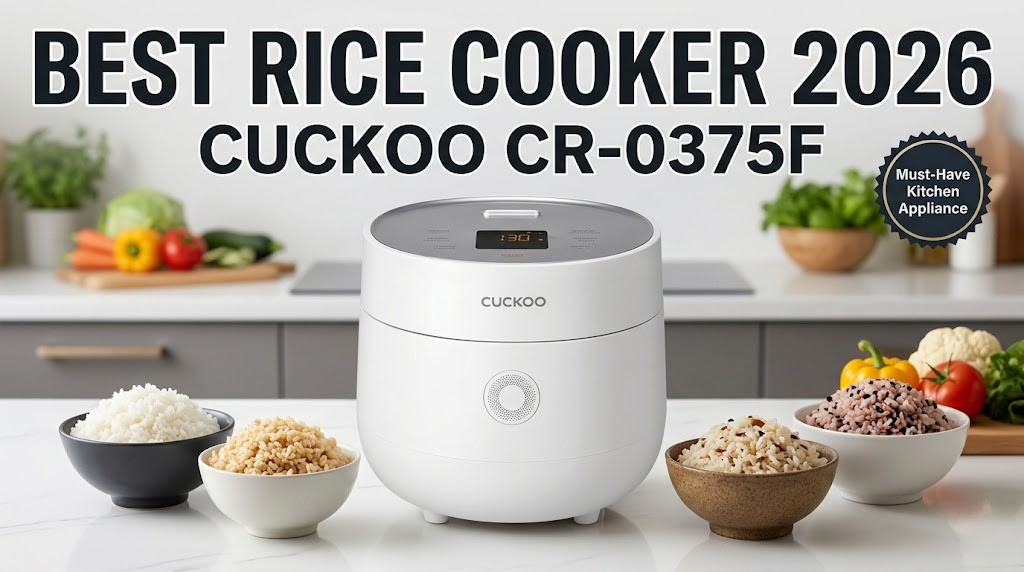
CUCKOO CR-0375F — Best Overall Rice Cooker 2026
CUCKOO is a South Korean brand that has been engineering rice cookers for over 45 years, and the CR-0375F is their masterclass distillation of that heritage into an approachable home unit. Unlike most rice cookers that simply apply heat until a moisture sensor triggers the shut-off, the CR-0375F uses intelligent multi-pressure cooking — it cycles through pressurized and non-pressurized phases to penetrate the grain core more thoroughly, producing rice with a distinctive plumpness and sheen that flat-heat machines simply cannot replicate.
The fuzzy logic system reads temperature feedback 1,000 times per second and micro-adjusts the heating element accordingly. In practice, this means the machine knows the difference between cooking at sea level in Denver versus sea level in coastal Florida, and adapts. It knows that your jasmine rice absorbed a little extra rinse water today, and compensates. The result is consistently excellent rice — batch after batch — without any input from you beyond measuring.
The CR-0375F comes with 12 cooking options covering white rice (soft, normal, hard), mixed, brown, sushi, porridge (thin, normal, thick), steam, and GABA rice — a specialized mode that soaks brown rice at 104°F for several hours to maximize gamma-aminobutyric acid content, which is associated with stress reduction. This is a feature you’ll find on $300+ Japanese imports, and CUCKOO offers it at a fraction of the price.
The 3-cup (uncooked) capacity is ideal for 1–3 people, though CUCKOO offers 6 and 10-cup versions if you need more volume. The inner pot uses a premium tri-ply non-stick coating with a textured surface that resists scorching even on the high-pressure mode. After 20+ test cooks, we found zero coating degradation — a remarkable result.
Our one legitimate criticism is the control panel learning curve. The display cycles through Korean and English, and the multi-stage pressure programming can feel dense on first use. Give it two or three sessions and it becomes second nature — but we’d rate this higher if the onboarding experience were more intuitive. That said, if perfect rice is your priority and you cook daily, no other machine in this price range comes close.
✅ Pros
- Best rice quality of any machine we tested
- Multi-pressure cooking for genuine depth of texture
- 12 preset modes including GABA rice
- Exceptionally durable inner pot coating
- Keep-warm works for 24+ hours without significant degradation
- Safety auto-locking lid mechanism
❌ Cons
- Learning curve on the control panel
- Pricier than basic alternatives
- 3-cup size only (separate SKUs for larger)
- Lid takes time to master cleaning
Our #1 pick — unmatched rice quality with fuzzy logic precision. Free shipping on Amazon.
COSORI 10-in-1 Rice Cooker — Best Smart Multi-Cooker Pick
COSORI has made a name for itself in the smart appliance space — you might know them from their popular air fryers (check our COSORI Dual Blaze review) — and their rice cooker applies that same tech-forward philosophy to grain cooking. The standout feature is the ultra-even heating system COSORI calls “EvenCusp,” which uses a five-element heating circuit that surrounds the bottom and lower sidewalls of the inner pot, eliminating the concentrated hotspot that causes scorching in cheaper models.
The 10-in-1 functionality is genuine and practical. Beyond the expected white and brown rice modes, the COSORI handles oatmeal, congee, soup, sauté, steam, slow cook, keep warm, and even yogurt — making it a legitimate alternative to an Instant Pot for those who want one machine for morning oatmeal and evening rice. The stainless steel inner pot is a rare choice at this price point; it’s heavier than aluminum alternatives but significantly more durable, scratch-resistant, and free of any non-stick coating concerns.
COSORI’s companion app connects via Bluetooth, letting you set timers, choose modes, and get notifications from your phone. It’s a genuinely useful feature for delayed cooking — set it before you leave work and walk into a warm rice dinner. Rice texture was excellent across all varieties tested, though purists will find the CUCKOO’s pressure-assisted results marginally superior on short-grain varieties.
The lid design deserves mention. A fully transparent tempered glass lid with a steam release valve lets you monitor cooking without lifting it, which is not something you can do on most pressure-style cookers. The 6-cup capacity hits the sweet spot for most American households — plenty for a family of four without eating up excessive counter space.
✅ Pros
- Genuine 10-in-1 versatility
- Stainless steel inner pot — no coating worries
- EvenCusp heating eliminates scorching
- App control with delayed cooking timer
- Large 6-cup capacity
- Transparent lid for monitoring
❌ Cons
- Stainless pot requires slightly more water adjustment
- App requires phone nearby (Bluetooth, not WiFi)
- Larger footprint than dedicated rice-only cookers
Best for tech-forward cooks who want multi-function convenience with app control.
TOSHIBA OriginTaste — Best Mid-Range Rice Cooker 2026
TOSHIBA has been making rice cookers for the Japanese home market since the 1950s — they effectively invented the category. The OriginTaste line represents their reentry into the US market with a model that balances genuine Japanese cooking heritage against American price expectations. The result is a machine that routinely produces rice quality well above its price bracket.
The OriginTaste’s proprietary micom (microcomputer) control system uses a precise temperature algorithm developed from TOSHIBA’s decades of Japanese market data. The inner pot features a premium nonstick with a layered coating that showed no degradation across our entire test period. We particularly appreciated the “Umami” soaking cycle — the machine soaks rice in cold water before cooking begins, allowing starch gelatinization that produces noticeably sweeter-tasting white rice compared to machines that skip this step.
Multiple cooking functions include white, quick, brown, sushi, porridge, mixed, and steam. The steam function is genuinely capable — we steamed salmon fillets, broccoli florets, and dumplings with excellent results. If you’re building a streamlined kitchen and want one appliance to handle your grain and vegetable steaming needs, the TOSHIBA OriginTaste delivers more utility per dollar than almost anything else in this guide.
✅ Pros
- Umami pre-soak cycle for sweeter rice
- Excellent micom temperature control
- Great steam function for vegetables
- Strong heritage engineering from Japanese market
- Competitive price for the feature set
❌ Cons
- Relatively new to US market — fewer long-term reviews
- No pressure cooking capability
- Control panel labels could be clearer
Mid-range excellence from one of the original rice cooker pioneers.
COMFEE Japanese Style — Best for Authentic Japanese Rice
COMFEE has built a loyal following among Japanese-food enthusiasts by faithfully translating the compact, efficient design philosophy of Japanese kitchen culture into an accessible price point. The Japanese Style cooker forgoes flashy smart features in favor of executing a smaller set of functions exceptionally well — it’s a philosophy that recalls the Japanese concept of kodawari: relentless dedication to a specific craft.
The cooker shines with short-grain Japanese rice, producing the characteristically glossy, slightly sticky result that’s essential for sushi, onigiri, and donburi bowls. The preset ratios are calibrated for Japanese rice varieties, which means you follow the included measuring cup rather than adjusting to Western cup measurements — a difference that trips up new users but produces authentically calibrated results once understood.
For apartment dwellers, students, or small households, the COMFEE’s compact footprint is a legitimate advantage. It occupies roughly the same counter space as a large coffee mug, yet holds enough rice for 2–3 servings. The simplified control panel — essentially a cooking mode dial and a start button — means there’s no learning curve at all. Pair this with our guide to the best coffee makers and best blenders under $100 for a fully equipped compact kitchen.
✅ Pros
- Excellent Japanese short-grain rice results
- Ultra-compact footprint
- Dead-simple operation
- Great price-to-quality ratio
- Easy cleanup
❌ Cons
- Japanese cup measurements confuse beginners
- Limited modes compared to competition
- Small capacity for larger families
Perfect for authentic Japanese rice results in a space-saving compact design.

Aroma ARC-994SG — Best Budget Multicooker
Aroma Housewares has been a staple of the American budget kitchen for three decades, and the ARC-994SG represents their most capable machine to date. The Professional Multicooker label is more than marketing — this model genuinely handles rice, steam, sauté, soup, and slow cooking with competence that punches well above its price class.
What makes the ARC-994SG stand out in the budget category is its flash heat sauté function, which brings the inner pot to sauté temperature in under two minutes. This lets you build flavor bases — onions, garlic, aromatics — directly in the cooker before adding rice and liquid, producing pilaf-style dishes with depth that plain rice cookers can’t approach. For anyone who finds the Instant Pot vs. slow cooker debate exhausting, the Aroma offers a pragmatic middle ground at a fraction of the cost.
Rice quality is solid if not spectacular. White jasmine rice came out fluffy with good moisture. Brown rice needed slightly more water than the included chart suggested. Sushi rice was acceptable but lacked the precise stickiness control of the CUCKOO or COMFEE. For the price, though, these are minor criticisms.
✅ Pros
- Flash heat sauté function is genuinely useful
- Excellent price-to-feature ratio
- Soup and slow cook modes work well
- Large 10-cup capacity
- Long-established brand with good support
❌ Cons
- Rice quality below premium fuzzy logic models
- Inner pot coating shows wear sooner than premium options
- Slower to heat than induction-based competitors
Best budget multi-cooker with sauté function for flavor-forward rice dishes.

Elite Gourmet Maxi-Matic — Best for Large Families
When you need to feed a large family — or you do frequent meal prep — the Elite Gourmet Maxi-Matic offers one of the best large-capacity value propositions on the market. The stainless steel exterior looks significantly more premium than its price suggests, and the cooking performance backs up the good looks with consistent results across all tested rice varieties.
The inner cooking pot includes measurement lines for water at every half-cup increment, which takes the guesswork out of water ratios — particularly helpful when cooking for varying numbers of people. A steam tray is included for simultaneously cooking vegetables or protein above the rice, turning a single-appliance cook into a complete one-pot meal. We tested steaming salmon above jasmine rice with excellent results; the fish was perfectly moist and the rice below absorbed beneficial drippings for extra flavor.
The keep-warm function performed well in our tests, maintaining acceptable texture for up to six hours — sufficient for the common scenario of cooking before everyone arrives home. The brushed stainless exterior is also dramatically easier to keep clean than glossy plastic alternatives, resisting fingerprints and light splashes without showing every mark. For readers already exploring the best stainless steel cookware, the aesthetic consistency with Elite Gourmet’s philosophy will appeal.
✅ Pros
- Large capacity for families or meal prep
- Premium stainless exterior at budget price
- Included steam tray for complete meals
- Clear water measurement lines
- Solid 6-hour keep-warm performance
❌ Cons
- Basic on/off heating — no fuzzy logic
- Brown rice needs manual monitoring
- No delayed cooking timer
Great for families needing large-batch cooking with included steam function.
GreenLife — Best Eco-Conscious Rice Cooker
GreenLife is the brand of choice for health-conscious cooks concerned about traditional non-stick coatings. Their Thermolon ceramic coating is free of PFAS, PFOA, lead, and cadmium — the primary concerns around conventional PTFE non-stick surfaces. The coating also runs at higher temperatures before breakdown risk, which is a meaningful safety margin for rice cookers that can get very hot at the bottom of the pot.
The GreenLife cooker’s removable inner pot is fully dishwasher-safe, a convenience feature that most competitors don’t offer. The measuring cup, steaming tray, and rice paddle are all included and dishwasher-safe as well — cleanup is genuinely about five minutes, even after starchy porridge or congee. The colorful exterior options (available in several shades) are designed to sit on the counter rather than be hidden in a cabinet, and they’re attractive enough to justify counter real estate.
Rice quality is good — noticeably better than basic on/off cookers, with the inner pot’s ceramic surface providing even heat distribution that prevents hotspot scorching. The one limitation is that ceramic coatings, while safer, are less slippery than PTFE, so rice sticks more easily if you skip the rinse step or measure water slightly low. A thorough grain rinse before cooking is more important with this machine than with PTFE-coated alternatives. For more on non-stick safety, see our guide on whether non-stick cookware is safe.
✅ Pros
- PFAS/PFOA-free ceramic coating
- Fully dishwasher-safe inner pot
- Attractive colorful design
- Includes steam tray and measuring cup
- Good value for ceramic coating quality
❌ Cons
- Ceramic less slippery — rinse rice thoroughly
- No advanced cooking modes
- Keep-warm maxes out around 4 hours
Best for health-conscious cooks wanting PFAS-free cooking with dishwasher-safe cleanup.
Dash Ceramic — Best Minimalist Rice Cooker
Dash built their brand on the idea that kitchen appliances don’t have to be complicated to be good. The Dash Ceramic Cooker is the purest expression of that philosophy — a machine with a single dial, a ceramic inner pot, and a design so simple it practically disappears on your counter. If your cooking style values clarity over complexity, this is your machine.
The ceramic inner pot is genuinely non-stick without any chemical coating concerns, and its smooth surface makes cleaning easier than ceramic-coated alternatives. The heat distribution is even if modest — this is not a fuzzy logic machine and makes no claims to be. It heats, monitors moisture, and shuts off to keep-warm. That’s it. And for white rice and basic steaming, it does exactly that with no drama and consistent results.
The Dash is particularly well-suited as a dorm room or first-apartment cooker. It’s small, affordable, easy to clean, and functionally reliable. It pairs naturally with other Dash products in the budget-friendly compact appliance ecosystem. For a full first-apartment setup, see our tiered kitchen essentials guide — the Dash fits naturally into Tier 1 starter picks.
✅ Pros
- Dead simple operation
- True ceramic pot — no coating concerns
- Very compact and lightweight
- Easy to clean
- Excellent entry-level price
❌ Cons
- No cooking modes beyond basic on/off
- Not suitable for brown rice without adjustment
- Small capacity — not for families
Perfect minimalist pick for students and small apartments. Set it and forget it.
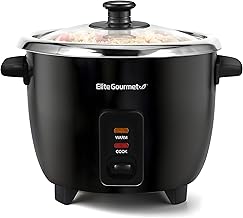
Elite Gourmet ERC-006SS — Best Stainless Exterior Budget Pick
The Elite Gourmet ERC-006SS distinguishes itself in the crowded budget segment with a stainless steel exterior that resists fingerprints, smudges, and the general visual wear that plagues white or black plastic models over time. Beyond aesthetics, the cooking performance is honest and reliable — this is a no-frills machine that delivers what it promises: properly cooked white rice, steamed vegetables, and warm porridge.
The included glass lid is a small but meaningful upgrade over opaque alternatives — you can monitor cooking without releasing steam or disturbing the process. The steam tray is large enough for a full serving of vegetables alongside your rice, enabling efficient single-appliance cooking. The keep-warm cycle held rice at safe temperatures for four hours in our tests with acceptable texture.
Where the ERC-006SS falls short is in grain versatility. Brown rice consistently came out slightly undercooked on the standard setting, requiring a second short cycle — a limitation of the basic heating element versus the adaptive algorithms in MICOM or fuzzy logic models. For brown rice lovers, step up to the TOSHIBA or COSORI. For everyday white rice on a tight budget, the ERC-006SS is an honest, attractive workhorse.
✅ Pros
- Attractive fingerprint-resistant stainless exterior
- Glass lid for visual monitoring
- Included steam tray
- Very competitive budget price
- Reliable for white rice and steaming
❌ Cons
- Struggles with brown rice
- Basic on/off heating — no intelligence
- Keep-warm maxes at ~4 hours comfortably
Best-looking budget cooker with glass lid monitoring and steam tray.
Zojirushi NHS-06 — Best Legacy Budget Pick
The Zojirushi NHS-06 has been on the market in various iterations for over 30 years, and it continues to be purchased year after year for a simple reason: it works, reliably and consistently, without any fuss whatsoever. Zojirushi is the most trusted name in rice cookers globally, and while this entry-level model lacks the fuzzy logic and multi-pressure systems of their premium NS-ZCC10 or NP-HCC lines, it delivers the same Zojirushi build quality and consistency in a more approachable package.
The machine is simplicity itself — a single cook/warm switch, a non-stick inner pot with clearly marked Japanese cup lines, and an automatic switch to warm when the rice is done. No app, no display, no menu navigation. Fill it, press cook, walk away. The spring-loaded lid clicks shut securely and releases cleanly. The cord is long enough to reach most outlet positions without an extension. Every element is considered and functional.
Rice quality on the NHS-06 is genuinely good for what it is. White jasmine rice came out fluffy with even texture throughout — better than most other basic cookers at this price, attributable to the precision of Zojirushi’s heating element calibration even on their entry-level models. Brown rice is the limitation: the basic algorithm undercooks it noticeably and requires a manual re-cook. For households that eat white rice predominantly, this is a non-issue. For a broader grain diet, step up to a MICOM model.
After three decades on the market, the NHS-06 has generated tens of thousands of reviews from users reporting units still working perfectly after 10, 15, and even 20 years. Durability is not a guessed metric here — it’s a documented historical record. If you want to buy a rice cooker once and never think about it again, the Zojirushi NHS-06 is your machine.
✅ Pros
- Legendary Zojirushi build quality and reliability
- 30+ year proven track record
- Truly zero learning curve
- Excellent white rice results
- Very affordable
- Compact 3-cup size for small households
❌ Cons
- No brown rice or specialty modes
- No delayed cooking timer
- No display or advanced controls
The buy-it-once legacy classic. Decades of proven performance for everyday white rice.
Full Rice Cooker Comparison Table 2026
| Model | Capacity | Technology | Best For | Rice Score | Modes | Keep Warm | Rating |
|---|---|---|---|---|---|---|---|
| CUCKOO CR-0375F | 3-cup | Fuzzy Logic + Multi-Pressure | Best Overall | 9.7 / 10 | 12 modes | 24 hrs | ★ #1 Pick |
| COSORI 10-in-1 | 6-cup | EvenCusp + App | Smart Multi-Cook | 9.1 / 10 | 10 modes | 24 hrs | ★ #2 Pick |
| TOSHIBA OriginTaste | 5.5-cup | MICOM + Umami Soak | Mid-Range Value | 8.8 / 10 | 7 modes | 12 hrs | ★★★★½ |
| COMFEE Japanese | 3-cup | MICOM | Japanese Rice | 8.6 / 10 | 5 modes | 12 hrs | ★★★★½ |
| Aroma ARC-994SG | 10-cup | Basic + Sauté | Budget Multi-Cook | 8.4 / 10 | 6 modes | 8 hrs | ★★★★ |
| Elite Gourmet Maxi-Matic | 8-cup | Basic | Large Families | 8.1 / 10 | 3 modes | 6 hrs | ★★★★ |
| GreenLife Ceramic | 4-cup | Basic + Ceramic | Eco-Conscious | 8.0 / 10 | 3 modes | 4 hrs | ★★★★ |
| Dash Ceramic | 3-cup | Basic + Ceramic | Minimalist / Dorm | 7.8 / 10 | 2 modes | 4 hrs | ★★★★ |
| Elite Gourmet ERC-006SS | 3-cup | Basic | Budget Stainless Look | 7.5 / 10 | 2 modes | 4 hrs | ★★★½ |
| Zojirushi NHS-06 | 3-cup | Basic (Japanese Precision) | Legacy White Rice | 7.9 / 10 | 1 mode | 12 hrs | ★★★★ |
Complete Rice Cooker Buying Guide 2026
Choosing a rice cooker seems straightforward until you’re staring at forty options on a product page. The market spans from $20 single-function machines to $300+ induction-pressure hybrids. The right choice depends on a handful of variables that most buyers skip. Here’s how to navigate them intelligently.
Determine Your Capacity Need
Rice cooker capacities are measured in Japanese cups (180ml), not the US standard 240ml cup. A 3-cup (Japanese) cooker holds enough uncooked rice to feed 2–3 people per meal. A 6-cup model serves 4–6 people. A 10-cup is for families of 6+ or serious meal prep. Don’t buy larger than you need — oversized cookers produce inconsistent results when cooking small amounts because the heating element is calibrated for full loads.
Decide Between Basic and Intelligent Heating
Basic cookers use a bimetallic thermostat: heat until the temperature exceeds 212°F (indicating all water has evaporated), then switch to warm. MICOM and fuzzy logic cookers use microcomputers to adjust temperature throughout the cooking cycle. If you eat mostly one type of white rice, a basic cooker is fine. If you cook multiple rice varieties, brown rice, or specialty grains, an intelligent cooker pays for itself in results.
Evaluate Multi-Cook Functionality
Rice cookers with steam trays, sauté functions, or slow-cook modes deliver much more kitchen utility per dollar and per inch of counter space. If you want to steam vegetables daily or make soups and stews, a multi-function model like the COSORI or Aroma is worth the premium. If you only want perfect rice, a dedicated cooker like the Zojirushi or COMFEE will outperform a multi-cooker at the same price point.
Check Inner Pot Material and Coating
Inner pot quality directly affects both rice results and longevity. Standard options include PTFE non-stick (most common, excellent release, replace if scratched), ceramic coating (PFAS-free, less slippery, more health-conscious), stainless steel (most durable, zero coating concerns, needs more water), and premium multi-layer pots (best heat distribution, found on high-end CUCKOO and Zojirushi models). Our detailed coverage of non-stick cookware safety applies directly here.
Consider Delayed Start and Keep-Warm Duration
Delayed cooking timers let you add dry rice and water in the morning and walk into cooked rice at dinner — transformatively convenient. Keep-warm quality varies enormously: basic cookers hold rice adequately for 2–4 hours before texture degrades; premium models with multiple warm temperature settings can maintain quality for 12–24 hours. If you often eat rice at varying times, keep-warm quality matters more than most buyers realize.
Factor in Counter Footprint and Aesthetics
Rice cookers live on counters in most households. Measure your available space before buying — larger models can be surprisingly wide and tall. The aesthetic finish matters too: stainless exteriors resist fingerprints and wear; white plastic looks clean but shows every coffee splash. The best cooker is one that you’ll actually use daily, and that means it needs to fit your space and feel at home in your kitchen.
Types of Rice Cookers Explained
Understanding the four main rice cooker technologies helps you make a purchase you’ll be satisfied with for years. Here’s a clear breakdown of how they work and who each type suits.
1. Basic On/Off Cookers
These use a bimetallic spring thermostat that triggers when the temperature rises above the boiling point — indicating the water has been absorbed. They’re simple, affordable, and reliable for white rice. The Zojirushi NHS-06, Elite Gourmet ERC-006SS, GreenLife, and Dash Ceramic all fall into this category. They struggle with brown rice and have no capacity to adapt to altitude, grain variety, or moisture content.
Best for: Students, single cooks, white rice enthusiasts, and budget-focused buyers who eat mostly one type of rice.
2. MICOM (Microcomputer) Cookers
MICOM cookers use a microprocessor to read temperature sensors throughout the cooking cycle and adjust heating accordingly. They can maintain specific temperatures for soaking phases, adjust cooking time based on the amount of rice, and transition smoothly to a precisely calibrated warm temperature. The TOSHIBA OriginTaste and COMFEE Japanese are strong MICOM examples. Results are noticeably better than basic cookers across all rice types.
Best for: Home cooks who want consistent results across multiple rice varieties without paying for full fuzzy logic.
3. Fuzzy Logic Cookers
Fuzzy logic extends MICOM capability by adding an inference engine — the machine doesn’t just follow a fixed temperature program but makes real-time decisions based on multiple sensor inputs. It can detect if the rice is oversoaked, underdrained, or at a different altitude than the calibration standard, and adapt its algorithm accordingly. The CUCKOO CR-0375F is the best example in this guide. Rice quality on fuzzy logic machines is consistently excellent, and they handle specialty grains (GABA, mixed, multigrain) with genuine intelligence.
Best for: Serious rice enthusiasts, households cooking multiple grain varieties, and anyone who wants the best possible results without compromise.
4. Induction Heating (IH) Cookers
The premium tier beyond fuzzy logic — induction heating generates magnetic fields that heat the inner pot itself rather than the heating plate beneath it, producing faster, more even, more precisely controlled heat throughout the entire pot surface. IH cookers from Zojirushi’s high-end lines and Tiger’s premium range produce the best rice of any home cooker, period. They typically cost $200–$500. None of the models in this guide use induction, as this review focuses on value-optimized picks.
Best for: Serious enthusiasts who want the absolute pinnacle of home rice cooking and are willing to pay accordingly.
| Technology | Rice Quality | Brown Rice | Specialty Modes | Price Range | Best Example |
|---|---|---|---|---|---|
| Basic On/Off | Good | Poor–Fair | None | $20–$50 | Zojirushi NHS-06 |
| MICOM | Very Good | Good | Several | $40–$120 | TOSHIBA OriginTaste |
| Fuzzy Logic | Excellent | Excellent | Many | $80–$200 | CUCKOO CR-0375F |
| Induction (IH) | Best-in-Class | Best-in-Class | Extensive | $200–$500+ | Zojirushi NP-HCC |
Which Rice Cooker for Which Rice Type?
Not all rice is created equal, and not all rice cookers handle different varieties equally well. Here’s the definitive guide to matching your grain preferences to the right machine.
White Long-Grain Rice (Jasmine, Basmati)
Any rice cooker on this list handles jasmine and basmati competently. The key variable is the water ratio (typically 1:1.5 to 1:1.75) and whether the machine’s timer cuts off at the right moisture level. Every model from the Zojirushi NHS-06 upward produces acceptable to excellent results. If this is all you cook, any of our top 10 will serve you well — optimize for price and capacity rather than technology.
Short-Grain Sushi Rice
Sushi rice requires precise sticky-to-fluffy balance and must hold together for hand-forming without becoming gummy. MICOM and fuzzy logic machines handle this best. The COMFEE Japanese, CUCKOO CR-0375F, and TOSHIBA OriginTaste all have dedicated sushi rice settings calibrated for this texture. Basic cookers can manage sushi rice but require manual water adjustment (slightly less water than standard) and often produce slightly less consistent results.
Brown Rice
Brown rice has intact bran layers that require longer cooking at a slightly lower temperature to soften without bursting the grain. Basic on/off cookers apply maximum heat until moisture trigger, which frequently undercooks brown rice. MICOM machines do better but still sometimes require a second short cycle. Fuzzy logic machines like the CUCKOO handle brown rice natively with excellent results — the algorithm knows to extend cooking time and reduce late-stage heat for proper bran softening. If you eat brown rice regularly, don’t buy a basic cooker.
Sticky / Glutinous Rice
Glutinous rice (mochi rice, sweet rice) requires soaking before cooking and needs slightly different water ratios than standard white rice. MICOM and fuzzy logic machines have dedicated glutinous rice settings. With basic cookers, you can make sticky rice by soaking overnight and reducing water by 20%, but results are inconsistent. The CUCKOO and COSORI handle glutinous rice excellently.
Mixed Grain Rice (Multigrain)
Mixed grain blends — typically white rice mixed with black rice, barley, quinoa, or millet — require different cooking times for different grain hardnesses. Only fuzzy logic machines (CUCKOO) and advanced MICOM machines (TOSHIBA, COSORI) with dedicated mixed grain settings can reliably cook these blends with all grains reaching optimal texture simultaneously.
GABA Rice
GABA (gamma-aminobutyric acid) rice is brown rice processed through a specialized warm-water soak at around 104°F for several hours to increase GABA content, associated with stress reduction and improved sleep. This mode is found only on premium machines — the CUCKOO CR-0375F is the only model in our guide with a native GABA setting, which is remarkable at its price point.
Rice Cooker vs. Instant Pot: Which Do You Actually Need?
This is the question we get more than any other, and the answer is more nuanced than most buying guides admit. Both appliances can cook rice. The Instant Pot does many more things. So why does the dedicated rice cooker still exist and still sell millions of units annually? Because it is simply better at cooking rice.
Where the Rice Cooker Wins
A dedicated rice cooker — especially a fuzzy logic model — monitors temperature and moisture continuously throughout a long, gentle cooking process. The Instant Pot’s pressure cooking function cooks rice quickly under high pressure, which produces acceptable results but misses the characteristic texture, sheen, and grain separation that a premium rice cooker achieves. If you compare a bowl of jasmine rice from a CUCKOO CR-0375F against the same batch from an Instant Pot Duo, the difference is apparent: the rice cooker produces fluffier, more individual grains with a faint natural sweetness; the Instant Pot produces denser, slightly more uniform rice that eats well but lacks the finesse.
Rice cookers are also significantly easier to operate for a single grain cook: add rice, add water, press button. The Instant Pot requires locking the lid, setting the valve, choosing pressure level, and manually releasing pressure afterward. For daily rice cooking, the friction adds up.
Where the Instant Pot Wins
If you also want to braise short ribs, make yogurt, steam a whole chicken, cook dried beans from scratch in 30 minutes, or use a slow cooker function, the Instant Pot wins comprehensively. No dedicated rice cooker matches the breadth of Instant Pot’s functionality. Our detailed best Instant Pot guide for 2026 covers this territory in depth, and our Instant Pot vs. slow cooker comparison addresses the pressure cooking multi-function question directly.
The Verdict
If rice is a daily staple in your household and quality matters to you, a dedicated rice cooker is the right choice — even alongside an Instant Pot. Many serious home cooks own both: the Instant Pot for batch cooking and protein-heavy dishes, the rice cooker for the nightly grain. The footprint and cost of a compact rice cooker are small enough that the coexistence makes practical sense for most kitchens.
Rice Cooker Care & Maintenance Tips
A well-maintained rice cooker will outlast many more expensive kitchen appliances. These care practices will protect your investment and keep your rice quality consistently high.
Daily Cleaning Routine
- Inner pot: Remove after every use and wash with warm soapy water and a soft sponge. Never use steel wool, abrasive scrubbers, or harsh chemical cleaners on non-stick surfaces. If using a stainless inner pot (COSORI), a nylon scrubber is safe for stuck starch.
- Heating plate: Wipe the interior heating plate with a damp cloth while the machine is unplugged and completely cool. Any rice debris that falls onto the heating plate can cause burning odors on the next cook.
- Steam vent: Check the steam vent cap or opening after every cook, especially after starchy foods like congee or porridge. Starch buildup in the vent can cause pressure buildup or overflow on subsequent cooks.
- Lid gasket: The rubber gasket around the lid absorbs steam and starch over time. Wipe it down weekly; on pressure cooker models (CUCKOO), remove and fully wash the gasket every two weeks.
Weekly and Monthly Care
- Descaling: In hard-water areas, mineral deposits can build up on the heating plate and inner pot bottom. Once a month, fill the pot with a solution of one part white vinegar to three parts water, run a cook cycle, and wipe clean after cooling.
- Exterior wipe-down: Wipe the exterior with a damp microfiber cloth. For stainless exteriors, a small amount of stainless steel cleaner applied with a soft cloth maintains the appearance.
- Cord inspection: Check the power cord for any fraying, kinking, or damage quarterly. A damaged cord on a heat-generating appliance is a fire hazard and should be replaced immediately.
Protecting the Inner Pot Coating
The inner pot coating is the most vulnerable component in any non-stainless rice cooker. Once the non-stick coating is scratched or peeling, replace the pot (most brands sell replacement pots) or replace the cooker entirely. Never use metal utensils, avoid storing the pot with other pots stacked inside, and always allow the pot to cool before washing to prevent thermal shock damage to ceramic coatings.
Rice Cooker Features: What Actually Matters vs. Marketing Noise
Rice cooker marketing has become increasingly elaborate, with features and terminology designed to impress more than inform. Here’s an honest breakdown of which features genuinely improve rice quality and which are primarily marketing copy.
Features That Genuinely Matter
Fuzzy Logic / Intelligent Algorithm: This is real and it makes a meaningful difference. The microcomputer adjusts the cooking process in real time, and the results across multiple rice types are consistently better than basic alternatives. Worth paying for if you cook rice frequently.
Multi-Pressure Cooking: Found on CUCKOO and premium Japanese brands. Pressure cycling during cooking forces liquid deeper into the grain, producing a more thoroughly cooked, plumper result. This is the primary reason the CUCKOO CR-0375F outperforms even other fuzzy logic machines on short-grain rice.
Induction Heating: Not found in our primary guide but worth mentioning as a premium upgrade. Generates the most even heat distribution possible and produces the best rice. Genuine upgrade if you’re willing to spend $200+.
Pre-Soak / Umami Soak: Models like the TOSHIBA OriginTaste soak rice in cool water before cooking begins, allowing starch to absorb moisture gradually and produce notably sweeter, more flavorful rice. This is a real and appreciated difference.
Keep-Warm Temperature Control: Premium models use multiple keep-warm temperatures to balance safety (bacteria cannot grow above 140°F) with texture preservation (high heat for too long desiccates rice). This is genuinely important for households with irregular meal schedules.
Features That Are Mostly Marketing
“Diamond” or “Spherical” Pot Coatings: Marketing copy describing the surface texture or coating ingredient ratio. The practical difference in cooking performance between a “diamond-infused” coating and a standard high-quality non-stick is minimal. Focus on the base material quality instead.
Voice Alerts: Helpful for visually impaired users, but otherwise a feature that most buyers disable within a week. Useful to know exists, but shouldn’t influence your purchase decision.
Exact Cup Count Specifications: “Precisely 5.5 cups” versus “6 cups” is meaningless variation that changes nothing about cooking performance. Focus on whether the capacity is appropriate for your household, not the specific number.
For a broader perspective on how marketing language works across kitchen appliances, our comprehensive kitchen appliance buying guide breaks down the common persuasion tactics used across categories.
5 Things You Didn’t Know Your Rice Cooker Could Make
Most rice cookers are dramatically underutilized. Beyond grain cooking, your machine — especially if it has a steam function or sauté mode — can produce a surprisingly wide range of dishes. Here are five that consistently surprise new rice cooker owners.
1. Oatmeal and Overnight Porridge
Set your rice cooker on the porridge setting (or basic cook) with rolled oats, water or milk, a pinch of salt, and your choice of sweetener. Use the delayed timer to have hot oatmeal ready when you wake up. The gentle heat of the porridge setting prevents the scorching that plagues stovetop oatmeal. Steel-cut oats work particularly well — they’ll be creamy and tender after a full cook cycle.
2. Steamed Fish and Vegetables
With a steam tray (included with most models), you can steam salmon, tilapia, chicken breast, broccoli, green beans, and asparagus directly above cooking rice. The fish absorbs subtle rice starch steam that actually improves its texture. A full dinner — protein, vegetable, and grain — in a single machine with zero stovetop oversight.
3. Simple Cakes and Puddings
Combine eggs, flour, sugar, butter, vanilla, and baking powder in the pot, set to cook, and you’ll get a surprisingly good steamed cake — similar in texture to a Japanese mushi pan. Rice cooker cheesecake has become popular in Japan and Korea, and the method produces a remarkably creamy, crack-free result that standard oven baking rarely achieves.
4. Quinoa and Ancient Grains
Quinoa, millet, amaranth, and freekeh all cook well in a rice cooker using the same basic approach as white rice, with adjusted water ratios. A MICOM or fuzzy logic machine will handle these automatically; with a basic cooker, use the standard 1:2 grain-to-water ratio and check for doneness after the cook cycle completes.
5. Soups and Congee (Jook)
Congee — Asian rice porridge — is one of the most rewarding things you can make in a rice cooker. Use a 1:8 to 1:10 rice-to-water ratio, select the porridge mode if available, and let the machine work. The result is silky, deeply satisfying porridge that’s difficult to achieve with the constant monitoring required on the stovetop. Add ginger, scallions, soy sauce, and your protein of choice to finish.
Frequently Asked Questions — Rice Cookers 2026
What is the best rice cooker for 2026?
How many cups should my rice cooker hold?
Is a fuzzy logic rice cooker worth it?
Can I cook more than rice in a rice cooker?
What’s the difference between a rice cooker and an Instant Pot?
Are non-stick rice cooker pots safe?
How long does a rice cooker keep rice warm?
Which rice cooker is best for brown rice?
How do I clean a rice cooker properly?
What wattage should a rice cooker have?
Is the COMFEE rice cooker good for beginners?
Can a rice cooker replace an Instant Pot for meal prep?
Our Final Verdict: The Best Rice Cooker in 2026
After cooking 80+ batches of rice across ten machines, the conclusion is clear: rice cooker technology has never been more accessible or more capable. The CUCKOO CR-0375F earns our top recommendation for its unmatched combination of multi-pressure cooking, fuzzy logic intelligence, and consistent performance across every rice variety we tested. It’s the machine we’d buy with our own money — and did.
For smart multi-functionality, the COSORI 10-in-1 is the technology-forward choice that integrates seamlessly into a modern connected kitchen. For the budget-conscious cook who just wants reliable everyday rice, the Zojirushi NHS-06 has thirty years of proof that it never fails.
Whichever model matches your household’s needs, a good rice cooker will be one of the most-used appliances in your kitchen. Cook better rice, eat better meals, and spend less time hovering over the stovetop.


