Air Fry vs. Bake: What’s the Difference? The Ultimate Guide (2024)
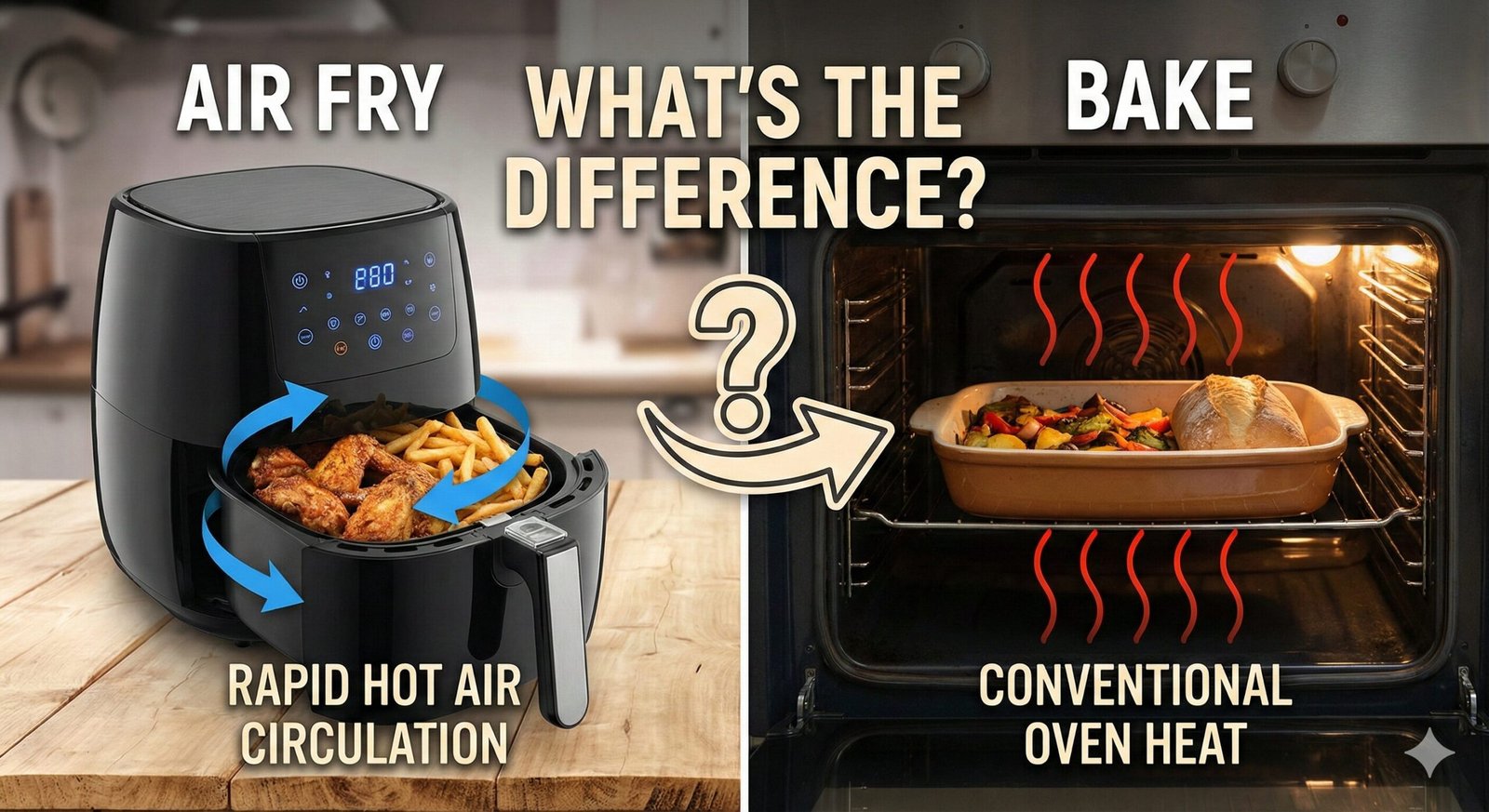
It is the most common debate in modern kitchens: “Do I really need an air fryer if I have an oven?” or “Can I just use the bake setting on my air fryer?”
While both methods use hot air to cook food, the intensity, speed, and airflow dynamics create vastly different results. Whether you are upgrading your kitchen with smart lifestyle upgrades or just trying to get dinner on the table, understanding this distinction is crucial for culinary success.
⚡ The Short Answer
The main difference is airflow speed and heating intensity.
Air Frying uses a powerful fan to circulate hot air at high speeds in a small chamber, mimicking the crisping effect of deep frying without the oil. It is best for crispy textures (fries, wings).
Baking relies on ambient heat with little to no air movement (or slower movement in convection ovens), surrounding food with gentle warmth. It is best for structure and rising (cakes, breads, casseroles).
The Science: Convection vs. Radiation
To truly understand the difference, we need to look at the physics inside the machine.
1. The Air Fryer Mechanism
An air fryer is essentially a turbocharged convection oven. The heating element is located directly above the food, and a large fan blows that heat down instantly. Because the chamber is small—like in the best small digital air fryers—the heat density is massive.
This rapid air movement strips away moisture from the surface of the food, creating the Maillard reaction (browning) much faster than a standard oven. This is why you need specific high-smoke point oils when air frying, as the intense heat can burn butter instantly.
2. The Baking Mechanism
Traditional baking usually comes from heating elements at the bottom (and sometimes top) of the oven. The heat radiates slowly, warming the air, which then warms the food. Even in a digital toaster oven air fryer combo, the “Bake” setting slows down the fan significantly.
This gentler heat allows leavening agents (baking powder/soda) to activate before the crust hardens. If you tried to bake a cake on “Air Fry” mode, the top would burn before the inside was cooked.
Watch the video above for a visual breakdown of how convection fans alter the cooking process.
3. Understanding Heat Transfer Modes
Professional chefs and food scientists break heat transfer into three categories, and understanding all three helps explain why air frying and baking feel so different even when the set temperature is identical:
- Convection heat transfer — the movement of heat via moving fluid (air, in our case). This is the dominant mechanism in air frying. The faster the air moves, the faster convective heat reaches the food surface, and the faster moisture evaporates. This is why air fryer food gets crispy.
- Conduction heat transfer — direct contact between the hot cooking surface (basket, pan) and the food. This contributes to the bottom browning of air-fried foods and baked goods alike.
- Radiation heat transfer — infrared energy emitted directly from the heating element. In traditional baking, the radiant heat from the oven element plays a larger role than most home cooks realize, particularly in browning the top of dishes placed close to the broil element.
In air frying, convection dominates overwhelmingly — the fan velocity creates a Reynolds number (a fluid dynamics measure of turbulence) that strips the boundary layer of still, moist air from the food surface almost instantly. This boundary layer is precisely what protects food from rapid moisture loss in a conventional oven. Removing it quickly is what creates the “fried” effect without the fat.
4. The Maillard Reaction vs. Caramelization
Both air frying and baking can produce browning, but through subtly different pathways depending on what’s in the food:
- The Maillard reaction occurs between amino acids and reducing sugars when surface temperatures exceed roughly 280°F (140°C). It produces hundreds of flavor compounds and the characteristic golden-brown color of well-cooked meat, bread crust, and roasted vegetables. Air frying accelerates this dramatically because the surface reaches high temperatures so quickly.
- Caramelization involves the breakdown of sugars alone, beginning around 320°F (160°C). This is why baked goods develop a sweet, complex caramel flavor as they cook — the slower, gentler oven heat allows sugars to caramelize without burning.
The practical upshot: air frying is better at producing savory Maillard browning. Baking is better at allowing caramelization and leavening chemistry to proceed without interruption.
The 3-Way Comparison: Air Fry vs. Convection Bake vs. Regular Bake
Most guides compare only air frying and standard baking, but there’s a critical middle ground that confuses many home cooks: convection bake mode. Many modern ovens have it. Many air fryer toaster ovens label it separately from air fry. And understanding how it differs from both extremes clarifies the entire landscape.
🔁 The Spectrum of Hot Air Cooking
Think of these three methods as a spectrum, not three completely separate categories:
Regular Bake → Convection Bake → Air Fry
As you move from left to right, fan speed increases, chamber size decreases (relative to food volume), heat density increases, cooking time decreases, and crispiness potential increases — while rise-and-structure potential decreases.
Regular Bake Mode
Standard bake mode uses bottom heating elements (and sometimes top elements in cycle) with no fan or a very slow one. Heat builds up gradually and distributes somewhat unevenly — the back of the oven is often hotter than the front, and the top is hotter than the bottom. This slow, gentle, radiant heat is ideal for delicate chemistry: leavening agents have time to do their work, proteins coagulate gradually, and moisture is retained inside the food because the surface temperature rises slowly enough that a crust doesn’t form before the interior is cooked.
Convection Bake Mode
Add a fan to a standard oven and you have convection bake. The fan — typically at low to medium speed — circulates the hot air, eliminating hot spots and reducing cooking time by roughly 15-20%. The gentler airflow strips the boundary layer of moisture from food surfaces, promoting somewhat more browning than regular bake. Convection bake is excellent for cookies (slightly crispier edges, more even browning), roasted meats, and multi-rack cooking where even heat distribution matters.
Air Fry Mode
Air fry mode — whether in a dedicated countertop air fryer or a full-size oven with an air fry setting — runs the fan at maximum speed. In a dedicated air fryer, the small chamber concentrates that high-velocity air around a relatively small amount of food, creating extraordinary heat density. This is why an air fryer at 400°F feels significantly hotter than an oven convection mode at 400°F — the heat transfer rate per square centimeter of food surface is dramatically higher.
| Feature | Regular Bake | Convection Bake | Air Fry |
|---|---|---|---|
| Fan Speed | None / Very slow | Low to medium | Maximum velocity |
| Heat Distribution | Uneven, radiant | Even, circulating | Intense, direct impact |
| Time vs. Regular Bake | Baseline | 15–20% faster | 25–35% faster |
| Crispiness | Low | Moderate | High |
| Moisture Retention | High | Moderate-High | Lower |
| Rise / Leavening | Excellent | Good | Poor |
| Best For | Cakes, soufflés, custards | Cookies, roasts, casseroles | Wings, fries, reheating |
| Energy Efficiency | Lowest (long preheat) | Moderate | Highest (small chamber) |
Performance at a Glance: Air Fry vs Regular Bake
Detailed Comparison: Air Fry vs. Bake
Let’s break down the metrics. If you are calorie counting, you might want to reference our guide on air-fried chicken vs deep fried chicken calories to see why air frying wins on health.
| Feature | Air Fry Mode | Bake Mode |
|---|---|---|
| Primary Goal | Crispiness, browning, speed. | Internal cooking, rising, structure. |
| Airflow | High velocity, direct impact. | Low velocity or static ambient heat. |
| Temperature | Usually constant, intense heat. | Cycles on and off to maintain average temp. |
| Best For | Wings, Fries, Reheating Pizza, Veggies. | Cakes, Muffins, Casseroles, Roasts. |
| Time Adjustment | Reduce standard recipe time by ~20%. | Follow standard recipe time. |
| Gear Needed | Perforated basket or strainer. | Solid pans, mixing bowls. |
Complete Temperature & Time Conversion Guide
One of the most common frustrations when switching between baking and air frying is getting the temperature and timing right. Use the wrong settings and you end up with burnt outsides and raw insides — or perfectly safe food that’s disappointingly pale and soft. This complete conversion chart eliminates the guesswork.
📏 The Universal Conversion Rule
Air Fryer Temperature = Oven Temperature − 25°F (15°C)
Air Fryer Time = Oven Time × 0.75 to 0.80 (reduce by 20–25%)
Always check food 5 minutes before the estimated finish time. Air fryers vary more than ovens in actual heat delivery, so checking early prevents overcooking — especially on your first attempt with a new recipe.
| Food | Oven Temp (Bake) | Oven Time | Air Fryer Temp | Air Fryer Time | Notes |
|---|---|---|---|---|---|
| Chicken wings | 425°F / 220°C | 40–45 min | 400°F / 200°C | 22–26 min | Flip halfway through |
| Chicken thighs (bone-in) | 425°F / 220°C | 35–40 min | 400°F / 200°C | 22–26 min | Skin-side up; flip once |
| Salmon fillet | 400°F / 200°C | 12–15 min | 375°F / 190°C | 8–10 min | Don’t overcook; check at 8 min |
| Frozen fries | 425°F / 220°C | 25–30 min | 400°F / 200°C | 14–18 min | Shake basket at 8 min |
| Broccoli / cauliflower | 400°F / 200°C | 20–25 min | 375°F / 190°C | 10–14 min | Toss in oil; don’t overcrowd |
| Muffins | 375°F / 190°C | 18–22 min | 350°F / 175°C | 12–15 min | Use silicone molds; cover top if browning fast |
| Cookies | 350°F / 175°C | 10–14 min | 325°F / 160°C | 7–9 min | Watch closely — very easy to overbrown |
| Bacon | 400°F / 200°C | 15–18 min | 375°F / 190°C | 8–10 min | No flip needed; lay flat |
| Steak (1 inch thick) | 450°F / 230°C | 10–14 min | 400°F / 200°C | 8–10 min | Rest 5 min; sear in pan after for crust |
| Pizza (fresh, thin crust) | 450°F / 230°C | 12–15 min | 375°F / 190°C | 7–9 min | Use parchment for easy transfer |
| Frozen pizza | 400°F / 200°C | 18–22 min | 350°F / 175°C | 10–14 min | Check at 10 min; toppings burn fast |
| Shrimp | 400°F / 200°C | 8–10 min | 375°F / 190°C | 5–7 min | Extremely fast — watch closely |
| Bread rolls | 375°F / 190°C | 14–18 min | 325°F / 160°C | 10–13 min | Cover loosely with foil to prevent over-browning |
| Whole chicken (3–4 lbs) | 375°F / 190°C | 75–90 min | 360°F / 180°C | 50–60 min | Use a meat thermometer; 165°F internal |
Different brands of air fryers run hot or cool by 10–25°F relative to their display. The first time you cook something new, set the timer for 80% of the estimated time and check. After one or two attempts, you’ll know your machine’s personality.
Food-by-Food Verdict: Air Fry or Bake?
The most useful question isn’t “which method is better overall?” — it’s “which method is better for this specific food?” Here is our food-by-food verdict based on texture science, cook time, and practical kitchen testing.
Air Fry vs. Bake: The Chicken Deep Dive
No food illustrates the air fry vs bake debate more vividly than chicken. It’s the dish that launched a thousand air fryer purchases and caused a thousand disappointed baking experiments. Let’s break it down by cut.
Chicken Wings
Wings are the unambiguous air fryer champion. The combination of skin, fat, and bone means they need high, direct heat to render the fat under the skin and create that signature crackle. In a standard oven, wings take 40–45 minutes at 425°F and still often come out with slightly flabby skin. In an air fryer at 400°F for 22–24 minutes, the result is genuinely crispy — restaurant-quality without deep frying. The secret is patting the wings dry before cooking and avoiding any marinade with high sugar content (which burns in the intense air fryer heat before the skin crisps).
Chicken Thighs and Drumsticks
Bone-in, skin-on thighs and drumsticks are another air fryer success story. The direct, intense heat renders skin fat beautifully. Air fry skin-side up at 400°F for 22–26 minutes, flipping once at the halfway point. The skin achieves a deep golden color and crispy texture that most ovens can only achieve with the broiler — and the broiler requires careful watching. Air fryer thighs forgive a little more easily. The internal temperature should reach 165°F; use a meat thermometer on the thickest part away from the bone.
Chicken Breast (Boneless, Skinless)
This is where the balance tilts. Boneless, skinless chicken breast has no fat layer to protect it from the intense convective heat of the air fryer. It dries out quickly if even slightly overcooked. In a conventional oven at 400°F for 20–25 minutes (covered in foil for the first 15 minutes), chicken breast stays juicy. In an air fryer, it’s faster — around 15–18 minutes at 375°F — but the margin for error is narrower. A meat thermometer is essential. Pull it at 160°F internal; carryover cooking will bring it to the safe 165°F. Brining the breast for 30 minutes before air frying dramatically improves moisture retention.
Whole Chicken
A 3–4 pound whole chicken fits in most large-basket air fryers and produces extraordinary results — crispier skin than any oven method short of dedicated rotisserie, in about 50–60 minutes at 360°F. Season liberally, truss loosely, and cook breast-side down for the first 30 minutes, then flip. The air fryer’s concentrated heat creates a golden, crackling exterior that takes an oven considerably longer to achieve.
Chicken Results by Method: Quality Scores
Air Fry vs. Bake: Fish and Seafood
Fish is an area where air frying provides clear, practical advantages for weeknight cooking — and where it also requires the most careful timing, because the window between perfect and overdone is genuinely narrow.
Salmon
Air-fried salmon at 375°F for 8–10 minutes produces a flaky, moist interior with a lightly crisped exterior. The key advantage over baking is that less fishy smell permeates the kitchen — the rapid cooking minimizes the time that volatile aromatic compounds are released into the air. The downside: salmon dries out faster in the air fryer than in the oven if you go even 2 minutes over. A digital meat thermometer is your best friend here; pull salmon at 125–130°F internal for medium-rare, or 145°F for fully cooked.
White Fish (Cod, Tilapia, Mahi-Mahi)
Lean white fish benefits enormously from air frying. At 375°F for 10–12 minutes with a light coating of breadcrumbs or seasoned oil, cod and tilapia develop a beautiful golden crust that’s impossible to achieve in a regular oven without deep frying. The rapid heat seals the surface quickly enough that the inside stays remarkably moist despite the lean flesh. Baking lean fish at conventional oven temperatures often results in watery, pale fillets — particularly if the fish releases liquid before the oven is fully up to temperature.
Shrimp
Shrimp is one of the most dramatic success stories for air frying. At 375°F for just 5–7 minutes, shrimp cook to a perfect pinkish-white with slightly crisp edges. They don’t require any batter or breading to develop excellent texture. In a conventional oven, shrimp tend to steam in their own moisture before the oven heat can crisp them — producing acceptable but texturally inferior results. The only caution with air frying shrimp: they can go from perfect to rubbery in less than 60 seconds at the end, so check at 5 minutes and again at 6.
Whole Fish
Whole fish — snapper, branzino, trout — are one of the few cases where baking may actually produce better results for flavor development. The cavity allows for aromatics (herbs, citrus, garlic), and the slow bake at 400°F for 25–35 minutes gives those aromatics time to infuse the flesh. That said, air frying a butterflied or scored whole fish at 375°F for 15–20 minutes produces incredible crispy skin — a texture that conventional baking struggles to match without broiling.
Air Fry vs. Bake: Vegetables
Roasted vegetables are one of the most compelling everyday arguments for owning an air fryer. The speed difference alone — roughly half the time of oven roasting — combined with superior caramelization and crispiness makes air-fried vegetables a revelation for weeknight cooking.
Why Air Frying Transforms Vegetables
When you roast vegetables in a conventional oven, the biggest enemy of crispiness is steam. Vegetables release significant amounts of moisture as they heat. In a full-size oven, that steam has nowhere to go quickly — it circulates around the vegetables, essentially braising them in their own water vapor before the surface has a chance to dry out and brown. This is why oven-roasted vegetables often emerge soft and slightly soggy, especially if the pan is crowded.
In an air fryer, the powerful fan instantly carries that moisture away from the food surface and out through the exhaust. The result: vegetables brown and crisp far more efficiently, even in smaller batches, with less oil than the oven requires to achieve comparable results.
Best Vegetables for Air Frying
- Broccoli florets — 375°F, 8–10 minutes; the florets get lightly charred and crispy at the tips while the stems stay tender. Better than any oven result.
- Brussels sprouts (halved) — 375°F, 12–15 minutes; the cut faces caramelize beautifully and the outer leaves become chip-like and crispy.
- Asparagus — 375°F, 6–8 minutes; almost impossibly quick and emerges with tender-crisp stalks and slightly charred tips.
- Zucchini (sliced) — 375°F, 8–10 minutes; golden and lightly crisped rather than watery and soft.
- Bell peppers — 380°F, 10–12 minutes; blistered, sweet, with a slightly charred edge.
- Corn on the cob — 370°F, 10–12 minutes; a surprising air fryer winner — kernels blister and pop with caramelized flavor.
Vegetables Better Left to the Oven
- Large root vegetable gratins — layered potatoes and cream need gentle, even heat and moisture. An air fryer dries them too aggressively.
- Stuffed bell peppers — the filling needs to heat through gently. Air fryer tends to overbrown the pepper exterior before the filling is hot.
- Green salads or delicate greens — the fan will blow light leaves around, creating uneven cooking or burned edges.
The number one mistake when air frying vegetables is crowding the basket. Food needs space for hot air to circulate on all sides. A single layer with small gaps between pieces produces dramatically better results than piling vegetables on top of each other. When in doubt, cook in two batches — the speed of the air fryer makes this painless.
Baking Cakes, Bread & Cookies in an Air Fryer
This is the territory where the air fryer’s limitations become most apparent — and where understanding those limitations helps you work within them rather than fighting them. Many baked goods can be made in an air fryer, but with meaningful compromises. A few work exceptionally well. A handful should never be attempted.
Can You Bake a Cake in an Air Fryer?
The short answer is yes, with important caveats. Small cakes — single-layer, dense, or flourless — work reasonably well. The same size that fits in a 6-inch round pan can go into an air fryer at 300°F (significantly lower than a standard oven cake temperature) for 20–25 minutes. The lower temperature compensates for the intense convective heat, allowing the interior to set before the exterior burns.
What doesn’t work well in an air fryer: multi-layer tall cakes, angel food cake (which needs to hang upside down to cool), any cake requiring a water bath, and soufflés (which need completely still air in the oven to rise). The fan is simply incompatible with the delicate atmospheric conditions these preparations require.
Bread in the Air Fryer
Quick breads — banana bread, zucchini bread, cornbread — air fry surprisingly well in a loaf pan that fits your basket. Use a temperature 25–30°F lower than your recipe calls for and check with a toothpick at 75% of the estimated time. The crust will be darker than an oven version, so tenting with foil halfway through is often necessary.
Yeasted breads are more problematic. The crust sets and darkens rapidly under the intense air fryer heat before the interior can fully develop its structure. Dinner rolls in a muffin tin or individual brioche work better than a full boule or sandwich loaf. If you want to make proper bread, the oven — ideally a Dutch oven setup — remains the right tool.
Cookies
Cookies are one of the genuine bright spots for air fryer baking. Drop cookies (chocolate chip, oatmeal raisin, snickerdoodle) bake in 7–9 minutes at 325°F — about half the oven time. The result: slightly crispier edges and golden bottoms, with a soft center. Batch sizes are smaller, but the speed compensates. Use parchment paper liners cut to fit the basket, leave space between cookies for spreading, and check 2 minutes before the estimated time. Thin, crispy cookies (like tuiles or lacy florentines) should be baked in a conventional oven — they need more precise temperature control and flat, still air to set properly.
Wet batters (classic deep-fried batter, tempura) will drip through the basket and burn on the heating element. Cheesecake requires a water bath. Angel food cake, chiffon cake, and soufflés all need still, humid air and the ability to cling to the pan walls for support. These preparations belong in a conventional oven, full stop.
Air Fry vs. Bake: Frozen Foods
If there’s one category where air frying achieves near-unanimous praise, it’s frozen foods. The transformation that an air fryer performs on items that come out of the freezer is genuinely remarkable — and understanding why helps you use the machine to its full advantage.
Why Frozen Foods Perform Better in an Air Fryer
Frozen foods contain trapped ice crystals throughout their structure. When they begin to heat in a conventional oven, those crystals melt and release water, which then needs to evaporate before the surface can brown and crisp. In a large oven cavity, this evaporation is slow — by the time the surface temperature is high enough to dry out and brown, the interior is often overcooked, or the exterior has spent so long steaming that it remains soft.
In an air fryer, the high-velocity fan immediately begins carrying away that released moisture as it evaporates. The surface dries and crisps almost simultaneously with the interior heating. This is why frozen fish sticks, onion rings, egg rolls, and similar breaded items come out genuinely crispy from an air fryer — not just “warm” the way they do from an oven.
Frozen Food Air Fry Times (Quick Reference)
| Frozen Food | Air Fryer Temp | Time | Notes |
|---|---|---|---|
| Frozen french fries | 400°F / 200°C | 14–18 min | Shake basket at halfway |
| Frozen onion rings | 400°F / 200°C | 8–10 min | Single layer only |
| Frozen fish sticks | 400°F / 200°C | 10–12 min | Flip halfway |
| Frozen nuggets | 400°F / 200°C | 10–12 min | Shake at 6 min |
| Frozen egg rolls / spring rolls | 390°F / 200°C | 8–10 min | Brush lightly with oil |
| Frozen mozzarella sticks | 375°F / 190°C | 6–8 min | Watch closely — cheese escapes fast |
| Frozen pot pie | 350°F / 175°C | 20–25 min | Cover top with foil first 15 min |
| Frozen waffles | 360°F / 180°C | 4–5 min | No oil needed; comes out toaster-crispy |
| Frozen tater tots | 400°F / 200°C | 12–14 min | Shake at 7 min |
Air Fry vs. Bake: Pizza
Pizza deserves its own section because it’s one of the most common foods people ask about — and because the answer is genuinely nuanced depending on whether you’re reheating leftovers, cooking fresh homemade pizza, or finishing a store-bought pie.
Reheating Leftover Pizza (Clear Air Fryer Win)
This is perhaps the most dramatic quality-of-life improvement an air fryer delivers. Cold leftover pizza reheated in a microwave becomes soft, rubbery, and sad. The same slice in an air fryer at 350°F for 3–4 minutes emerges with a crispy base, properly melted (not congealed) cheese, and hot toppings. The crust recovers something close to its original texture. No other reheating method — not the skillet, not the toaster oven, and certainly not the microwave — matches the air fryer for leftover pizza.
Fresh Homemade Pizza
For thin-crust fresh pizza, the air fryer at 375°F for 7–9 minutes works surprisingly well for individual portions. The crust crisps from below while toppings heat from above. The limitation is size — most basket-style air fryers fit only a 7–8 inch pizza. If you’re making personal-size pies, the air fryer is genuinely excellent. For a 12–16 inch family pizza, you need a full-size oven or a large air fryer toaster oven model.
Frozen Pizza
Frozen pizza is a middle-ground case. A standard 12-inch frozen pizza won’t fit most basket air fryers, but personal-size or mini frozen pizzas work beautifully at 350°F for 10–14 minutes. The crust gets crisper than oven results; the cheese melts evenly. For full-size frozen pizza, the oven remains the practical choice — but an air fryer toaster oven with an air fry setting handles this flawlessly if you have one.
Energy & Electricity Cost Comparison
With energy prices a significant household concern, the electricity cost comparison between air frying and oven baking is one of the most practically useful data points for the everyday cook. The numbers are clearer than most people realize.
The Wattage Reality
⚡ Power Consumption at a Glance
Average Air Fryer: 1,400 – 1,800 watts (preheats in 2–3 minutes)
Standard Electric Oven: 2,400 – 5,000 watts (preheats in 10–15 minutes)
Convection Oven: 2,400 – 3,500 watts (preheats in 8–12 minutes)
Energy Use: Air Fryer vs Oven (Visual)
*Estimates based on average wattages and typical cycle behavior. Actual savings vary by model and usage.
Real-World Cost Savings
At the US average electricity rate of approximately $0.16 per kWh (2024), the cost difference per cook is modest but meaningful over time. Air frying a batch of chicken wings (22 minutes at ~1,600W) costs roughly $0.09 in electricity. Baking the same wings in a standard oven (45 minutes including preheat, at ~3,000W average) costs approximately $0.36. That’s a saving of about $0.27 per cook — small individually, but worth over $50 per year if you cook with an air fryer five times per week instead of an oven.
The larger saving comes from summer: running a full-size electric oven also heats your kitchen, increasing air conditioning load. An air fryer generates significantly less ambient heat, which compounds the efficiency benefit during warm months.
Preheating: Air Fryer vs. Oven — Does It Matter?
The preheating question seems trivial but has a real impact on cooking quality, and the answer differs between the two methods.
Oven Preheating (Non-Negotiable for Most Baking)
For baking — cakes, cookies, bread, muffins — oven preheating is not optional. Leavening chemistry starts the moment batter or dough enters a hot environment. If the oven is still heating up, the temperature curve the food experiences is completely different from what the recipe was designed around. Cakes placed in a cold oven that gradually heats can set on the outside before the leavening has fully activated, resulting in dense, flat results. Ovens take 10–15 minutes to reach temperature; always preheat for baking.
For roasting meats and vegetables, preheating matters less but still affects surface browning. Food placed in a cold oven and gradually heated effectively poaches in its own moisture as it warms — the surface never gets the sudden blast of high heat needed for Maillard browning. For best roasting results, preheat your oven.
Air Fryer Preheating
Air fryers heat up in 2–3 minutes, making preheating both practical and genuinely impactful. A preheated air fryer basket is already hot when food touches it, immediately searing the bottom surface and beginning the crisping process. Food placed in a cold basket starts more slowly and often comes out with a softer base. For crispy results — fries, wings, fish fillets — always preheat the air fryer. For gentler cooking (muffins, bread rolls, reheating), preheating matters less.
Moisture, Texture & Browning: The Real Science
The single most important practical concept for understanding air fry vs bake outcomes is the water activity of food surfaces during cooking. Every food holds water, and what happens to that water during cooking determines the final texture.
The Boundary Layer: Why It Matters
When any food cooks in still or slow-moving air, a thin layer of water vapor builds up immediately around the food surface — this is the thermal boundary layer. It acts as insulation, slowing heat transfer and keeping the surface slightly cooler and moister than the surrounding air temperature. This is actually desirable for baked goods: it gives the surface time to cook gently, allows gases to expand inside before the crust sets, and helps maintain moisture in the interior.
Air frying at high fan speeds strips this boundary layer away almost instantaneously. The food surface is directly exposed to the full temperature of the air, heat transfer accelerates dramatically, and moisture evaporates from the surface faster than it can be replaced from the interior. The result: a dry, crispy surface and — if timed correctly — a still-moist interior. This is the mechanism behind all successful air-fried food.
The Crisping Window
Achieving the perfect air-fried texture requires hitting what food scientists call the “crisping window” — the period when surface moisture is low enough for browning reactions to proceed but internal moisture is still sufficient to keep the center tender and palatable. This window is wide for thick, fatty foods (chicken thighs, bone-in cuts) and narrow for lean, thin foods (fish fillets, chicken breast). Understanding this explains most air fryer failures: lean thin foods that dry all the way through, and succulent thick cuts that perform brilliantly.
Health Comparison: Air Fry vs. Bake
The health question is genuinely nuanced and depends heavily on what you’re comparing and why.
Fat Content
Compared to deep frying, air frying uses 70–80% less oil — a dramatic reduction. Compared to baking, the fat difference is minimal. Both baking and air frying are fundamentally low-fat cooking methods that don’t require submersion in oil. The small amount of oil (usually 1–2 teaspoons) used when air frying vegetables or proteins is comparable to what most baking recipes require for coating or pan greasing. If you’re choosing between air frying and baking for health reasons specifically, the health profiles are nearly identical.
Acrylamide Formation
There is a legitimate health consideration worth knowing: high-heat cooking of starchy foods (potatoes, bread, cereals) produces a compound called acrylamide, which forms in the Maillard reaction at temperatures above about 250°F. Since air frying produces intense surface browning, it can produce higher acrylamide levels in starchy foods than gentler baking methods at lower temperatures. Practical mitigation: don’t air fry starchy foods to a deeply dark color. Golden is fine; dark brown means higher acrylamide. Soaking potato pieces in water for 30 minutes before air frying also reduces formation significantly.
Nutrient Retention
Shorter cook times generally mean better nutrient retention — particularly for heat-sensitive vitamins like C and certain B vitamins. Air frying’s faster cook times theoretically preserve more nutrients than longer baking sessions, though the difference is modest for most foods. The bigger enemy of nutrient retention is water — boiling leaches water-soluble vitamins dramatically, while both air frying and baking preserve them relatively well.
Noise, Smell & Cleanup: The Practical Reality
Beyond food quality, the practical day-to-day experience of using each method differs in ways that matter for long-term habits.
Noise
Air fryers are noticeably noisy. The powerful fan runs continuously during cooking at a volume comparable to a medium-loud desktop computer fan or a small window air conditioner — typically 50–65 decibels. This is not disruptive in most kitchens but is noticeable if you’re trying to have a conversation directly next to the machine. Conventional ovens are essentially silent. If noise is a concern (apartment cooking late at night, households with young children napping), a conventional oven is the quieter choice.
Cooking Odors
Both methods release cooking aromas, but the character and intensity differ. Air fryers circulate hot air through a relatively small, enclosed space, which can concentrate aromas. Fish, garlic, and strongly spiced foods cooked in an air fryer can produce intense smells that linger in the machine and may transfer to the next food cooked. Running the air fryer empty for 2–3 minutes with a small piece of lemon or a spoonful of water before cooking the next item helps clear residual odors. Conventional ovens distribute aromas more broadly through the kitchen but don’t retain them in the appliance the same way.
Cleanup
Air fryer cleanup is genuinely easier for greasy, oily foods. The basket catches drippings, is typically dishwasher safe, and requires far less scrubbing than a full-size oven pan with baked-on grease. Many air fryer baskets clean in 2–3 minutes with hot soapy water. For baked goods cooked in a pan inside the air fryer, cleanup is comparable to oven cleanup. The interior walls of air fryers do need periodic cleaning — grease splatters against the interior during high-fat cooking. Lining the bottom of the air fryer drawer (not the basket itself) with perforated parchment helps significantly.
Pro Tips for Getting the Best Results from Both Methods
Air Fryer Pro Tips
Baking Pro Tips
When to Use Which? (Real World Scenarios)
Scenario A: The Crispy Factor
If the food needs a “crunch,” use the Air Fry setting. This includes frozen foods (nuggets, fries) or raw vegetables like Brussels sprouts. To keep your basket clean during these high-mess cooks, we highly recommend using air fryer liners.
Scenario B: The Delicate Rise
Are you making a soufflé or a sponge cake? Do not use Air Fry. The fan will blow the batter around, making it lopsided, and the crust will form too early, preventing the rise. Use “Bake.” Ensure you are using precise measurements with the best digital kitchen scales and sifters for light, airy results.
Scenario C: The Hybrid (Roasting)
Roasting sits in the middle. You can roast a chicken in an air fryer (often faster and juicier), but you need to watch the skin. Many advanced models, like the Kalorik Maxx or the NuWave IQ360, allow you to toggle fan speeds to find that perfect middle ground.
Scenario D: Speed vs. Quantity
Cooking for a crowd of 6 or more? The conventional oven is almost always the better choice — not because it produces better results per piece, but because volume matters enormously. A full sheet pan of roasted vegetables serves eight people in one batch. Getting the same quantity through an air fryer requires four to five batches, eliminating the speed advantage. Air frying excels at cooking for 1–3 people quickly. Oven baking scales better for families and entertaining.
Scenario E: Weeknight Convenience
For weeknight cooking where speed and minimal cleanup are priorities, the air fryer wins for almost every savory protein and vegetable preparation. The 2–3 minute preheat, 15–25 minute cook time, and easy-clean basket mean dinner is on the table 30–40 minutes faster than an oven-based approach for the same dishes. The psychological barrier to cooking is lower when you know cleanup takes 3 minutes instead of 20. This convenience effect is why air fryer owners report cooking at home more frequently than before purchase.
Speed Comparison by Food Category
Cooking Time: Air Fryer vs Oven (Minutes)
Best Equipment for Both Worlds
Why choose one when you can have both? The market has shifted toward “Combo” units. Here are the top performers that excel at switching between high-velocity Air Frying and gentle Baking.
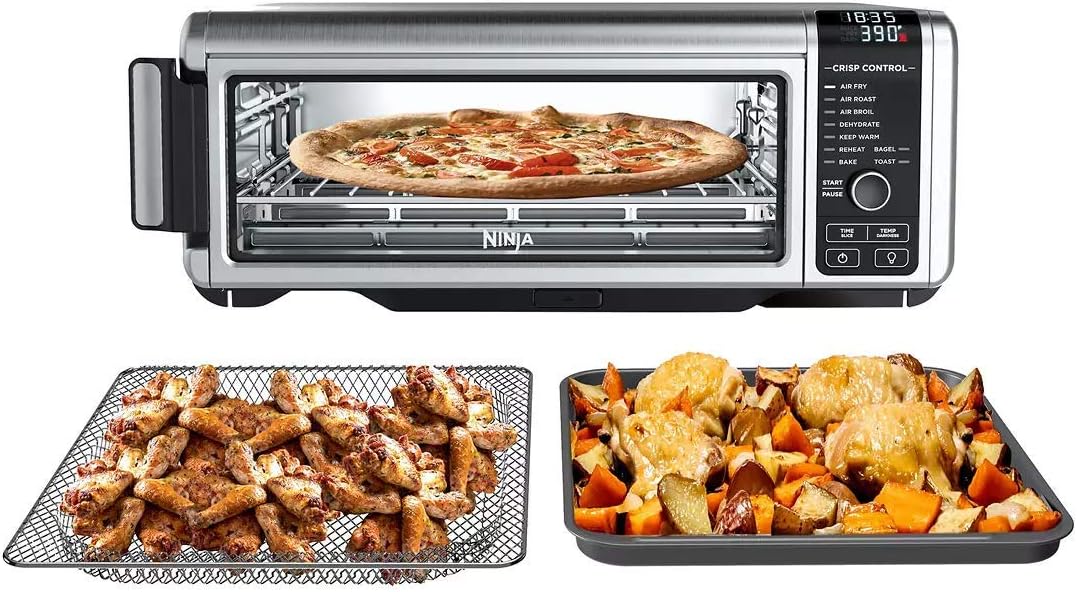
Ninja Digital Air Fry Countertop Oven
This unit flips up to save space but offers distinct “Air Fry” and “Bake” functions that actually change the fan speed and heat distribution logic. A masterclass in versatility.
Check Price on Amazon
Instant Vortex Plus 6-in-1
Famous for its “Bake” setting which is surprisingly gentle for a basket-style fryer. Perfect for cupcakes using silicone molds.
Check Price on Amazon
Air Fryer Silicone Baking Pan Set
If you want to bake in your air fryer, you cannot use just any pan. These are sized to fit standard baskets and withstand the intense convection heat.
Check Price on AmazonFrequently Asked Questions
Can I use aluminum foil in air fry vs bake modes?
In Bake mode, foil is generally safe. In Air Fry mode, you must be careful. The high-speed fan can suck loose foil into the heating element, causing a fire hazard. Weigh it down with food or use perforated liners.
Does air frying dry out food more than baking?
It can, if you aren’t careful. Because the air moves so fast, it strips moisture. This is great for crispy chicken skin, but bad for a lean breast. We suggest using a marinade or checking internal temps with a thermometer (see our must-have appliances list).
Is there a temperature conversion?
Yes. The general rule of thumb when converting a Baking recipe to an Air Fry recipe is: Lower the temperature by 25°F (15°C) and reduce cooking time by 20%. For more details, read our guide on air fryer temperature control.
More Questions Answered
Final Thoughts
Ultimately, the difference between air frying and baking comes down to the texture you want to achieve. If you want soft, fluffy, and moist—Bake it. If you want crunch, color, and speed—Air Fry it.
To get the most out of whichever method you choose, ensure you have the right tools. From fryer gloves for handling hot baskets to the right cookbooks, preparation is key.
🏁 The Final Verdict
Own both if you can — they’re genuinely complementary, not substitutes. Use your air fryer for proteins, vegetables, frozen foods, and reheating. Use your oven for large batches, delicate baked goods, casseroles, and anything requiring a water bath or slow rise. If you could only have one, a quality combo unit with both true air fry and genuine bake modes (not just a label change) is the smart investment that covers 95% of cooking needs.
The real lesson: stop thinking of the air fryer as a replacement for your oven. Think of it as an incredibly efficient, specialized tool that handles specific cooking tasks better than any other method — and let your oven continue doing what it does best.