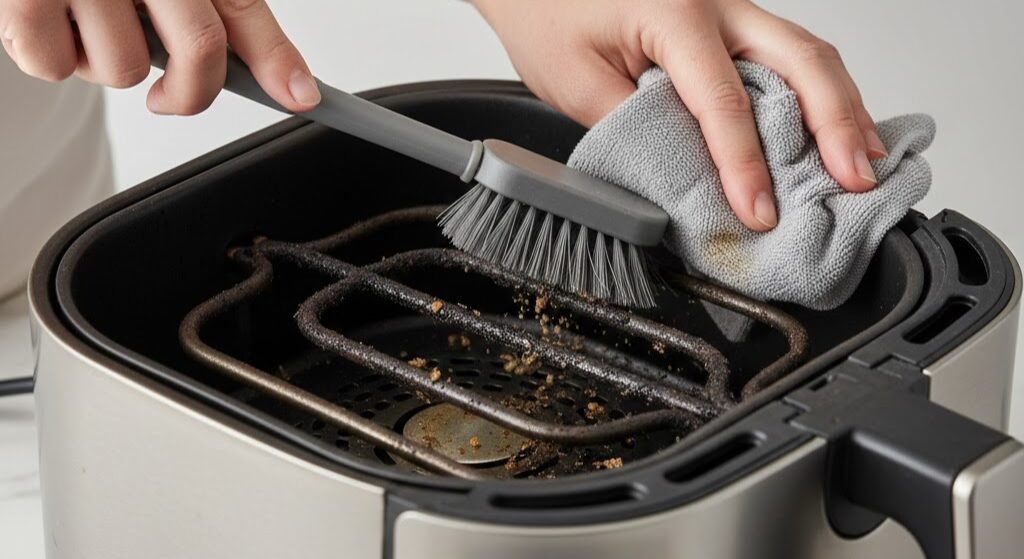
Mastering the Deep Clean: How to Clean an Air Fryer Heating Element Like a Pro
Tired of your air fryer smoking and ruining the flavor of your food? Discover the safe, step-by-step method to degrease your heating coil without damaging your appliance.
1. The Hidden Culprit of Air Fryer Smoke
We’ve all been there. You load up your favorite basket air fryer with a batch of perfectly seasoned chicken wings or fresh-cut potato wedges. You set the timer, walk away, and five minutes later, your kitchen looks like a foggy London morning. The smoke alarms are blaring, and worse, your food has taken on an acrid, bitter, burnt flavor.
You pull out the basket, scrub the non-stick grate until it shines, and try again the next day—only to be met with the exact same cloud of noxious white smoke. What gives?
The problem isn’t your cooking, and it isn’t the basket. You are dealing with the most neglected part of the appliance: the heating element. Learning exactly how to clean an air fryer heating element is the secret separator between amateur cooks who replace their appliances every year and seasoned kitchen pros whose machines run flawlessly for a decade.
Because the heating coil sits stealthily tucked away in the “ceiling” of the cooking chamber, it falls into the category of out of sight, out of mind. Yet, this delicate metallic spiral is the beating heart of your appliance. In this ultimate, comprehensive guide, we will break down the exact science, the safety protocols, and the most effective techniques to resurrect a grease-choked heating element back to factory-fresh condition.
2. Appliance Anatomy: Why Does the Heating Element Get So Dirty?
To understand how to clean it, you must first understand how an air fryer actually works. Despite the name, an air fryer does not “fry” anything. It is, essentially, a highly compact, turbocharged convection oven.
Right above the food basket sits a thick, coiled metal heating element (similar to what you see at the bottom of a traditional electric oven, or inside a toaster). Above that element is a powerful, high-speed fan. When you turn the machine on, the element generates intense infrared heat, and the fan drives that heat downward in a rapid vortex around your food. This aggressive airflow is what creates the famous, crispy Maillard reaction on your food without the need for deep frying.
When grease hits a 400°F (200°C) metal coil, it instantly bakes on, polymerizing into a hard, sticky, carbonized resin. Over weeks of cooking burgers, bacon, and sausages, layer upon layer of this resin builds up. Eventually, the element becomes completely coated in a thick, black crust. The next time you turn the unit on, the machine isn’t just cooking your food—it is actively burning the old grease permanently attached to the coil, resulting in a kitchen full of foul-smelling smoke.
If you are struggling with different colors of smoke and aren’t sure if it’s grease or a mechanical failure, we highly recommend reading our detailed guide on air fryer smoking diagnosis: white, black, and blue smoke explained.
3. Safety First: The Pre-Cleaning Protocol
Before you even think about reaching for a sponge, we need to establish the ground rules of appliance maintenance. An air fryer is a high-wattage electrical device. The heating element is directly wired into the internal motherboard and temperature sensors. One wrong move can result in permanent damage, voided warranties, or severe electrical shock.
The Pre-Wash Checklist:
- Unplug the Unit: Do not just press the power button to turn off the digital display. Physically remove the plug from the wall socket.
- Achieve Total Cool Down: If you have recently used the air fryer, leave the basket open and allow the machine to sit for an absolute minimum of 45 to 60 minutes. The heating coil holds residual heat for a shockingly long time.
- Remove the Basket and Drip Tray: Take out all removable parts. Wash these separately in the sink with warm, soapy water. This gives you clear, unobstructed access to the interior cavity of the main unit.
- Invert the Machine: Gently turn the main unit upside down. Place a soft microfiber towel on your countertop to protect the glossy digital display or the top of the housing from getting scratched. Looking down into the inverted unit is the only way to get a clear, ergonomic view of the heating element and the fan behind it.
For a broader overview of how to handle electrical appliances in your kitchen safely, review our air fryer safety checklist covering fire, smoke, and electrical overload.

Upgrade Your Cleaning Arsenal
Stop struggling with old sponges. Invest in a dedicated Air Fryer Soft-Bristle Cleaning Brush Set. Designed specifically to reach behind the delicate heating coil and fan blades without scratching the non-stick coating.
View Cleaning Sets on Amazon4. The Safe Arsenal: Tools and Supplies You Actually Need
The biggest mistake consumers make when figuring out how to clean an air fryer heating element is using the wrong chemicals. The interior cavity of an air fryer is a high-heat, food-contact zone. Using commercial oven cleaners, heavy-duty degreasers, or bleach is highly dangerous. These chemicals can seep into the metal or the fan motor, and when the unit heats up, they will off-gas toxic fumes directly into your next meal.
Furthermore, abrasive tools will scratch the delicate anti-corrosion coating on the heating element and the non-stick walls of the cavity, leading to irreversible rust.
What You Need (The Approved List):
- Baking Soda (Sodium Bicarbonate): The undisputed king of appliance cleaning. It acts as a natural, non-toxic abrasive that cuts through polymerized grease without scratching metal.
- Dawn Dish Soap (or similar grease-cutting liquid): Excellent for breaking down fresh, surface-level oils.
- Warm Water: To activate the baking soda and soap.
- Soft-Bristled Brushes: A clean, unused soft toothbrush is the absolute best tool for getting behind the coil. Specialized air fryer fan cleaning sets are also phenomenal.
- Microfiber Cloths: Far superior to paper towels, which tend to shred and leave lint behind the coil.
- Wooden Skewers or Toothpicks: Essential for carefully dislodging stubborn, burnt-on food particles stuck in the corners where the coil meets the wall.
| Safe to Use ✅ | NEVER Use ❌ | Why to Avoid |
|---|---|---|
| Baking Soda Paste | Easy-Off / Commercial Oven Cleaner | Leaves toxic chemical residue; creates noxious fumes when heated. |
| Soft Toothbrush | Steel Wool / Wire Brushes | Will scratch the element coating, exposing bare metal to rust and failure. |
| Damp Microfiber Cloth | Soaking Wet Sponges | Dripping water can enter the fan motor housing and short out the motherboard. |
| White Vinegar | Bleach or Ammonia | Highly toxic in high-heat environments; degrades internal plastics. |
5. Step-by-Step: The Light Maintenance Wipe (Do This Every 3 Weeks)
If you are diligent, you will rarely need to perform a grueling deep clean. By implementing a “Light Maintenance Wipe” every few weeks, you prevent the grease from baking into a hardened resin. This process takes less than 5 minutes.
- Prep the Unit: Ensure it is unplugged, cooled, and inverted on a towel as described in the safety section.
- Create a Soap Solution: In a small bowl, mix warm water with a few drops of a high-quality grease-cutting dish soap (like Dawn).
- Dampen the Cloth: Dip your microfiber cloth into the soapy water. Crucial step: Wring the cloth out aggressively. It should be barely damp, not dripping. You do not want water running down into the fan motor.
- Wipe the Coil: Gently wipe the exposed face of the heating coil. Use a light touch. Do not press hard enough to bend or warp the metal coil, as displacing it can affect the precision of your air fryer’s temperature control.
- Clean Behind the Coil: Take your soft toothbrush, dip it lightly in the soapy water, tap off the excess, and gently brush the top side (the side facing the fan) of the coil.
- The Final Wipe: Take a second, clean microfiber cloth dampened only with plain water to wipe away the soap residue. Finally, use a dry cloth to pat the element completely dry.
6. Step-by-Step: The Baking Soda Deep Clean (For Heavy Grease)
If your air fryer is billowing smoke like a chimney, a damp cloth isn’t going to cut it. The grease has polymerized, forming a hard, carbonized shell around the element. It is time to bring in the heavy artillery: the Baking Soda Paste method.
Baking soda is alkaline, which means it excels at breaking down acidic grease and organic compounds. When mixed into a paste, it clings to the coil, giving it time to dissolve the baked-on grime.
The Deep Clean Procedure:
- Make the Paste: In a small bowl, mix approximately 3 tablespoons of baking soda with 1 tablespoon of warm water. Stir until it forms a thick paste, roughly the consistency of toothpaste. If it’s too runny, add more baking soda. If it’s too crumbly, add a few drops of water.
- Apply the Paste: With your air fryer unplugged, cooled, and inverted, use your soft toothbrush to generously apply the paste directly onto the heating element. Ensure you coat the front, sides, and use the bristles to push the paste onto the back of the coil. Avoid getting large globs of paste directly onto the fan blades if possible, though a little bit won’t hurt.
- Let It Sit (The Magic Step): This is where patience is required. Let the baking soda paste sit on the coil for at least 1 to 2 hours. If the buildup is exceptionally bad, you can leave it overnight. The alkaline mixture needs time to chemically break the bonds of the carbonized grease.
- Scrub the Grime: After the waiting period, take your soft toothbrush (slightly dampened) and begin scrubbing the coil. You will see the white paste turn brown or black as it lifts the baked-on grease away from the metal. Work methodically around the entire spiral.
- Detailed Extraction: If there are large chunks of carbonized food stuck between the coil and the wall, use a wooden skewer to gently pry them loose. Do not use a metal knife.
- The Great Wipe Down: Once the grease is lifted, you must remove all the baking soda residue. Take a microfiber cloth, dampen it with plain warm water, wring it out completely, and carefully wipe the coil clean. You may need to rinse the cloth and repeat this step 3 or 4 times to get all the gritty residue off.
- Dry Completely: Use a dry cloth to dab the element and surrounding area. Leave the unit sitting open and inverted for at least an hour to air dry completely before using it.

Tough on Grease, Safe on Food
If you don’t want to mix your own paste, check out these highly-rated, plant-based, non-toxic appliance degreasers. Formulated without harsh chemicals, they are perfect for food-contact surfaces like air fryer coils and oven interiors.
Shop Natural Degreasers7. The Lemon-Steam Hack: Work Smarter, Not Harder
If the idea of scrubbing a dry, encrusted heating coil sounds miserable, you can use the machine’s own mechanics to do half the work for you. This is known as the “Steam Hack,” and it is highly effective for softening grease before you attempt the baking soda scrub.
Why the Steam Hack Works
By placing water in the basket and turning the machine on, the high-speed fan circulates hot steam throughout the cavity. The steam rehydrates the hard, baked-on grease, making it pliable. Adding lemon juice or white vinegar introduces a mild acid that further cuts through the lipids and neutralizes foul odors.
A Word of Caution
You must not use too much water, and you must not let the machine run too long, or you risk boiling the water violently into the fan motor. Follow the exact measurements below.
How to Execute the Steam Hack:
- Take your empty air fryer basket and pour in 3 to 4 tablespoons of water. (Just enough to coat the bottom, no more).
- Add 1 tablespoon of lemon juice or white vinegar to the water.
- Insert the basket into the air fryer.
- Turn the air fryer on and set the temperature to 400°F (200°C) for exactly 4 to 5 minutes.
- When the timer goes off, do not open the basket immediately. Let it sit closed for another 10 minutes so the steam remains trapped inside, softening the grime.
- Unplug the unit, remove the basket (dump the dirty water), invert the machine, and immediately begin your wipe down while the grease is still soft and pliable.
8. Red Flags: What NEVER to Use on the Heating Element
We cannot stress this enough: the heating element is the most sensitive part of the appliance. A mistake here will ruin your machine. If you are ever in doubt, remember these absolute “Do Nots”:
- NEVER submerge the main unit in water. The basket and crisper plate are dishwasher safe; the main housing, which contains the motherboard, digital display, and wiring, is not. Submerging it is a fatal error.
- NEVER use abrasive scouring pads. Things like Brillo pads, SOS pads, or the rough green side of a heavy-duty sponge will strip the dark protective coating off the element. Once bare metal is exposed to the high heat and moisture of cooking, it will rust rapidly.
- NEVER use a dripping wet sponge. Gravity works against you when the machine is upright. If you squeeze a wet sponge against the ceiling of the unit, water will drip into the fan motor bearings and short out the circuitry. Always use a damp, heavily wrung-out cloth.
- NEVER ignore a distinct plastic smell. If you clean the element and still smell burning, it might not be grease. Sometimes, internal wire casing or plastic housing begins to melt due to manufacturer defects. Learn to tell the difference by reading our guide on air fryer burning plastic smells vs. grease.
9. Troubleshooting Post-Cleaning Issues
You spent an hour meticulously cleaning the heating element. It looks brand new. But when you plug it back in, something is wrong. Here is how to troubleshoot common post-cleaning issues:
Issue 1: The Air Fryer Smokes Worse Than Before!
The Cause: You likely left baking soda or soap residue on the heating element. As the element reaches 400°F, that chemical residue is burning off.
The Fix: Unplug the unit, let it cool, and do another highly thorough wipe down with a damp cloth to remove the invisible residue. Once clean, run the air fryer empty at 400°F outside or under an exhaust hood for 10 minutes to safely “burn off” any remaining traces before cooking food.
Issue 2: The Fan is Making a Grinding Noise
The Cause: During the cleaning process, you may have pushed a chunk of hardened grease up into the fan blade cavity, or you accidentally bent the thin metal fan guard/coil so that it is now scraping against the rotating blades.
The Fix: Unplug and invert the unit. Shine a flashlight behind the coil. Use a wooden skewer to clear out any dislodged debris blocking the fan. Gently check that the heating coil has not been pushed upward into the path of the fan. If your fan has stopped entirely, consult our guide on diagnosing an air fryer fan that won’t spin.
Issue 3: The Unit Won’t Turn On at All
The Cause: Moisture likely entered the safety switch mechanism or the internal motherboard during the cleaning process.
The Fix: Do not attempt to use it. Leave the unit unplugged in a dry, well-ventilated area for 24 to 48 hours to allow any internal moisture to evaporate completely. If it still fails to turn on, the internal fuse may have blown, requiring professional repair or replacement.
10. Prevention Strategies: Keep the Element Clean Forever
Now that you know how to clean an air fryer heating element, your primary goal should be avoiding the need to do it again anytime soon. By tweaking how you cook, you can drastically reduce the amount of grease that reaches the ceiling of the appliance.
- Avoid High-Smoke Point Oils in Aerosol Cans: Commercial non-stick sprays (like PAM) contain propellants (like soy lecithin) that cause terrible, sticky buildup on both your basket and your heating element. Instead, invest in a reusable glass oil spritzer and fill it with a high-quality, high smoke point oil like Avocado or Light Olive Oil. Read more about the best oils for crispy, smoke-free air frying.
- Never Overfill the Basket: When you cram too much food into the basket, the food sits physically closer to the heating element. This proximity means splattering grease has a much shorter distance to travel, guaranteeing it hits the coil. Cook in smaller, single-layer batches.
- Use a Splatter Guard (Carefully): Some modern air fryers come with removable mesh splatter guards that sit below the element. If yours doesn’t, you can place a lightweight stainless steel trivet or mesh screen over high-fat foods (like bacon or burgers) to catch the grease before it flies upward. Warning: Never use loose aluminum foil or parchment paper as a cover; the fan will suck it directly into the heating element, causing a severe fire hazard. Always understand safe air fryer liner materials before modifying your setup.
- Add Bread or Water for Fatty Foods: When cooking extremely greasy foods (like a ribeye steak or bacon), place a slice of plain bread or two tablespoons of water in the very bottom of the drawer (underneath the crisper plate). The bread will soak up the dripping fat, or the water will prevent the drippings from smoking, reducing the overall volatile grease circulating in the air chamber.
Protect Your Investment and Your Health
Cleaning your air fryer heating element is not just about keeping your kitchen free of embarrassing smoke; it is about extending the lifespan of an expensive appliance and ensuring your food tastes exactly how it should. A pristine heating coil operates more efficiently, reaches target temperatures faster, and produces healthier, better-tasting meals.
Make the “Light Wipe Down” a part of your monthly kitchen routine. Treat your air fryer with the respect it deserves, and it will reward you with years of crispy, golden, guilt-free perfection.
Discover the Top 20 Must-Have Air Fryer Accessories