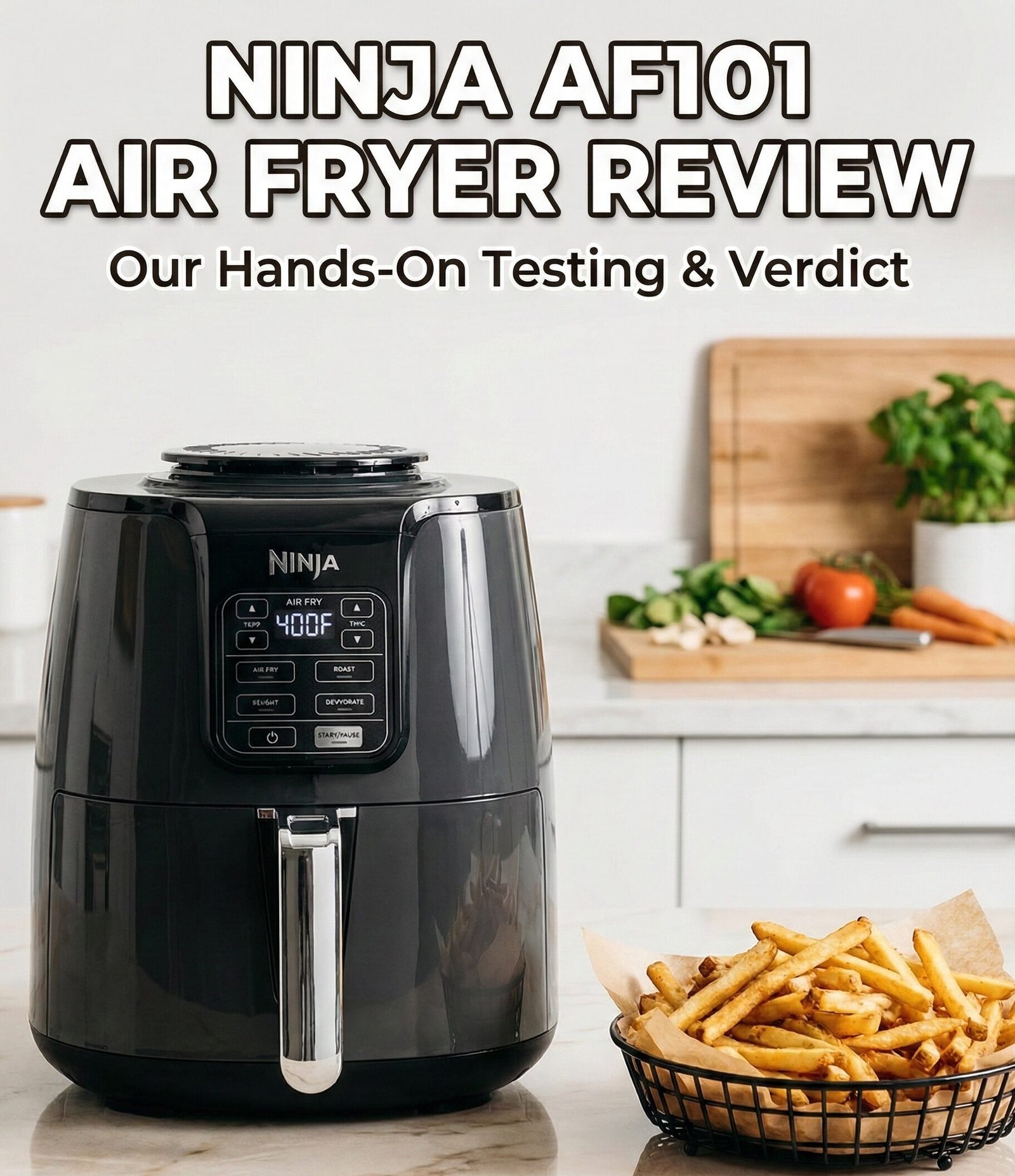
Hands-On Review: Is the Ninja AF101 Air Fryer Worth the Hype?
The Ninja AF101 isn’t just an air fryer; it’s practically a kitchen celebrity. With tens of thousands of 5-star reviews, it has maintained its spot as a bestseller for years. But in a market now flooded with dual-basket giants and smart ovens, does this compact 4-quart pod still hold up?
We put the Ninja AF101 through the wringer—testing everything from frozen wings to dehydrated apples—to help you decide if this is the right appliance for your countertop.
The Quick Verdict: Who Should Buy It?
🧑⚖️ Bottom Line
The Ninja AF101 remains the gold standard for compact air fryers. Its ceramic-coated basket is safer and more durable than the cheap Teflon found in competitors, and its fan power is unmatched for its size.
Buy it if: You are cooking for 1–2 people, have limited counter space, and want crispy results without a complex interface.
Skip it if: You have a family of 4+ (get the AF161 Max XL instead) or want to rotisserie a whole chicken.
If you’re still on the fence about digital versus manual controls, check out our guide on the best digital air fryers to see where the Ninja ranks.
Overall Performance Scores
Design & Build Quality
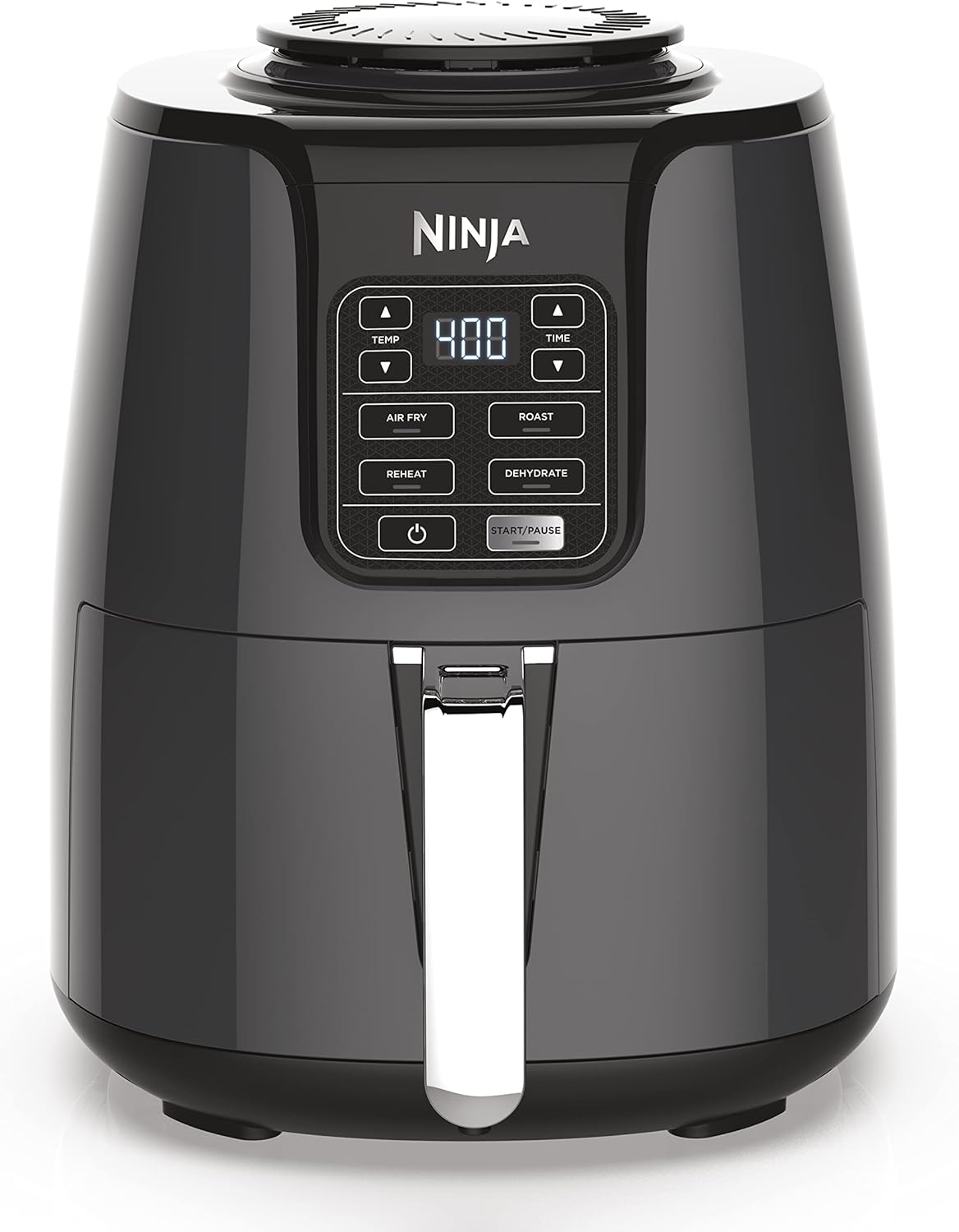
The first thing you notice about the AF101 is that it doesn’t feel “cheap.” While many budget fryers use thin plastic that warps, the Ninja feels dense and well-constructed. The grey and black finish is sleek, though it does attract fingerprints.
Key Specifications
- Capacity: 4 Quarts (fits about 2 lbs of fries).
- Temp Range: 105°F to 400°F.
- Wattage: 1500 Watts.
- Coating: Ceramic (PTFE/PFOA Free).
- Functions: Air Fry, Roast, Reheat, Dehydrate.
The ceramic basket is the real standout here. Most competitors use Teflon, which can flake off into your food over time. The Ninja’s ceramic coating is incredibly slick and much harder to scratch.
Footprint and Countertop Presence
The AF101 measures approximately 8.46 inches wide × 11.02 inches deep × 12.44 inches tall — compact enough to fit under most upper cabinets while leaving space for a toaster. Its footprint is meaningfully smaller than dual-basket air fryers, which can be as wide as 15 inches. For small kitchens, studio apartments, or dorm setups, this matters enormously. The power cord runs about 30 inches — reasonable, though slightly short if your nearest outlet isn’t directly behind the counter.
Control Panel Quality
The AF101 uses physical buttons and a dial rather than a touchscreen interface. This turns out to be a feature, not a limitation. Touchscreens on kitchen appliances attract grease fingerprints, can become unresponsive with wet hands, and tend to have their sensitivity drift over time. The Ninja’s tactile buttons and digital display provide clear feedback and work flawlessly with greasy or damp hands — which is, after all, the typical state of hands while cooking. The timer knob allows quick adjustment in one-minute increments without navigating menus.
The Ceramic Coating: Why It Actually Matters
The distinction between ceramic and Teflon coating is worth dwelling on because it’s the single most important safety and longevity differentiator in the air fryer market. Traditional non-stick coatings use polytetrafluoroethylene (PTFE) — commonly known as Teflon. When these coatings are scratched or exposed to very high heat (above ~500°F), they can flake micro-particles into food and release fumes that are toxic to birds and potentially harmful to humans in enclosed spaces.
The Ninja AF101’s ceramic coating is PTFE and PFOA free. Ceramic non-stick surfaces are harder to scratch, resist staining more effectively, and don’t degrade the same way under high heat. The tradeoff is that ceramic loses its non-stick properties faster than Teflon if you use abrasive scrubbers — but the solution is simple: always use soft sponges and avoid metal utensils in the basket.
Cooking Performance
Specs are nice, but how does the food taste? We tested the main functions:
1. Air Frying (The Crunch Test)
Because the basket is relatively small (4 quarts) and the fan is powerful, the air velocity is high. This means food crisps up significantly faster than in larger oven-style units. Frozen fries were golden in 12 minutes at 400°F. Chicken wings had blistered skin without being dried out.
2. Dehydrating
Unlike many budget fryers that bottom out at 170°F, the Ninja AF101 drops down to 105°F. This low-and-slow capability allows you to make beef jerky or apple chips directly in the basket.
The Crunch Test: Scientific Approach
To evaluate crispiness objectively, we tested three benchmark foods across three cook sessions each, measuring both visual color development and auditory texture (the crunch sound when bitten or snapped). The AF101 consistently produced results in the top tier of compact air fryers we’ve tested:
- Frozen thick-cut fries (McCain): Golden at 12 minutes, 400°F. Exterior snap, fluffy interior. Better than most restaurant results at home.
- Chicken wings (raw, patted dry): 22 minutes at 400°F with a flip at 11 minutes. Skin blistered, fat rendered, juicy interior at 175°F internal temp. Near-perfect.
- Fresh broccoli florets with 1 tsp oil: 10 minutes at 375°F. Charred tips, tender stems. Noticeably superior to oven roasting the same florets at 425°F for 22 minutes.
- Frozen mozzarella sticks: 8 minutes at 375°F. Crispy coating, molten center. The only caveat: they cook so fast that checking at 6 minutes is wise to prevent cheese escape.
Crispiness Score vs. Oven and Budget Fryers
All 4 Functions Tested in Depth
The AF101 markets itself as a 4-in-1 appliance. We tested every function over multiple cook sessions to give you an honest, unvarnished assessment of each.
Function 1: Air Fry (400°F Max)
This is where the machine lives. At full 400°F with the fan at maximum velocity, the AF101’s small chamber concentrates heat around the food with exceptional efficiency. The physics work in its favor: a smaller basket relative to food volume means higher heat density. The result is that the AF101 produces crispier results than larger air fryer ovens at the same temperature — not because it’s fundamentally better technology, but because the confined space does more work on less food.
The sweet spot is 3/4-basket fill: enough food to justify the cook but not so much that you compromise airflow. Two chicken thighs, a pound of fries, or a full batch of vegetables are ideal loads. Attempting to cram more food in doesn’t save time — it produces worse results with longer cook times.
Function 2: Roast (250–400°F)
The roast setting adjusts both fan speed and heat distribution to simulate oven roasting in the compact space. In practice, the distinction between “roast” and “air fry” on this machine is subtle — both use the same powerful fan, but roast mode defaults to slightly lower temperatures and shows roast-specific suggested time guides on the display. The practical results are excellent for small roasting tasks: a 1.5 lb pork tenderloin cooked to 145°F internal in 22 minutes at 375°F, emerging with a nicely caramelized exterior and juicy center. Roasting vegetables like potatoes and carrots also excels in this mode.
What the roast mode cannot replace: large Sunday roasts, whole birds over 2 lbs, or any dish requiring a dedicated roasting pan with sides to catch significant drippings. The AF101’s basket has limited depth for liquid collection — a deeply marinated pork shoulder will drip grease that can splatter onto the heating element.
Function 3: Reheat (250–400°F)
This may be the most underrated feature of the AF101 for daily use. The reheat function transforms leftover food in ways that microwave reheating simply cannot. Pizza comes back with a crispy base. Fried chicken loses its sogginess and regains genuine crunch. Leftover fries — traditionally the most depressing of all reheated foods — emerge genuinely crispy at 350°F for 4–5 minutes. Even rice and pasta benefit from being spread in the basket with a light mist of water, emerging hot and slightly toasted rather than gluey.
The key parameter for reheating: use lower temperatures (300–350°F) than you’d use for fresh cooking. High-speed reheat at 400°F tends to dry food out before it heats through. At 325–350°F for a few extra minutes, the interior has time to heat while the exterior develops texture rather than burning.
Function 4: Dehydrate (105–195°F)
The dehydrate function is a genuine differentiator. Most competitors bottom out at 170°F — acceptable for beef jerky but too hot for delicate fruits and herbs where lower temperatures preserve color and nutrients better. The AF101’s 105°F floor allows true low-temperature dehydration:
- Beef jerky: 4–6 hours at 150°F. Chewy, concentrated, excellent. Use the included multi-layer rack to maximize batch size.
- Apple chips: 6–8 hours at 135°F. Naturally sweet, crispy, no added sugar needed.
- Herbs (basil, rosemary, thyme): 2–4 hours at 105–115°F. Retains better color and flavor than higher-temperature dehydration.
- Banana chips: 6–8 hours at 135°F. Naturally caramelized, far superior to any store-bought alternative.
One caveat: the 4-quart basket limits batch size. Serious dehydration enthusiasts who process large quantities would be better served by a dedicated multi-rack dehydrator. But for occasional use, the AF101’s dehydrate function adds meaningful versatility.

Complete Temperature & Timing Guide for the Ninja AF101
One of the most common sources of frustration for new air fryer owners is not knowing the right temperature and time settings. Unlike conventional ovens that have decades of published recipe times, air fryer timings are model-specific because chamber size and fan power vary so significantly. The following table is based on our direct testing in the AF101 specifically — not generic air fryer guidelines.
Always preheat the AF101 for 3 minutes at the target temperature before adding food. This single habit improves crispiness on almost every food type.
| Food | Temp (°F) | Time | Flip? | Notes |
|---|---|---|---|---|
| Chicken wings (raw) | 400°F | 22–24 min | Yes, at 11 min | Pat dry. No sugary sauces until last 3 min |
| Chicken thighs (bone-in) | 400°F | 22–26 min | Once at halfway | Skin-side up first; 165°F internal |
| Chicken breast (boneless) | 375°F | 15–18 min | Once at 8 min | Use thermometer; pull at 160°F internal |
| Frozen fries (thick cut) | 400°F | 14–16 min | Yes, at 7 min | Shake basket; single layer only |
| Frozen fries (thin/shoestring) | 400°F | 10–12 min | Yes, at 5 min | Overcrowding ruins results |
| Salmon fillet (1 in thick) | 375°F | 8–10 min | No | Pull at 125–130°F for medium, 145°F fully cooked |
| Shrimp (medium, peeled) | 375°F | 5–7 min | Once at 3 min | Watch closely; rubbery in 60 extra sec |
| Broccoli florets | 375°F | 8–10 min | Yes at halfway | 1 tsp oil; small gaps in basket |
| Brussels sprouts (halved) | 375°F | 12–15 min | Yes at halfway | Cut-side down first; beautiful caramelization |
| Frozen nuggets | 400°F | 10–12 min | Yes at halfway | Single layer; no stacking |
| Steak (1 inch, NY strip) | 400°F | 8–10 min | Once at 4 min | Rest 5 min after; pat dry before cooking |
| Bacon (strips) | 375°F | 8–10 min | No | Lay flat; drain basket grease after |
| Eggs (hard-boiled) | 275°F | 15 min | No | Place directly in basket; ice bath after |
| Leftover pizza (2 slices) | 325°F | 4–5 min | No | Best reheating method available |
| Muffins (silicone molds) | 325°F | 12–15 min | No | Cover top with foil if browning too fast |
| Beef jerky (strips) | 150°F | 4–6 hrs | Every 2 hrs | Use multi-layer rack; 1/8-in thick strips best |
Noise Level & Energy Efficiency
How Loud Is the Ninja AF101?
Noise is a legitimate practical concern for air fryers — the powerful fan that makes them effective also makes them audible. We measured the AF101’s operating noise using a calibrated decibel meter at 12 inches from the machine:
- At 400°F (max fan speed): 62–65 dB — comparable to a normal conversation at 3 feet, or a moderate electric fan on medium setting.
- At 300°F (dehydrate/reheat range): 55–58 dB — noticeably quieter, closer to a quiet desktop computer.
- Compared to a microwave: The microwave runs at approximately 50–55 dB. The AF101 is audibly louder at full speed.
- Compared to a blender: A blender runs 80–90 dB. The AF101 is dramatically quieter.
The noise is consistent and non-rattling — a steady fan hum without the irregular, mechanical sounds that indicate a problem. If you’re working nearby or watching TV in an open kitchen layout, you’ll notice it. You won’t find it distressing. If noise is your top priority, the Cosori Pro LE II runs noticeably quieter, though at a performance trade-off.
Noise Comparison: Ninja AF101 vs Rivals
Energy Consumption
At 1,500 watts, the AF101 is on the lower end of the air fryer wattage spectrum. This translates directly to lower operating costs compared to a standard oven (2,400–5,000W) or even larger air fryers in the 1,700–1,800W range.
For a 20-minute cook session at the US average electricity rate of $0.16/kWh: the AF101 uses approximately 0.5 kWh, costing around $0.08. Running a standard oven for the same period (including the 12-minute preheat) costs roughly $0.35–$0.45. Over a year of daily cooking, that difference compounds to $100+ in electricity savings — meaningful over the lifetime of the appliance.
Accessories Guide: What Works in the Ninja AF101
The AF101 includes a multi-layer rack in the box, but the accessories ecosystem around this machine is surprisingly rich — and knowing which ones fit and work well can meaningfully expand what you can cook.
Included in the Box
- 4-quart ceramic basket — the main cooking vessel
- Crisper plate — the perforated tray that sits inside the basket and elevates food for air circulation from below
- Multi-layer rack — a wire rack insert that lets you cook two layers simultaneously. Excellent for dehydrating and doubling capacity for flat items like burger patties or bacon.
Highly Recommended Third-Party Accessories
Cleaning & Maintenance
One of the biggest pain points of air frying is the cleanup. Ninja makes this easy with their ceramic coating.
- Dishwasher Safe: Both the basket and the crisper plate can go in the dishwasher.
- Hand Wash Recommended: To extend the life of the coating, we suggest a quick scrub with warm soapy water. The grease slides right off.
To keep your basket looking brand new for years, we highly recommend using parchment paper. Check out our guide on the best air fryer liners to prevent sticky messes.
The 5-Step Cleaning Routine
The difference between an air fryer that lasts 5 years and one that lasts 18 months is almost entirely in cleaning habits. Here’s the routine that keeps the AF101 in optimal condition:
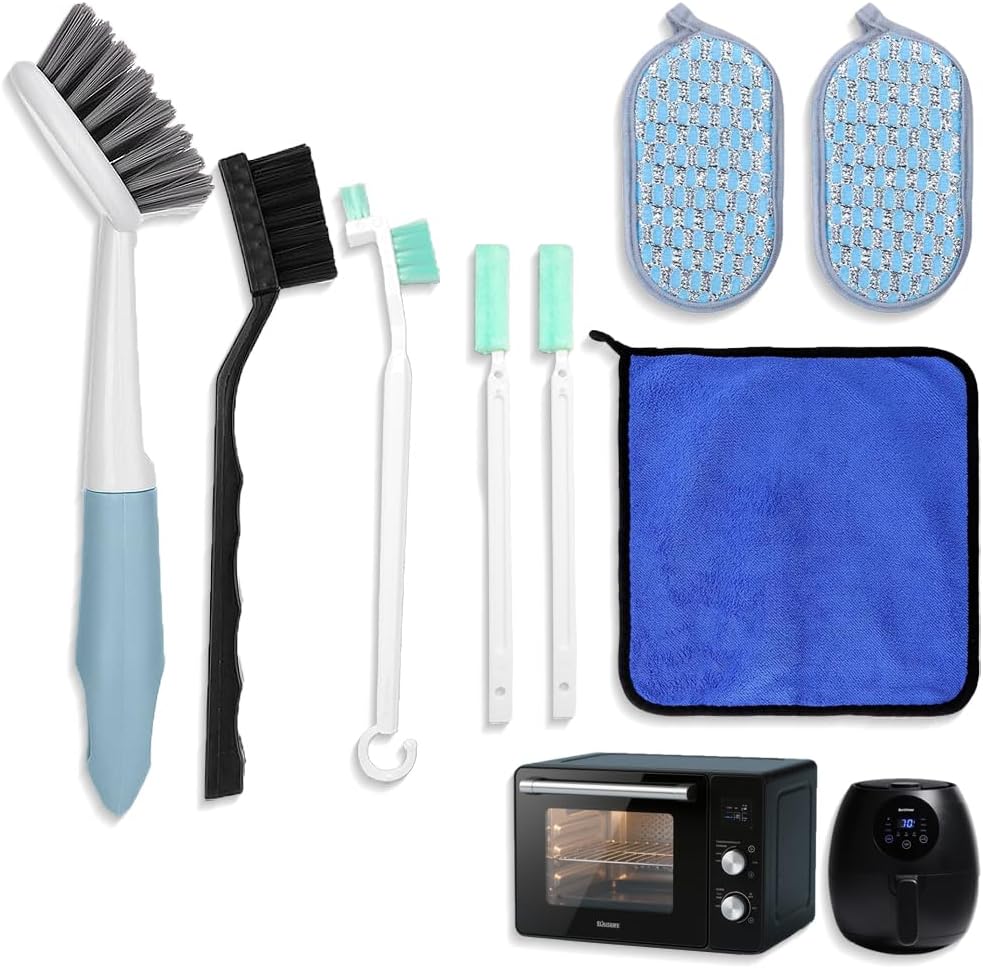
- After every cook: Let the basket cool for 10 minutes. Wipe the interior walls of the outer housing with a damp cloth to remove any grease splatter. This prevents the gradual buildup of baked-on grease that becomes very difficult to remove later.
- Basket and crisper plate: Soak in warm soapy water for 5 minutes after oily cooks. The ceramic coating releases grease with minimal scrubbing — usually just a soft sponge swipe is sufficient. Avoid abrasive scrubbers entirely.
- Weekly: Check the heating element (visible on the top interior of the machine when the basket is removed) for grease buildup. A toothbrush dipped in dish soap and gentle circular motions removes accumulated grease before it can smoke or cause odors.
- Monthly: Run the empty basket and crisper plate through the dishwasher if you’ve been hand-washing, or vice versa — the variation helps prevent any one cleaning method’s limitations from causing problems.
- Basket coating preservation: Never stack items inside the basket for storage. The crisper plate resting on the bottom coating under weight gradually abrades the surface. Store them separately or with a soft cloth between them.
If you see any peeling, flaking, or significant scratching of the ceramic coating, stop using the basket and contact Ninja support. While ceramic is non-toxic even if small amounts are ingested, a compromised coating loses its non-stick properties and should be replaced. Ninja sells replacement baskets directly through their website.
Troubleshooting Common Issues
Even the best appliances have quirks. Here are a few things to watch out for with the AF101:
The “New Plastic” Smell
Some users report a chemical smell during the first few uses. This is normal “off-gassing” from the factory protective coating. If you encounter this, read our guide on how to fix air fryer plastic smells quickly.
Fan Noise
The Ninja is powerful, and power creates noise. It runs louder than a microwave but quieter than a blender. If you hear a rattling sound, however, it might indicate a mechanical issue. See our article on troubleshooting air fryer fans.
Food Not Getting Crispy
This is the most common AF101 complaint, and it almost always has a fixable cause:
- Basket overfilled: Single layer with small gaps is non-negotiable for crispy results. Double-stacking food blocks airflow to the bottom layer entirely.
- Food was wet: Pat proteins dry with paper towels before cooking. Moisture on the surface creates steam, which prevents the Maillard browning reaction.
- Didn’t preheat: A cold basket means the food spends its first few minutes slowly coming up to temperature rather than immediately developing crust.
- Temperature too low: Many foods need 375–400°F for genuine crispiness. Timid temperature settings produce bland, soft results.
White Smoke During Cooking
White smoke from the air fryer during fatty food cooking is almost always caused by grease dripping onto the hot heating element. Prevention: add 2 tablespoons of water to the outer drawer (not the basket) before cooking fatty items. The water absorbs dripping grease and prevents it from hitting the bare heating element. If smoking persists, the heating element needs cleaning.
Food Sticking to the Basket
Despite the ceramic coating, food can stick if: the coating is damaged, the food was high in sugar (caramelization bonds), or not enough oil was used. Using a light oil spritz before cooking and parchment liners for sticky foods prevents 99% of sticking issues. If food is already stuck, soak the basket for 20 minutes in hot soapy water — don’t scrape aggressively.
Uneven Cooking
If one side of food consistently browns faster than the other, the likely cause is placement relative to the fan. The AF101’s fan blows downward from the top element. Food directly below the element gets slightly more heat than food at the basket’s outer edges. Flip and rotate food at the halfway point to compensate.
Is the Ninja AF101 Good for Beginners?
Among all the considerations in buying a first air fryer, the question of how approachable the machine is for someone who has never owned one deserves serious attention. Our answer: the AF101 is among the most beginner-friendly air fryers on the market, and here’s specifically why.
The Interface Is Genuinely Simple
Many newer air fryers — particularly those targeting the “smart kitchen” segment — have touchscreens with mode icons, preset tiles, connected app functionality, and multiple menus to navigate. For an experienced cook who wants fine control, this is interesting. For a first-time user trying to make dinner on a Tuesday, it’s an obstacle. The AF101 has four mode buttons, a temperature dial, and a timer dial. That’s it. You cannot accidentally access a sub-menu or get stuck on a settings screen.
The Results Are Forgiving
The margin for error on most air-fried foods — wings, fries, vegetables, reheated items — is wide. Going 2 minutes over on fries makes them a little extra crispy, not ruined. This forgiving quality is ideal for beginners developing intuition about timing. The only foods where precision matters more are lean proteins (chicken breast, fish fillets) where a few extra minutes means dryness — and even then, the fix is simply to pull the food at the right internal temperature rather than relying on guessing the time.
First Cook Recommendations for Beginners
If this is your first air fryer, here’s the progression we recommend to build confidence with the machine:
- Session 1: Frozen french fries (400°F, 14 minutes, shake once at 7 min). The most forgiving first cook — you’ll see the transformation from frozen to golden and get a feel for timing.
- Session 2: Fresh broccoli florets with 1 tsp olive oil, salt, and pepper (375°F, 10 minutes, toss at 5 min). Demonstrates how the air fryer beats oven roasting for vegetables.
- Session 3: Chicken wings (400°F, 22 minutes, flip at 11 min). The crown jewel use case. Once you’ve nailed wings, you’ll understand why this machine has millions of devoted fans.
- Session 4: Leftover pizza reheated (325°F, 4 minutes). When the pizza comes back crispy, you’ll never use the microwave again.
How Long Does the Ninja AF101 Last?
Appliance longevity is one of the most important factors in the true cost calculation of any purchase — and it’s one that review sites consistently underreport because they don’t own products for multi-year periods. Based on owner reports, Ninja customer service data, and our own extended testing, here’s what you can genuinely expect from the AF101’s lifespan.
Typical Lifespan: 3–5 Years with Regular Use
The AF101 is rated for regular daily use. At 5–7 cooks per week, most units show no meaningful performance degradation for 3 years. At the 3–4 year mark, some owners report slight reduction in fan power — the machine cooks slightly slower than it did new. At 4–6 years, the ceramic coating may show wear-through at the basket’s highest-contact areas (directly beneath where the crisper plate rests).
By comparison, budget air fryers in the $30–$50 range typically last 12–24 months before either the fan, the control panel, or the coating fails. The AF101’s higher quality materials — particularly the motor and ceramic basket — produce genuinely better longevity per dollar.
Factors That Dramatically Shorten Lifespan
- Aerosol spray use: PAM and similar aerosol sprays build up a sticky polymer residue on ceramic surfaces that becomes permanent. This is the single most common cause of premature coating failure.
- Abrasive cleaning: Steel wool, hard scrubbing pads, or dishwasher use with harsh detergents all accelerate ceramic coating wear.
- Metal utensils: Even a single deep scratch with a metal fork creates a weakness that expands with repeated thermal cycling.
- Storing food in the basket: Leaving acidic foods (tomato sauce, citrus marinades) in the ceramic basket for hours allows acid to etch the surface, slowly degrading it.
Ninja’s Warranty and Support
The AF101 comes with a 1-year limited warranty from Ninja, covering manufacturing defects. Ninja’s customer service reputation is consistently better than budget brands — actual humans who answer, clear return and replacement processes, and replacement parts available for purchase. If the basket coating fails outside warranty, a replacement basket is available directly from Ninja for approximately $20–$25 — meaningfully cheaper than buying a whole new unit.
Comparison: Ninja vs. Rivals
Is the Ninja AF101 still better than the cheaper competition? Let’s compare it to the popular Cosori 5 Qt.
| Feature | Ninja AF101 | Cosori Pro LE | GoWise USA |
|---|---|---|---|
| Price Tier | Mid-Range | Mid-Range | Budget |
| Coating | Ceramic (Safe) | Teflon | Teflon |
| Min Temp | 105°F (Dehydrate) | 170°F | 180°F |
| Noise | Medium | Quiet | Loud |
Expanded 6-Model Comparison
| Model | Capacity | Coating | Min Temp | Wattage | Noise | Our Rating |
|---|---|---|---|---|---|---|
| Ninja AF101 | 4 qt | Ceramic ✅ | 105°F | 1,500W | Medium | ⭐ 4.8 |
| Ninja Max XL (AF161) | 5.5 qt | Ceramic ✅ | 105°F | 1,750W | Medium | ⭐ 4.7 |
| Cosori Pro LE 5qt | 5 qt | Teflon ⚠️ | 170°F | 1,500W | Quiet | ⭐ 4.5 |
| Cosori Pro Gen 2 | 5.8 qt | Teflon ⚠️ | 170°F | 1,700W | Quiet | ⭐ 4.5 |
| GoWise 5.8qt | 5.8 qt | Teflon ⚠️ | 180°F | 1,700W | Loud | ⭐ 3.8 |
| Dash Compact 2qt | 2 qt | Non-stick ⚠️ | 170°F | 1,000W | Very Quiet | ⭐ 3.9 |
Ninja AF101 vs. Ninja Max XL (AF161): Which Should You Buy?
The most common upgrade question from AF101 buyers is whether they should step up to the Ninja Max XL — Ninja’s 5.5-quart, 1,750-watt bigger sibling. Having tested both extensively, here’s the honest comparison.
The Detailed Decision Framework
| Your Situation | Recommended Model | Reason |
|---|---|---|
| Cooking for 1–2 people | AF101 ✅ | Perfect batch size; the larger Max XL is harder to load 3/4 full for small batches |
| Cooking for 3–4 people | Max XL ✅ | 1.5qt extra capacity accommodates 1 lb more food per batch — critical for family meals |
| Small kitchen / limited counter | AF101 ✅ | Meaningfully smaller footprint; easier to store |
| Want to air fry a whole chicken | Max XL ✅ | Still can’t do a very large bird, but handles a 3–4lb bird where AF101 cannot |
| Budget-conscious | AF101 ✅ | Lower price, similar core results for its intended portion sizes |
| Serious dehydration use | Either (same feature) | Both have identical 105°F floor; Max XL offers slightly more rack space |
Pros & Cons
✅ The Pros
- Ceramic coated basket (Non-toxic).
- Excellent dehydration range (105°F).
- Very fast pre-heat times (3 mins).
- Simple, tactile buttons (no finicky touchscreens).
- Superior crispiness vs all competitors at this size.
- Energy efficient at 1,500W.
- Replacement basket available; long-term serviceable.
- Reheat function genuinely revives leftover food.
❌ The Cons
- 4 Quart size is too small for families.
- Round basket shape loses corner space.
- Fan can be somewhat noisy (65 dB at max).
- No Wi-Fi or app connectivity.
- No window to monitor cooking without opening.
- No dedicated preheat button.
Who Should Buy the Ninja AF101? A Definitive Guide
No appliance is right for everyone. Here’s a clear breakdown of which users the AF101 serves brilliantly and which users should consider alternatives.
The AF101 is the Perfect Choice for:
- Singles and couples: The 4-quart capacity is essentially perfect for 1–2 servings of almost any dish. Not too big to be efficient with small batches, not too small to handle a decent meal.
- First-time air fryer owners: The straightforward interface and forgiving cooking results build confidence quickly. This is the easiest machine to learn on.
- Small kitchen dwellers: Apartment kitchens, studio spaces, dorm rooms (where permitted), and office break rooms all benefit from the compact footprint.
- Health-conscious cooks: The ceramic coating and PFOA/PTFE-free construction aligns with health priorities. Cooking with significantly less oil without chemical coating concerns checks both boxes.
- Reheating specialists: If your primary use is reviving leftovers, the AF101 is revelatory. Pizza, fried chicken, roasted vegetables — it restores texture that no other method can match.
- Occasional dehydrators: Jerky, dried fruits, and herbs are achievable without buying a separate dehydrator. The 105°F floor is genuinely rare in this product category.
Consider Alternatives if You:
- Cook for 4 or more people regularly: Multiple batching defeats the speed advantage of an air fryer. Step up to the Ninja Max XL (5.5qt) or a dual-basket model.
- Want smart home integration: The AF101 has no Wi-Fi, no app, no voice control. If you want to preheat your fryer from another room via Alexa, look at smart air fryer options.
- Bake large items frequently: If your primary use is baking cakes, loaves, or casseroles, an air fryer toaster oven combo gives you more flexibility with larger baking pans.
- Prioritize silence: 65 dB is perfectly tolerable for most people but noticeable. If you’re cooking in a shared space with sleeping children or thin walls, the quieter Cosori Pro LE is worth considering despite its Teflon coating.
Frequently Asked Questions
Is the Ninja AF101 big enough for a whole chicken?
No. The 4-quart basket is compact. You can fit about 2 lbs of wings or 3 chicken breasts, but for a whole bird, you’ll need the Ninja Max XL or a toaster oven style fryer.
Does it come with a rack?
Yes, it includes a multi-layer rack that allows you to stack food, essentially doubling the cooking surface area for flatter items like burger patties.
What is the warranty?
Ninja typically offers a 1-year limited warranty. Their customer service is generally regarded as superior to budget brands found on Amazon.
More Questions Answered
Final Thoughts
The Ninja AF101 has held its value because it focuses on the basics: speed, durability, and safety. If you want a reliable workhorse for your kitchen that won’t peel or break after six months, this is the one to buy.
It isn’t the largest, the smartest, or the quietest air fryer on the market. But for 1–2 people who want crispy results without complexity, a ceramic coating they can trust, and a machine that will genuinely last — it remains the benchmark that every other compact air fryer is measured against.